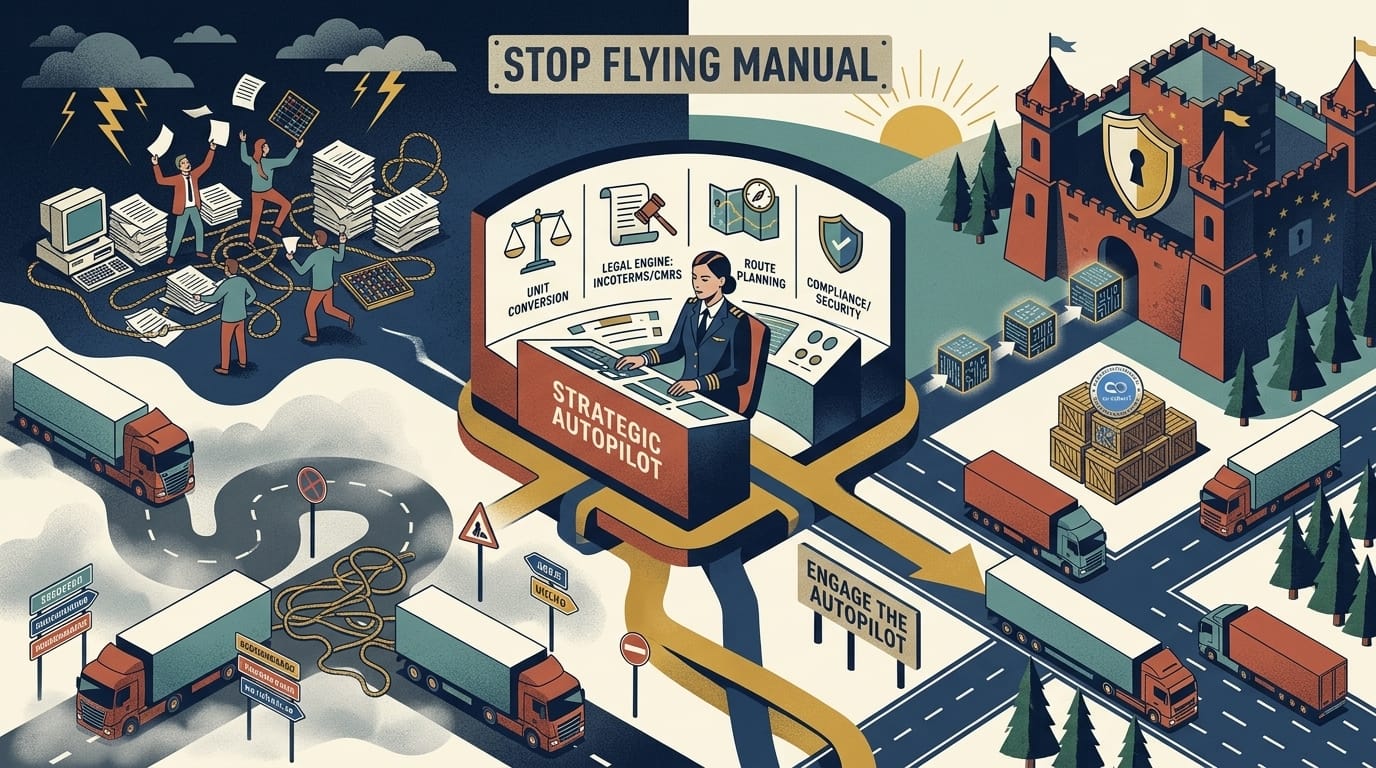
Stop Flying Manual - Engage the Autopilot
navichain fungerar som en strategisk autopilot för transportföretag, automatiserar rutiner och säkerställer affärskontinuitet. Sluta flyga manuellt – engagera autopiloten.
Stop Flying Manual —
Engage the Autopilot
No pilot flies a 12-hour commercial flight by hand — yet most European logistics operations still do. navichain acts as a Strategic Autopilot for SME transport businesses, automating the relentless routine and ensuring business continuity even when turbulence hits.

After decades in the global logistics sector — traversing supply chain shocks and severe European labour shortages — a harsh truth has become impossible to ignore. The primary vulnerability of an SME transport operation is not fluctuating freight rates or high fuel costs. It is a critical, structural dependency on manual control: the belief that if the right people show up and work hard enough, the operation will hold together.
Dispatchers are mentally calculating load meter conversions, manually typing out Delivery Terms, guessing route efficiencies, and generating CMRs by hand. The system runs on institutional knowledge stored not in software — but in people's heads. That is not an operational architecture. That is a liability.
The vulnerability of manual control
Consider the anatomy of a bad week at a typical transport SME. A lead dispatcher takes sick leave. Order volumes spike unexpectedly at the same time. The remaining team scrambles. Incoterms get misapplied — invoicing stalls. Routes go unoptimised — fuel costs spike. A CMR ships with the wrong barcode format — a consignee refuses the delivery. None of these failures are caused by bad people. They are caused by a system designed around heroic individuals rather than intelligent automation.
- ✗Manual unit conversion — dispatchers guess load meter-to-weight ratios, introducing billing errors on every other booking.
- ✗Wrong Incoterms — without centralised Delivery Term logic, financial responsibility is ambiguous until someone notices the invoice.
- ✗Redundant mileage — routes are built in sequence, not by address proximity. The same driver visits the same street twice.
- ✗CMR errors — each Consignment Note formatted slightly differently depending on who printed it and from which template.
- ✗Zero Business Continuity — if the one person who knows how to do something is absent, the operation stalls.
- ✗Fragmented data — no AI, no analysis, and no insight can run on data scattered across spreadsheets, emails and paper.
Manual dispatching is not an inefficiency. It is a Business Continuity Plan failure waiting to happen.
The conceptual shift: a Strategic Autopilot

To scale, European logistics SMEs must redefine what transport management software is. It cannot simply be a digital ledger — a place to record what already happened. It must be an active participant: a Strategic Autopilot that hardcodes your operational rules and executes them flawlessly, without constant human intervention.
No pilot flies a 12-hour commercial flight manually. The autopilot does not replace the pilot — it handles the relentless routine, the thousand small corrections, the continuous monitoring, so that the human crew is free to do what only humans can: read context, build relationships, and respond to the genuinely unexpected. Logistics needs the same architecture.
Standardisation & Efficiency
- Automated unit and weight conversions per master rules
- Fuel surcharges and other charges pre-loaded and applied
- Incoterms and Payment Terms locked at booking
- CMRs generated perfectly formatted, every time
- Frees top people for strategy and customer relationships
Business Continuity
- Operational cycle continues when the team thins out
- No single point of failure in the dispatch process
- Best practices execute automatically under pressure
- Keeps operations airborne while humans regain control
- No institutional knowledge is lost when people leave

navichain: your unified logistics autopilot
navichain SaaS is engineered as the unified operating system for asset-heavy European SMEs. The platform replaces fragmented tools — the disconnected TMS modules, the manual paper trails, the spreadsheets masquerading as systems — with an integrated platform that hardcodes your operational rules into the software itself. By establishing an automated baseline, navichain ensures best practices are executed flawlessly without constant human intervention.
How the navichain Autopilot is structured
Two layers — Pre-Flight configuration and In-Flight dispatch — work together continuously

Technical breakdown: Pre-Flight and In-Flight
The autopilot relies on two operational layers working in concert. Pre-Flight configurations establish the business logic before any truck moves. In-Flight dispatch tools apply that logic dynamically on the planning floor, in real time.
Automated unit conversions bridge billable space and physical weight. Set master rules once — "1 pallet = 780 kg" — and the autopilot applies them to every booking without exception.
Centralised Incoterms (DAP, EXW) and Payment Terms lock financial responsibility at the moment of booking. Planners select from dropdowns. Ambiguity is eliminated by design.
Every CMR is perfectly formatted and compliant. Barcode type (EAN 13 or Code 128), office details, and layout are configured once and applied to all documents in the background.
Granular User Roles and Claims enforce the principle of least privilege. Sensitive operational and commercial data is protected by access architecture, not by trust alone.
With rules established, the In-Flight layer guides daily dispatch. Unassigned bookings sit ready on the planning board. Using a fluid Drag-and-Drop Planning Board, a dispatcher drags a booking onto a run. If the system detects the new booking shares an address with an existing stop, a Route Optimisation Available window triggers immediately — prompting the dispatcher to merge the stops and eliminating a redundant driver visit automatically.
Planners can execute a Direct Delivery (A-to-B) or route via a Hub Transfer. As the run builds, the Run Grid allows filtering by Pickup or Delivery, maintaining total visibility across the entire operation — even as complexity scales.
The data argument: operational ROI
Delegating the routine to an autopilot yields immediate, measurable return on investment. The impact lands simultaneously across three dimensions: time, cost, and cash flow velocity.

Route Optimisation directly combats high fuel costs by stripping redundant mileage from every run. Because Payment Terms and Incoterms are hardcoded by the autopilot at the moment of booking, the downstream invoice is mathematically correct and legally unambiguous — disputes disappear, payment cycles shorten.
Your operational intelligence stays in Europe
In Europe, Operational Excellence must pair with Strategic Trust. Many platforms store logistics data on US cloud infrastructure, exposing it to the Cloud Act — meaning US authorities can compel access to your routing data, carrier pricing, and customer patterns without your knowledge or consent.
navichain is self-hosted and strictly GDPR compliant. Your autopilot operates as a sovereign shield: proprietary route logic, carrier relationships, and pricing structures stay within European jurisdiction, under your control, always. This is not a compliance checkbox. It is a durable competitive advantage that cannot be taken away by a foreign subpoena.

Navigate the storm
Automation is the layer that keeps SME operations airborne when the unexpected hits. A lead dispatcher calls in sick. A volume spike arrives without warning. A new regulatory requirement appears overnight. With the navichain autopilot engaged, your operation continues — without missing a beat. The rules run, the CMRs print, the routes optimise, the invoices go out.
The strategic case is simple: stop treating your most expensive, most experienced people as data-entry machines. The autopilot handles the relentless routine. Your team focuses on the horizon — building carrier relationships, winning new accounts, and scaling the business with confidence. That is the difference between an operation that survives turbulence and one that thrives through it.
The autopilot doesn't replace the pilot. It gives the pilot back their attention for the decisions that actually matter.

Ready to engage the navichain autopilot?
navichain is available free for up to two users. The full autopilot — automated dispatch, route optimisation, CMR generation, and GDPR-compliant document storage — is included from day one.
- Create a free account at navichain.se — no credit card, no lock-in
- Configure your Pre-Flight settings: unit conversion rules, Incoterms, Payment Terms, and CMR format
- Enter a test booking and watch the autopilot apply your rules instantly
- Build a run on the planning board — drag a second booking to the same address and trigger Route Optimisation
- Generate a CMR and experience a perfectly formatted, compliant document — produced without a single manual step
Free up to 2 users · Full autopilot functionality included · Self-hosted · GDPR compliant · All data on European servers · No binding period · navichain.se · blog.navichain.se
The only reason not to automate is inertia
Most SME transport managers know their operation is too dependent on manual effort. They know one bad week — a flu, a resignation, a sudden surge — could expose the cracks. They delay the decision because the right system has historically seemed too large, too expensive, or too complicated to implement. navichain removes all three objections. The autopilot is fully operational from day one, costs nothing to try, and requires no consultant, no integration project, and no months of configuration. The only remaining reason not to engage it is inertia — and inertia is not a business continuity plan.