The Efficiency Dividend: How Data, Not Capital, Will Fund the SME Green Transition
Table of Contents
The Efficiency Dividend: How Data, Not Capital, Will Fund the SME Green Transition
The green capex trap: An insurmountable barrier?
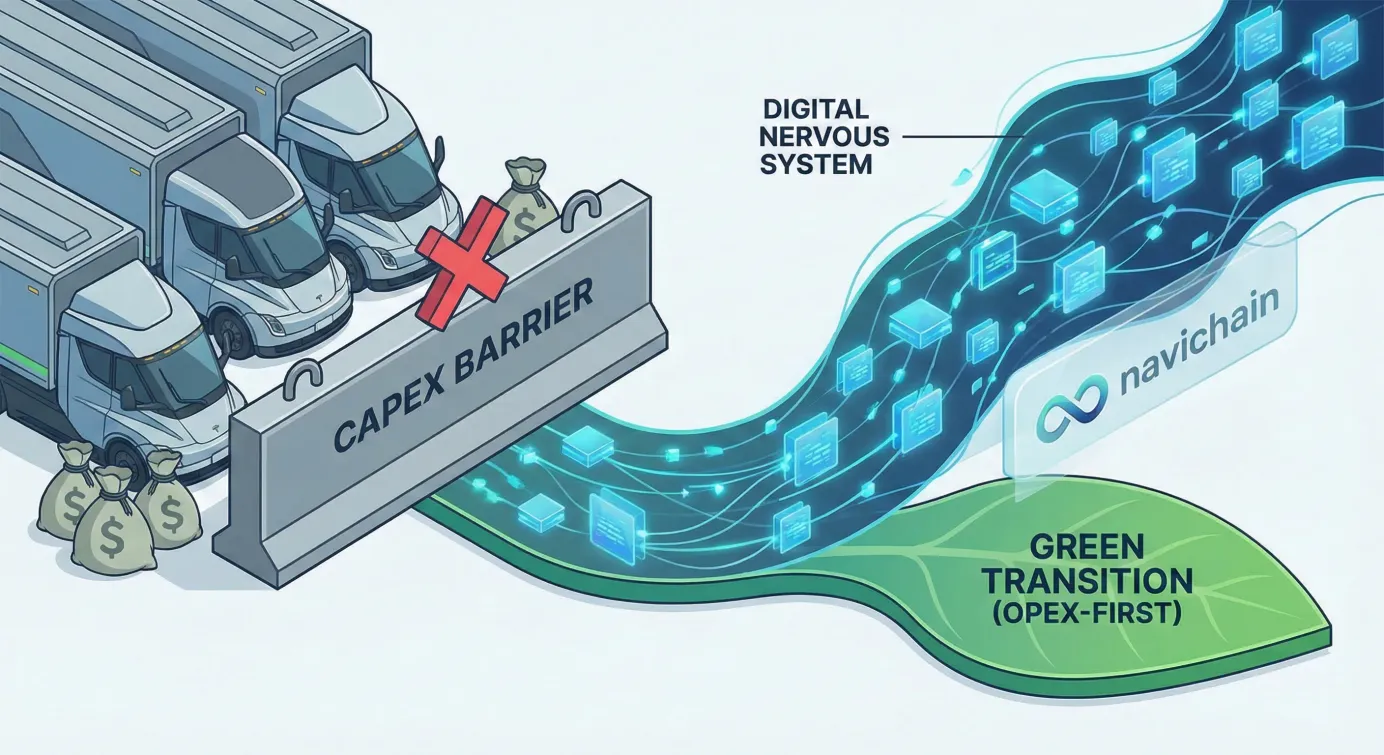
The high upfront cost of transitioning to green technology presents a significant barrier for SMEs operating on tight margins, making the green transition seem financially unattainable.
For the owner or operations director of a small to medium-sized (SME) haulage company in Europe, the conversation around the 'green transition' is dominated by one thing: capital expenditure. The pressure from regulators, clients, and the public is to invest in fossil-free vehicles—a fleet of new electric or hydrogen-powered trucks. The problem is that for a business operating on thin margins, this is not a strategic choice; it's a financial impossibility. A single electric truck can cost two to three times its diesel equivalent. The charging infrastructure is sparse and requires massive private investment. We need only look to Norway, where heavy subsidies from organizations like Enova have been the primary driver of adoption, to see the plain truth: the market for fossil-free heavy vehicles is not yet commercially mature. For the pragmatic SME, this 'Green CapEx' path is not a roadmap, it's a capital barrier that excludes them from the transition. This paper argues that this entire conversation is strategically flawed. By focusing on the most expensive and longest-term solution (new vehicles), SME hauliers are distracted from the most immediate, profitable, and impactful green strategy available to them today. The primary barrier to the green transition is not the capital cost of new vehicles, but the operational inefficiencies and data fragmentation that prevent them from maximizing the profitability and sustainability of their existing assets.
The real "green" problem: The operational efficiency gap
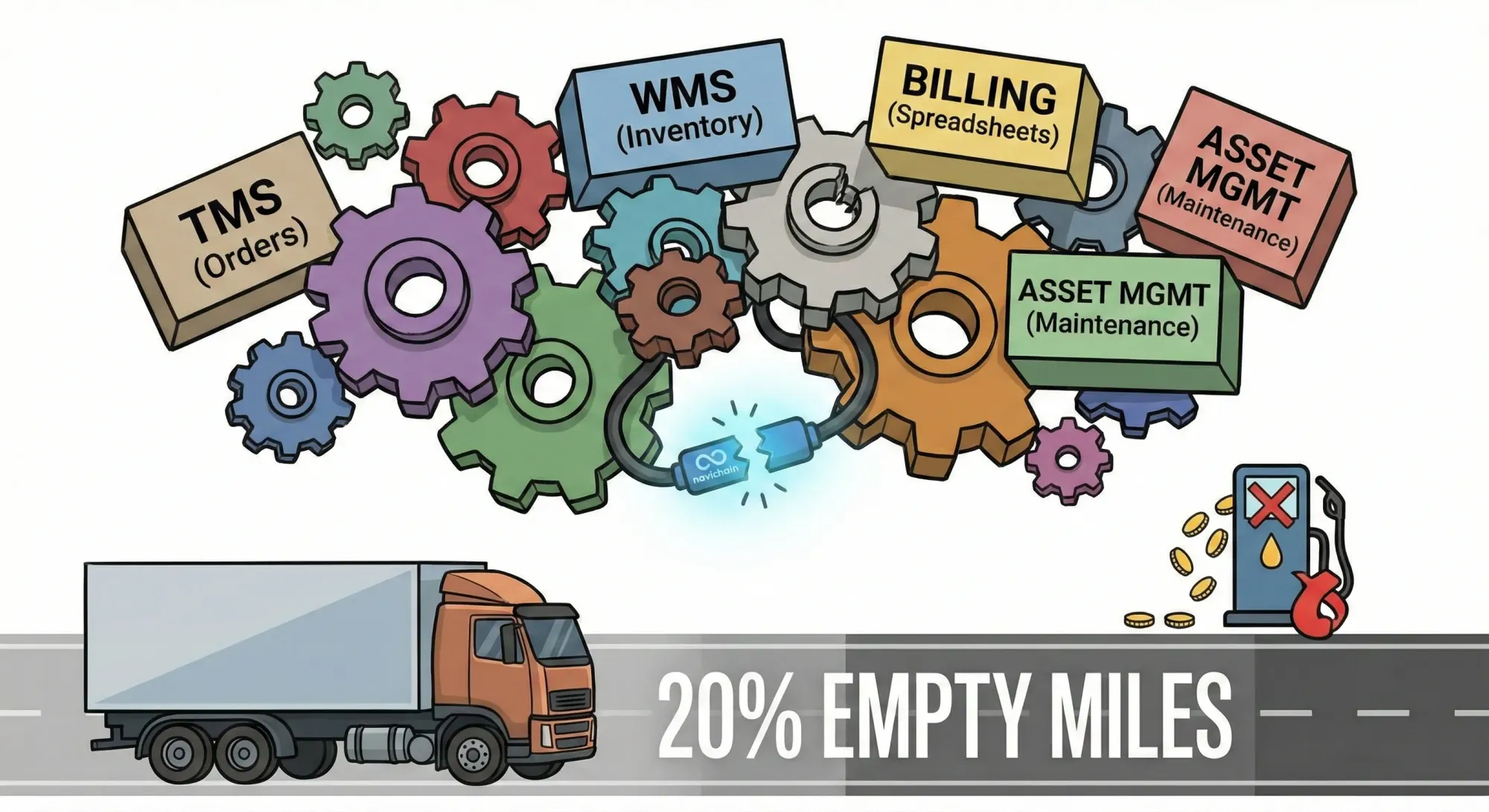
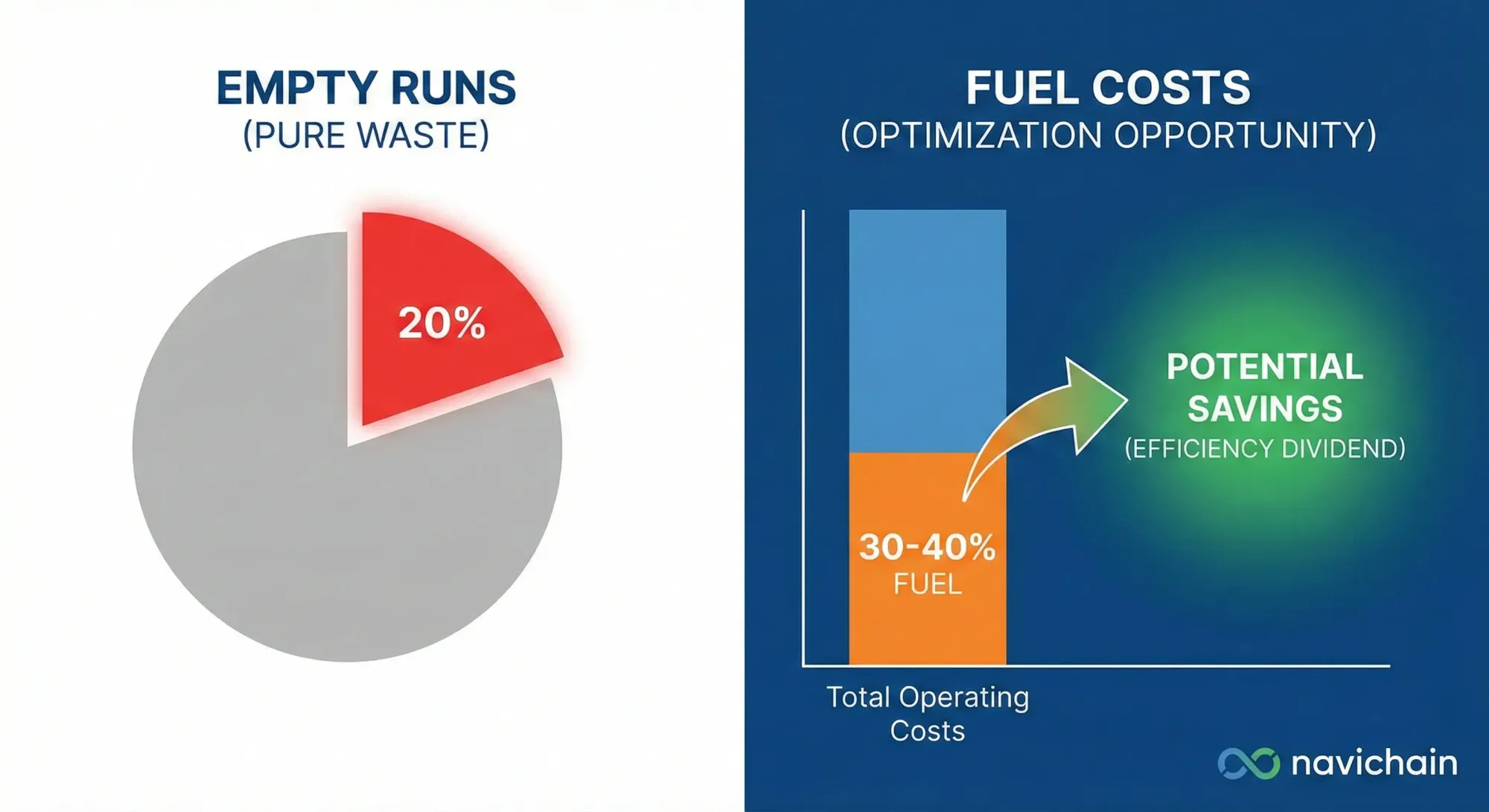
Fig 2: This is the 'Operational Efficiency Gap', and it is driven by two primary factors: 1. The most significant source of carbon emissions in your operation is not the type of fuel your trucks burn; it's the amount of fuel they waste. This waste is a direct symptom of deep, structural inefficiencies, which represent a massive, untapped source of both profit and decarbonization. This is the 'Operational Efficiency Gap', and it is driven by two primary factors: 1. Empty Kilometers: According to Eurostat and industry analysis, 'empty runs' (driving a heavy goods vehicle with no cargo) account for approximately 20% of all kilometers driven in the EU. This is pure waste—20% of your fuel, 20% of your driver's time, and 20% of your fleet's emissions, all generating zero revenue. For a fleet of 50 trucks, this is the equivalent of 10 trucks doing nothing but polluting for profit. 2. Fuel & Asset Inefficiency: Fuel typically represents 30-40% of an SME haulier's total operating costs. Even minor deviations in route planning, poor asset matching (e.g., using the wrong truck for the job), or suboptimal driver behavior can have an outsized impact on your bottom line and your carbon footprint. When combined with the administrative overhead of manual invoicing, order management, and compliance reporting, the financial bleed is constant. This is not a capital problem that can be solved by a new truck. This is a data problem. You cannot optimize what you cannot measure, and you cannot measure what you cannot see.
From data silos to data-driven decarbonization
Why does this crippling efficiency gap exist?
Why does this crippling efficiency gap exist? The answer for nearly every SME haulier is the same: data fragmentation. The average logistics operation is not a single entity; it is a collection of disconnected data silos: * Your Transportation Management System (TMS) manages orders and routes.
- Your Warehouse Management System (WMS) manages inventory and picking.
- Your Billing Management is in an accounting program or, worse, a spreadsheet.
- Your Asset Management (truck maintenance, trailer locations) is tracked separately. These systems do not talk to each other. Your TMS has no real-time data from your WMS on when a load will actually be ready. Your billing system has no automated way to confirm proof-of-delivery from the driver's TMS app. Your planners have no unified view to see if a truck scheduled for maintenance is also being assigned a critical, time-sensitive load. This fragmentation makes true optimization impossible. You cannot dynamically re-route a driver based on a last-minute order because the order data isn't linked to the real-time asset location. You cannot reduce empty miles because you lack a single view of all available assets, orders, and return-trip possibilities. You cannot provide the CO2 emissions report your biggest customer is demanding because the fuel data, route data, and order data are in three different places.
Data silos prevent true optimization and hinder sustainability efforts due to lack of interconnectedness and real-time visibility.
The strategic pivot: Opex-first sustainability
This brings us to the strategic pivot. Instead of a 'CapEx-first' approach (buying new trucks), SMEs must adopt an 'OpEx-first' model. This model focuses on using technology to close the Operational Efficiency Gap, creating a self-funding engine for sustainability. The 'Efficiency Dividend' is the profit and carbon savings unlocked from your existing operations. This dividend, generated by a software-based strategy, becomes the capital that funds your long-term, hardware-based (CapEx) green transition.
The high-roi gains: Reducing empty kilometers
The single fastest way to reduce costs and emissions is to attack empty miles. A unified logistics platform provides a single source of truth for all orders and all assets in real-time. This allows planners to move from static, reactive planning to dynamic, predictive optimization. The system can automatically identify backhaul opportunities, consolidate less-than-truckload (LTL) shipments, and ensure every kilometer driven is a kilometer paid for. A 10% reduction in empty miles can drop straight to your bottom line, representing tens of thousands of euros saved per year.
The compounding benefit: Asset utilization & admin automation
When your TMS, WMS, Asset Management, and Billing are one, the compounding benefits are transformative. You can improve asset utilization by ensuring the right truck is on the right job, automatically scheduling maintenance around low-demand periods. You can eliminate weeks of administrative overhead by automating the entire order-to-cash cycle—from order entry to proof-of-delivery to final invoice. This doesn't just cut costs; it frees up your most valuable resource—your team's time—to focus on customer service and growth, not data entry.
The market demand: From haulier to sustainable partner
Increasingly, large shippers are required to report on their Scope 3 emissions—which includes their logistics partners. They are no longer just buying transport; they are buying measurable, sustainable transport. SMEs who cannot provide accurate, automated CO2 emissions reports per shipment will be deselected from tenders. An OpEx-first strategy, built on a unified data platform, makes this reporting automatic. It transforms you from a cost-center commodity to a strategic, sustainable partner, protecting your client relationships and giving you a powerful competitive advantage.
From diagnosis to design: The blueprint for a resilient logistics operating system
Fig 3: This strategic diagnosis implies a specific technological design.
We have established that the path to a sustainable and profitable future for SME hauliers is not through immediate, high-cost CapEx, but through a high-ROI, OpEx-first strategy of operational unification. This strategic diagnosis implies a specific technological design. To execute this strategy, a modern logistics platform must be built on a foundation of core principles. These are the hallmarks of a system designed not just for today's efficiency, but for tomorrow's resilience.
Principle 1: The unified operational fabric
The fundamental problem of data silos must be solved at the architectural level. A true logistics operating system cannot be a patchwork of integrations. It must be a single, unified 'operational fabric'—a central nervous system for your entire business. Your Transportation Management (TMS), Warehouse Management (WMS), Billing Management, and Order Management must function as one cohesive unit, drawing from and writing to a single source of truth. When an order is updated, it must be instantly visible to planning, the warehouse, the driver, and billing. This fabric is the non-negotiable prerequisite for eliminating waste and enabling automation.
Principle 2: The sovereign data architecture
If your operational data is the fuel for your new, efficient engine, you must have absolute control over it. For European SMEs, this is a critical point of strategic risk. Where is your data being stored? Who has access to it? A platform hosted outside the EU, particularly in the US, subjects your most sensitive operational and financial data to foreign legislation like the US CLOUD Act. This act grants US authorities the right to access data stored by US-based companies, even if that data is stored in Europe. True operational resilience, therefore, requires 'data sovereignty'. This is a non-negotiable principle. Your platform and your data must be hosted and processed within your own legal jurisdiction (e.g., within the EU/Sweden), fully and natively compliant with GDPR, and completely shielded from extraterritorial laws. This is the foundation of digital trust and risk management.
Principle 3: The embedded analytic intelligence
Finally, a unified data fabric, secured within a sovereign architecture, creates the perfect environment for the ultimate payoff: embedded intelligence. With all your operational data in one clean, secure, and unified place, an embedded Artificial Intelligence (AI) layer can perform deep, secure data analysis. This intelligence moves you beyond simple reporting (what happened) to predictive and prescriptive insight (what will happen, and what should we do). It is this AI layer that will find the hidden route optimizations, predict asset failures, and identify the efficiency dividends that are invisible to the human eye, continuously funding your green transition.
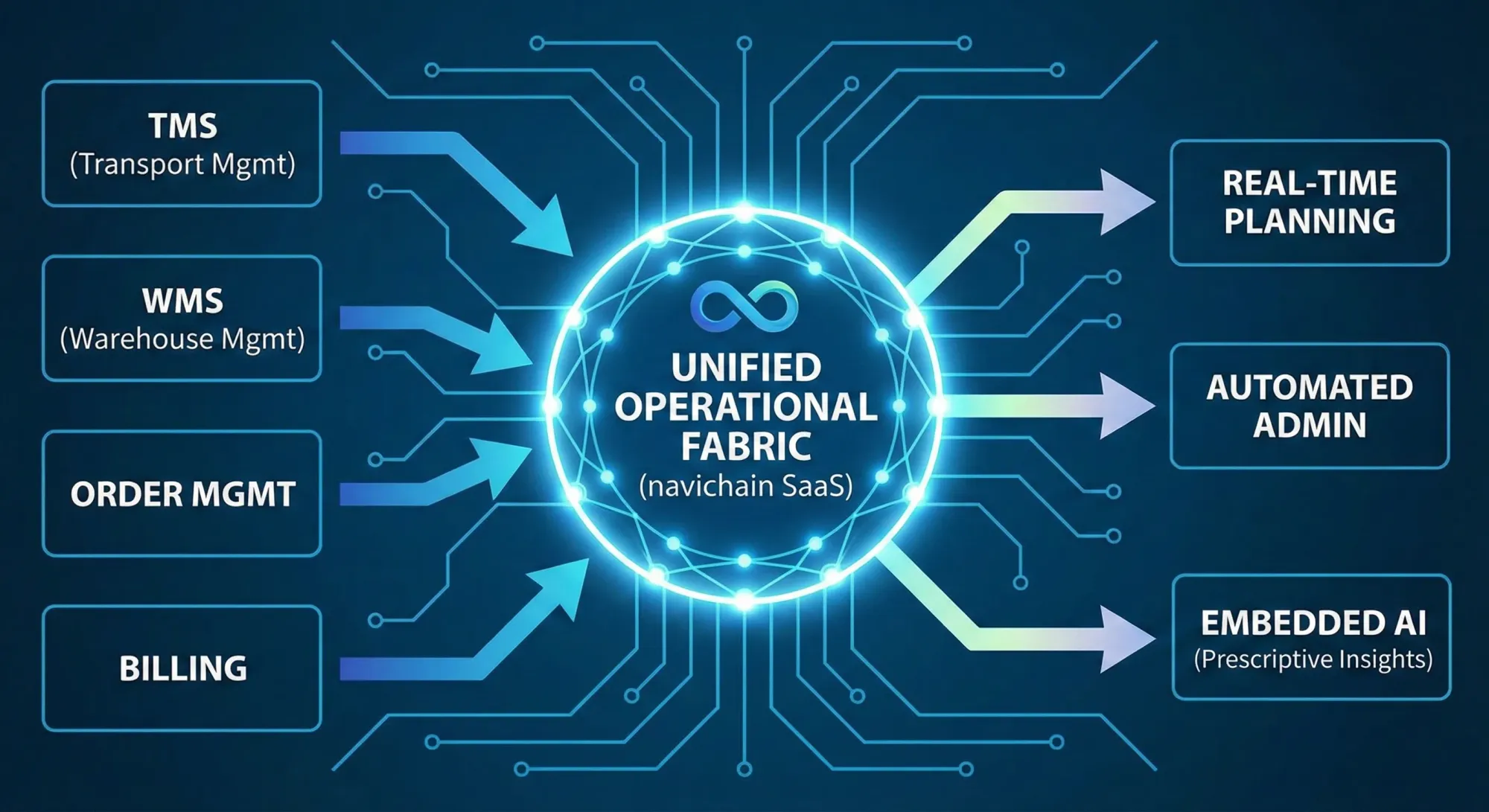
A schematic illustrating the unified operational fabric, highlighting the interconnectedness of core logistics functions.
Fig 4: It is this AI layer that will find the hidden route optimizations, predict asset failures, and identify the efficiency dividends that are invisible to the human eye, continuously funding your green...
References/sources
- Eurostat (2024). Road freight transport statistics - empty runs. https://ec.europa.eu/eurostat/statistics-explained/index.php?title=Road_freight_transport_statistics_-_empty_runs
- International Road Transport Union (IRU) (2024). EU Road Freight Rates & Costs Analysis. https://www.iru.org/intelligence/tools-apps/iru-road-freight-rates
- Ti Insight (2024). European Road Freight Transport 2024 Report. https://ti-insight.com/reports/european-road-freight-transport-2024/
- McKinsey & Company (2023). The road to zero-emission trucks: A European perspective. https://www.mckinsey.com/industries/automotive-and-assembly/our-insights/the-road-to-zero-emission-trucks
- Enova SF (2024). Støtte til tunge kjøretøy (Support for heavy vehicles). https://www.enova.no/bedrift/transport/tunge-kjoretoy/
Fig 4: We have established that the path to a sustainable and profitable future for SME hauliers is not through immediate, high-cost CapEx, but through a high-ROI, ...
Enabling the blueprint: The navichain SaaS unified logistics platform
Fig 5: It is the exact design philosophy we used to build the navichain SaaS platform.
This white paper has laid out a strategic blueprint for a resilient, profitable, and sustainable future for SME hauliers. This blueprint is not theoretical. It is the exact design philosophy we used to build the navichain SaaS platform. We designed navichain SaaS from the ground up to embody the principles of a Unified Operational Fabric, Sovereign Data Architecture, and Embedded Analytic Intelligence.
- Unified Operational Fabric: navichain SaaS is not an integration; it is a single, unified logistics operating system. Our platform seamlessly combines Transportation Management (TMS), Warehouse Management (WMS), Asset Management, Billing Management, and Order Management into one OS. This breaks down the data silos that create inefficiency, providing one single source of truth for your entire operation.
- Sovereign Data Architecture: This is our core promise. Unlike most SaaS providers, the entire navichain SaaS platform is hosted on our own proprietary infrastructure in Sweden. Your data never leaves Sweden. It remains under Swedish and EU jurisdiction, guaranteeing full GDPR compliance and, critically, making it completely immune to foreign legislation like the US CLOUD Act. This is true data sovereignty.

Navichain SaaS empowers SME hauliers with a unified, sovereign, and intelligent platform to unlock efficiency dividends and drive sustainable growth.
- Embedded Analytic Intelligence: Because your unified data is already on our secure, sovereign platform, our integrated AI can run directly on your data within this protected environment. This new feature allows you to perform deep, secure analysis to unlock the 'Efficiency Dividend'—finding the savings and optimizations discussed in this paper—without your data ever being exposed to third-party AI models or external jurisdictions. Our mission is to democratize this level of logistics technology, empowering SMEs to increase efficiency, reduce costs, and deliver exceptional service—all from a single, secure, and sovereign platform.
navichain SaaS unifies TMS, WMS, Asset Management, Billing Management, and Order Management into a single operating system, hosted on our sovereign Swedish infrastructure.
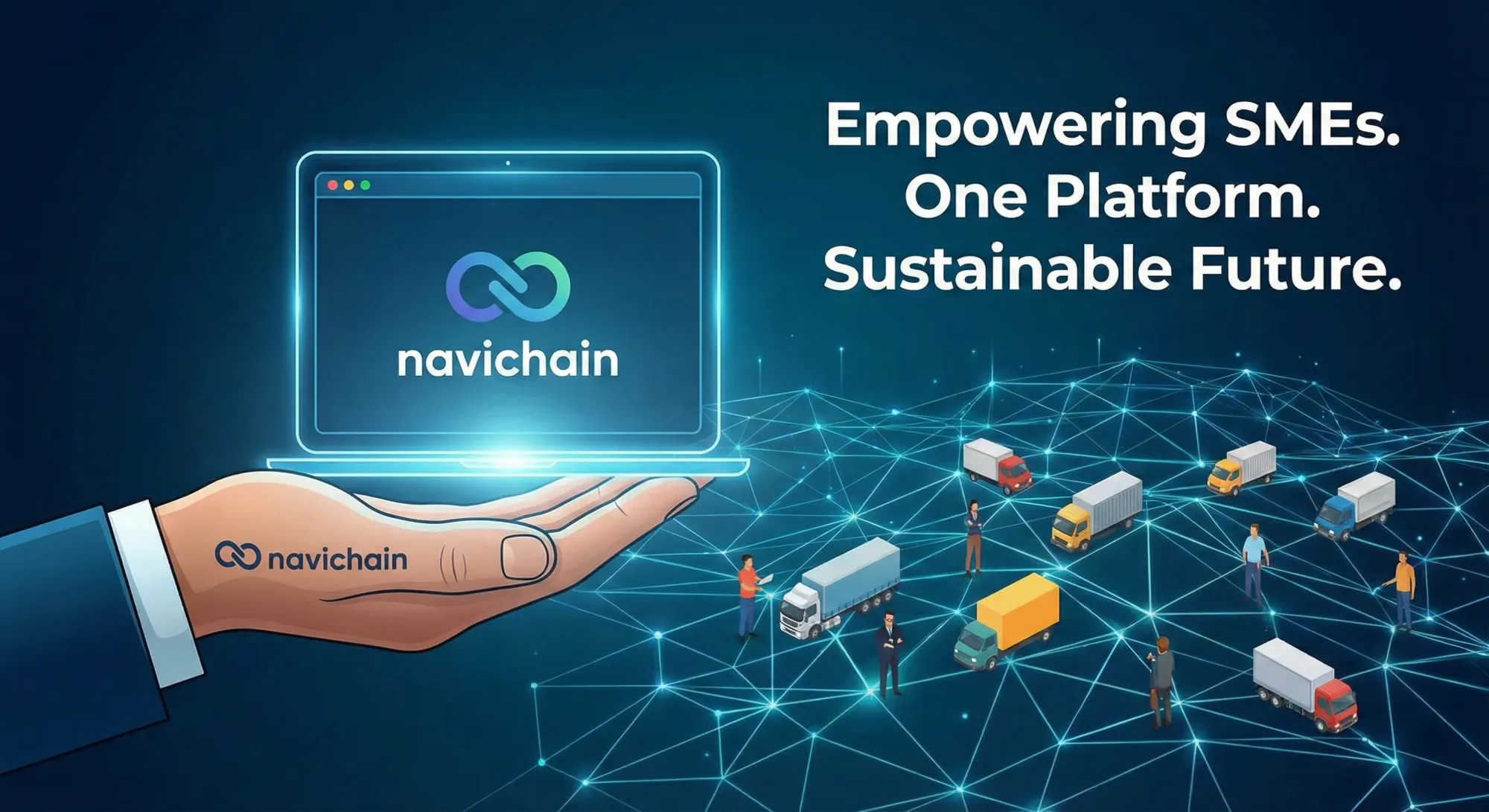
The navichain platform: Unifying critical logistics functions within a secure, sovereign environment to unlock efficiency gains for SMEs.
Ready to optimise your supply chain?
navichain Insights Newsletter
Join the newsletter to receive the latest updates in your inbox.