The Competitiveness Trap: Why Your 'Efficient' Cloud Platform Is Costing You the Game
Table of Contents
European logistics SMEs face unprecedented challenges, squeezed by razor-thin margins and global competition. Discover why adopting seemingly cost-effective, US-based cloud solutions could be a strategic blunder, potentially exposing your sensitive data and undermining your long-term viability. This white paper reveals how a 'Sovereign-by-Design' approach, leveraging secure, EU-based AI, can transform your data into a protected competitive advantage.
The Competitiveness Trap: Why Your ''Efficient'' Cloud Platform Is Costing
Here's a compelling teaser paragraph for your white paper, tailored to the British audience and highlighting the key concerns: European logistics SMEs are fighting for survival, with margins now consistently below 3% and intense, technology-driven pressure from global giants. The default strategy—adopting seemingly low-cost, US-based cloud SaaS—is a strategic trap. This approach not only fails to solve critical internal data silos but, more dangerously, exposes core competitive data (routes, client lists, pricing) to foreign jurisdictions via the US CLOUD Act. This white paper presents a new framework for sustainable competitiveness. It argues that SMEs must build on a 'Sovereign-by-Design' foundation, unifying TMS, WMS, and billing, and leveraging secure, integrated AI on EU infrastructure to turn their data into a protected, decisive asset.
1. the new competitive battlefield: Data vs. data
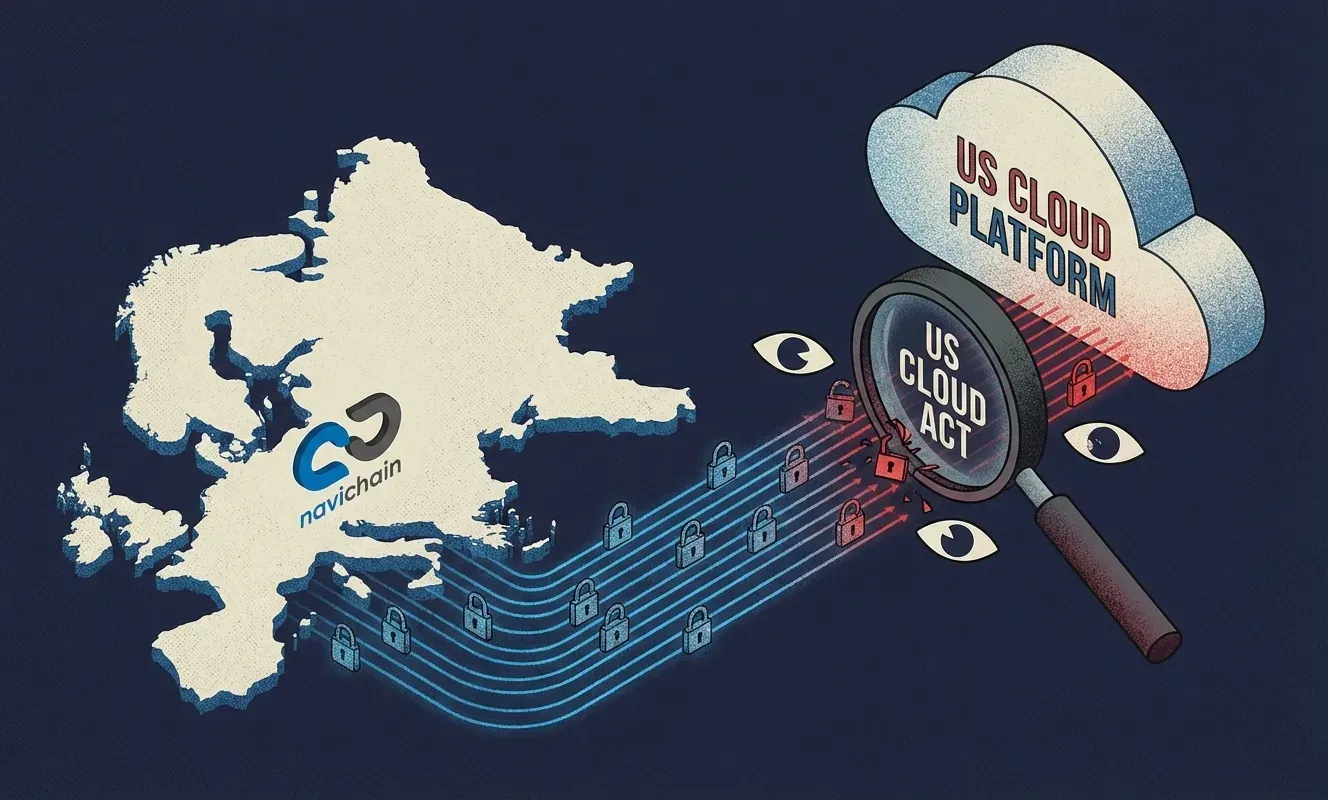
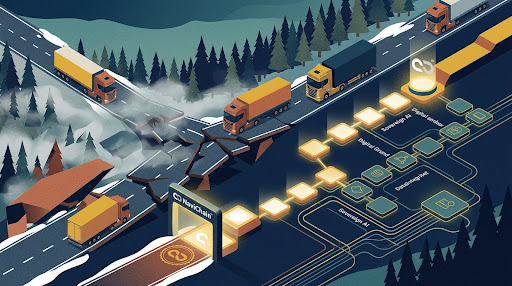
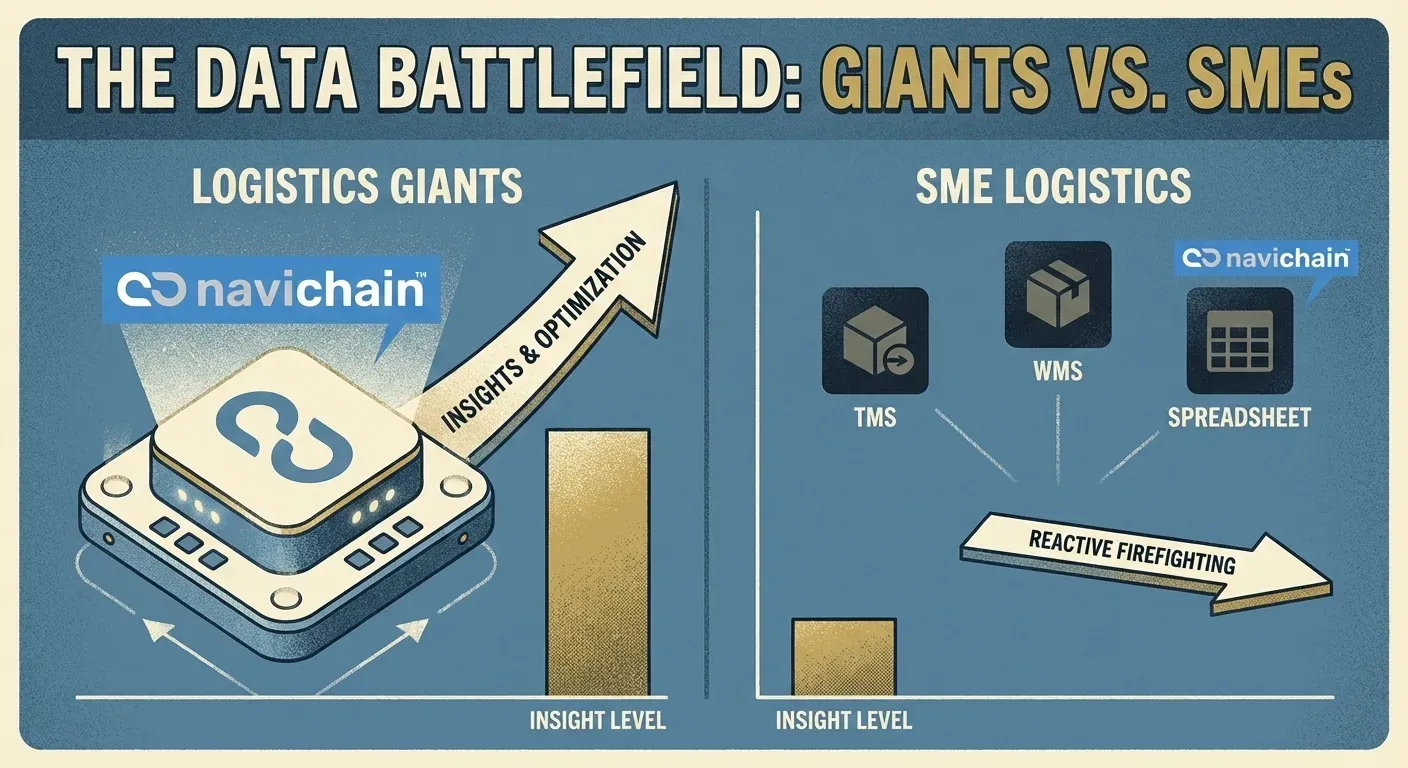
Fig 1: Fragmented data and outdated systems leave many European logistics SMEs vulnerable in an increasingly competitive landscape.
For decades, small and medium-sized enterprises (SMEs) in the European logistics sector competed on two primary fronts: price and personal relationships. An owner-operator or a local haulage firm won business through reliability, flexibility, and a deep understanding of their customers' needs. Today, this model is collapsing under the weight of digital transformation. The industry, which moves over 75% of all inland freight in the EU, is now a data-driven battlefield. Large, tech-enabled giants like DSV, DHL, and Maersk are no longer just moving boxes; they are competing on information. They leverage vast, integrated platforms to offer real-time, end-to-end visibility, AI-driven predictive ETAs, and dynamic pricing. They present clients with dashboards, analytics, and optimization insights that a typical SME, running on a patchwork of disconnected systems, simply cannot match. This has left the SME logistics leader in a perilous position. You are data-rich but insight-poor. You have valuable information trapped in separate 'black boxes': * Your Transportation Management System (TMS) knows your routes, fuel costs, and driver hours.
- Your Warehouse Management System (WMS) knows your inventory turns and pick-and-pack times.
- Your accounting software and Excel spreadsheets know your customer profitability and billing cycles. Because these systems do not talk to each other, you are forced to compete in a reactive, 'firefighting' mode. You cannot answer a client's simple question—"Where is my shipment, and what's the true, all-in cost?"—without manual, time-consuming data-stitching. This operational drag is a direct competitive disadvantage.
2. the 'efficiency' trap: Why your tech stack is failing you
Fig 2: The marketing promises are alluring: lower costs, rapid deployment, and access to powerful features.
The logical response to this pressure is to 'go digital.' Overwhelmed by complexity, SME leaders seek out modern, cloud-based SaaS platforms to replace their aging, on-premise systems. The marketing promises are alluring: lower costs, rapid deployment, and access to powerful features. This move, however, often becomes a strategic trap that makes the SME less competitive. First, many SMEs replicate their old silo problem in the cloud. They buy a best-in-class cloud TMS from one vendor and a separate cloud WMS from another. They create a fragmented, expensive, and complex web of APIs and subscriptions that still fails to provide a single source of truth. They've simply swapped on-premise silos for cloud-based silos. Second, and more critically, the vast majority of these dominant, low-cost SaaS platforms are operated by US-based corporations. In the pragmatic rush to find an 'efficient' solution, European SMEs are unknowingly sleepwalking into a profound geopolitical and competitive liability. They are ceding legal control of their most valuable asset—their data—to a foreign jurisdiction. This isn't just an IT problem. It's a foundational business risk that undermines your ability to compete.
3. the hidden liability: Competing with exposed data
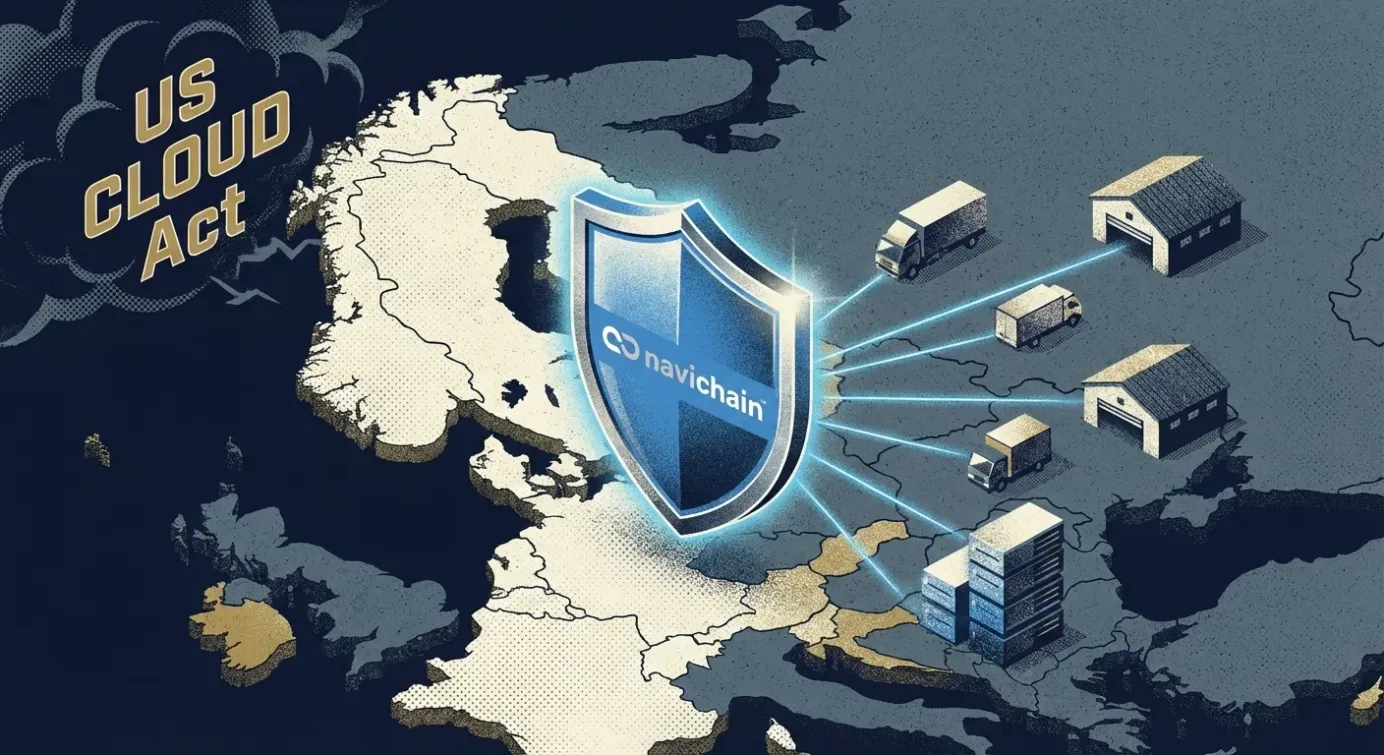
Fig 3: The conversation about data in Europe is typically dominated by the General Data Protection Regulation (GDPR). The conversation about data in Europe is typically dominated by the General Data Protection Regulation (GDPR). For a logistics manager, this is often seen as a compliance cost. What is dangerously overlooked is the direct conflict between EU law and foreign surveillance laws.
Visual representation of the conflict between GDPR and foreign surveillance laws like the US CLOUD Act, highlighting the risk of data exposure for European companies using US-based cloud providers.
The 'CLOUD Act' vs. GDPR collision
Here lies the core conflict for any European company using a US-based cloud provider: * The EU Position (GDPR): Data must be protected by EU law. The 'Schrems II' ruling by the Court of Justice of the EU invalidated previous data-sharing agreements, finding that US surveillance laws do not provide adequate protection for EU data.
- The US Position (CLOUD Act): The US CLOUD Act of 2018 gives US federal agencies the power to compel US-based technology companies (and their EU subsidiaries) to provide requested data, regardless of where that data is physically stored. This means that even if your US-provider's server is in Frankfurt, Dublin, or Stockholm, they are still subject to US law. They can be legally obligated by a US court to hand over your European operational data—your entire competitive playbook—without your knowledge or consent.
This is a competitive risk, not a compliance risk
For an SME, this is not a theoretical legal debate. It is a direct threat to your competitiveness in two ways: 1. Loss of Client Trust: Your customers—a German auto-parts manufacturer, a Swedish retailer—are increasingly sophisticated about data sovereignty. Can you guarantee to them that their sensitive supply chain data, their customer lists, and their production volumes are not being accessed by foreign entities? If your competitor can make that guarantee and you cannot, you will lose the contract. Data sovereignty is becoming a non-negotiable requirement in high-value tenders. 2. Exposure of Core IP: Your routes, your optimized delivery schedules, your client-specific pricing, and your operational cost models are your 'secret sauce.' This is your core intellectual property. Hosting this data on a non-sovereign platform is akin to handing your competitive playbook to a third party that cannot legally promise to protect it. You are competing with your data completely exposed. A fragile, fragmented, and non-sovereign tech stack is the very definition of a competitive disadvantage. It is operationally inefficient, costly, and legally compromised.
From diagnosis to design: The blueprint for a resilient logistics operating system
Fig 3: The goal is to build an operating system that is not only efficient and intelligent but also fundamentally secure and sovereign.
To escape this trap and build a sustainable competitive advantage, SME logistics leaders must adopt a new strategic framework. The goal is to build an operating system that is not only efficient and intelligent but also fundamentally secure and sovereign. This 'Sovereign-by-Design' blueprint is based on three core, non-negotiable principles.
Principle 1: The unified operational fabric
Competitiveness starts with a single source of truth. You must move away from data silos and implement a single, integrated platform where all core functions—Transportation Management (TMS), Warehouse Management (WMS), Billing Management, and Order Management—are part of one cohesive system. This platform acts as the 'central nervous system' for your entire operation. This eliminates data redundancy, provides real-time visibility to you and your clients, and creates the clean, unified data pool required to compete on insights, not just price.
Principle 2: The sovereign data architecture
This principle is the strategic lynchpin of modern competition. Your unified operational fabric must be built upon a 'sovereign' data architecture. For a European SME, this means your platform and all your data must be hosted, processed, and managed on infrastructure located within the EU (e.g., in Sweden), by an EU-owned and EU-operated company that is exclusively subject to EU and member-state law. This is the only structural way to ensure full GDPR compliance and, crucially, to legally shield your data from the reach of extraterritorial foreign laws like the US CLOUD Act. This architecture transforms compliance from a cost into a powerful competitive advantage and a signal of trust to your clients.
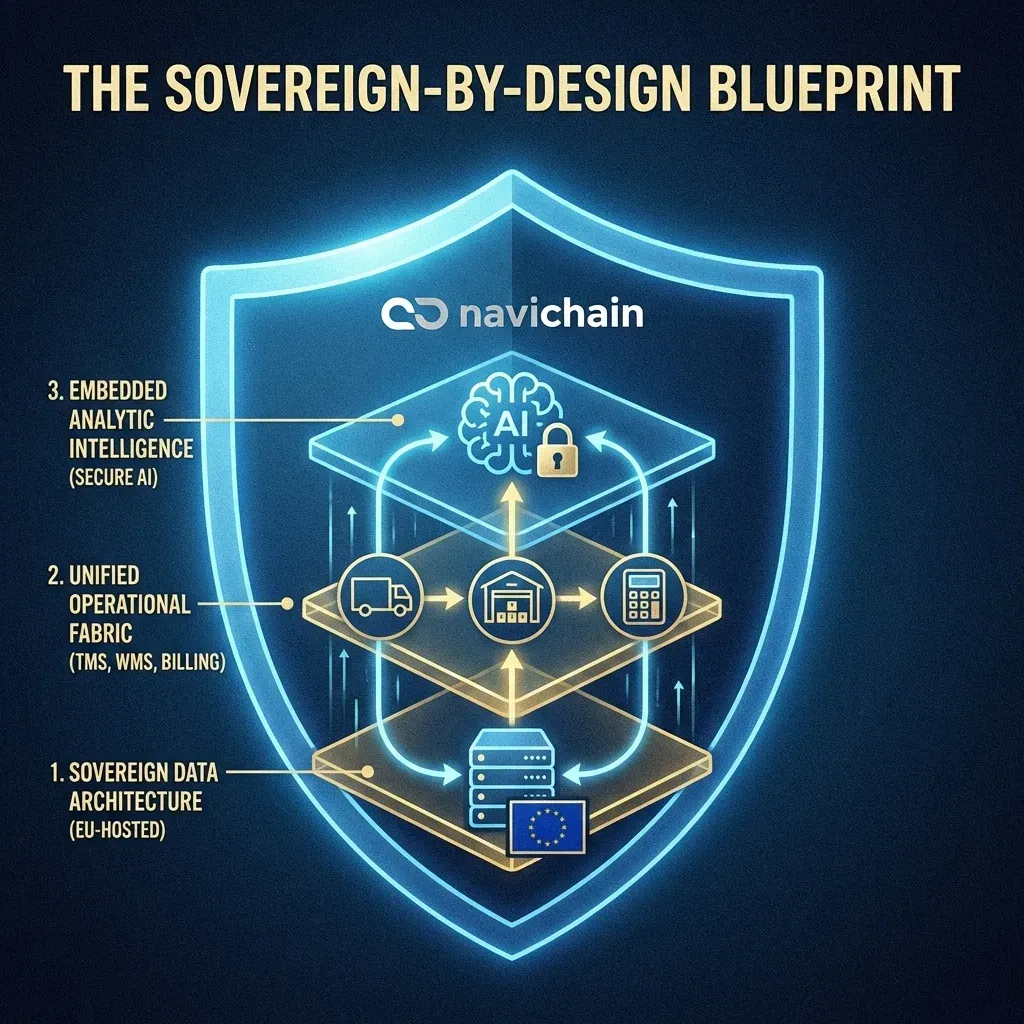
Schematic illustrating the 'Sovereign-by-Design' operating system, emphasizing data sovereignty and unified operational fabric.
Principle 3: Embedded analytic intelligence
With a unified data fabric (Principle 1) secured within a sovereign architecture (Principle 2), you can finally deploy the tools to out-compete larger, slower rivals. The third principle is to embed an AI or analytic intelligence layer directly into this secure, unified system. Because the AI runs on the same sovereign infrastructure and analyzes the complete, real-time data from your TMS, WMS, and billing, it can provide profound insights with zero data-security compromise. It can identify hidden margins, predict demand, and optimize routes, all within your secure data fortress. This is how you move from reactive 'firefighting' to the predictive, data-driven operations that your clients now demand.
Fig 4: With a unified data fabric (Principle 1) secured within a sovereign architecture (Principle 2), you can finally deploy the tools to out-compete larger, slower rivals.
References/sources
- Eurostat (2024). Road freight transport statistics. https://ec.europa.eu/eurostat/statistics-explained/index.php?title=Road_freight_transport_statistics
- International Road Transport Union (IRU) (2024). Global Road Transport Services Price Developments. https://www.iru.org/intelligence/tools-apps/road-transport-services-price-developments
- Transport Intelligence (Ti) (2024). European Road Freight Market 2024. https://www.ti-insight.com/report/european-road-freight-market-2024/
- Center for Strategic & International Studies (CSIS) (2018). What Is the CLOUD Act? https://www.csis.org/analysis/what-cloud-act
- European Data Protection Board (EDPB). Information on the EU-US Data Privacy Framework. https://www.edpb.europa.eu/our-work-tools/our-documents/information-note/edpb-information-note-eu-us-data-privacy-framework_en Fig 4: To escape this trap and build a sustainable competitive advantage, SME logistics leaders must adopt a new strategic framework.
Enabling the blueprint: The navichain SaaS unified logistics platform
Fig 5: The navichain SaaS platform was designed from the ground up to be the concrete embodiment of these three principles.
This white paper has laid out a strategic blueprint for a resilient, secure, and competitive logistics operation. The navichain SaaS platform was designed from the ground up to be the concrete embodiment of these three principles. 1. Embodying the Unified Operational Fabric: navichain SaaS is not a collection of loosely connected modules. It is a single, unified logistics operating system. We built our Transportation Management (TMS), Warehouse Management (WMS), Asset Management, Billing Management, and Order Management systems to work as one, breaking down the data silos that kill SME competitiveness and creating a single, actionable source of truth. 2. Delivering Sovereign Data Architecture: This is our key differentiator and your ultimate competitive shield. navichain SaaS is hosted entirely on our own proprietary infrastructure in Sweden. Your data stays in Sweden, under Swedish and EU jurisdiction, at all times. This design choice makes us immune to the reach of foreign legislation like the US CLOUD Act, ensuring maximum security, full GDPR compliance, and a powerful "trust" signal for your customers. 3. Activating Embedded Analytic Intelligence: Because your unified data resides within our secure Swedish infrastructure, we deploy our new, integrated AI engine to analyze your operations safely. This AI runs on the same secure servers, allowing you to perform deep, secure data analysis to unlock hidden efficiencies, optimize routes, and predict trends—all without your data ever leaving its sovereign, protected environment. This is how you build a lasting data-driven advantage. Our mission is to democratize logistics technology, empowering SMEs to increase efficiency, reduce costs, and deliver exceptional service. We believe the only way to do this responsibly is by providing a platform that is not only powerful but also fundamentally secure.
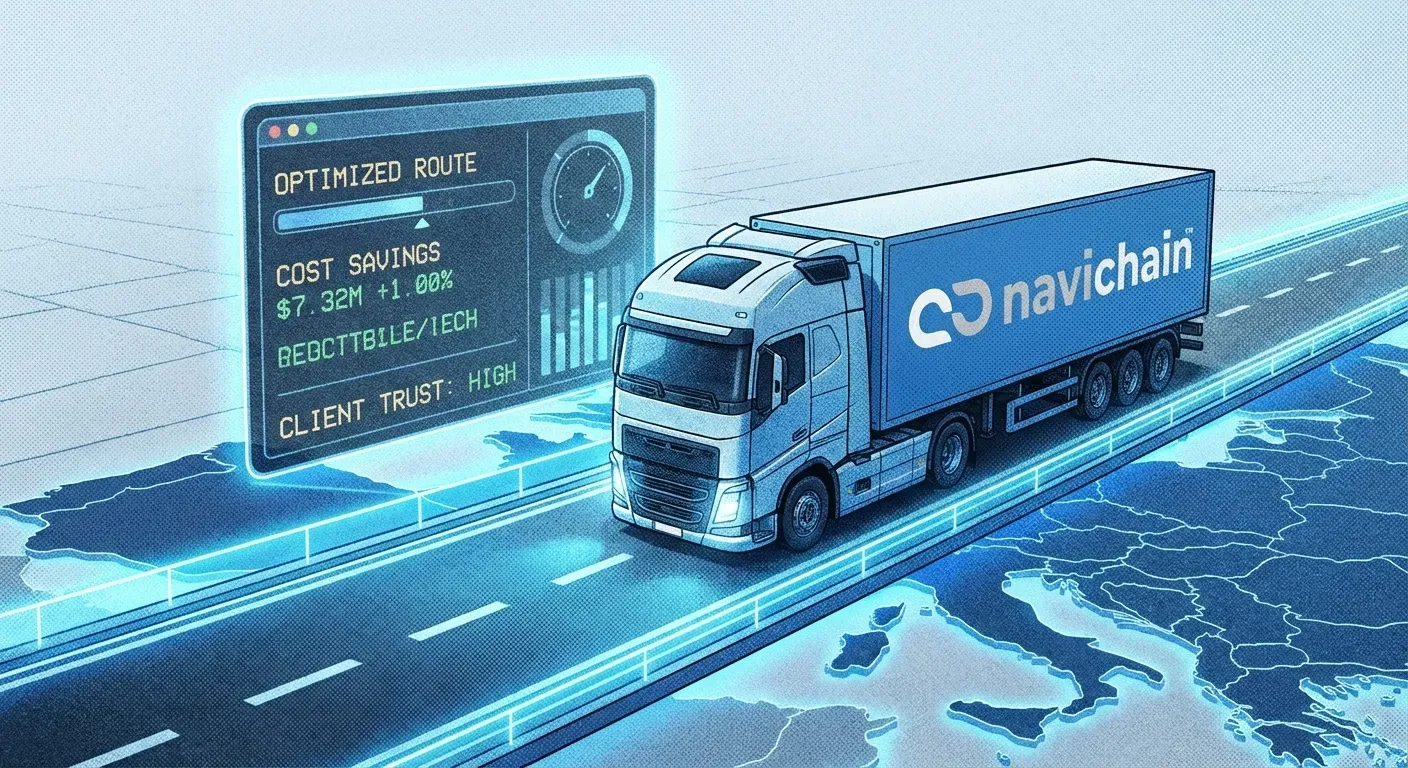
The navichain platform unifies logistics operations, ensuring data sovereignty and enabling embedded analytic intelligence for a lasting competitive advantage.
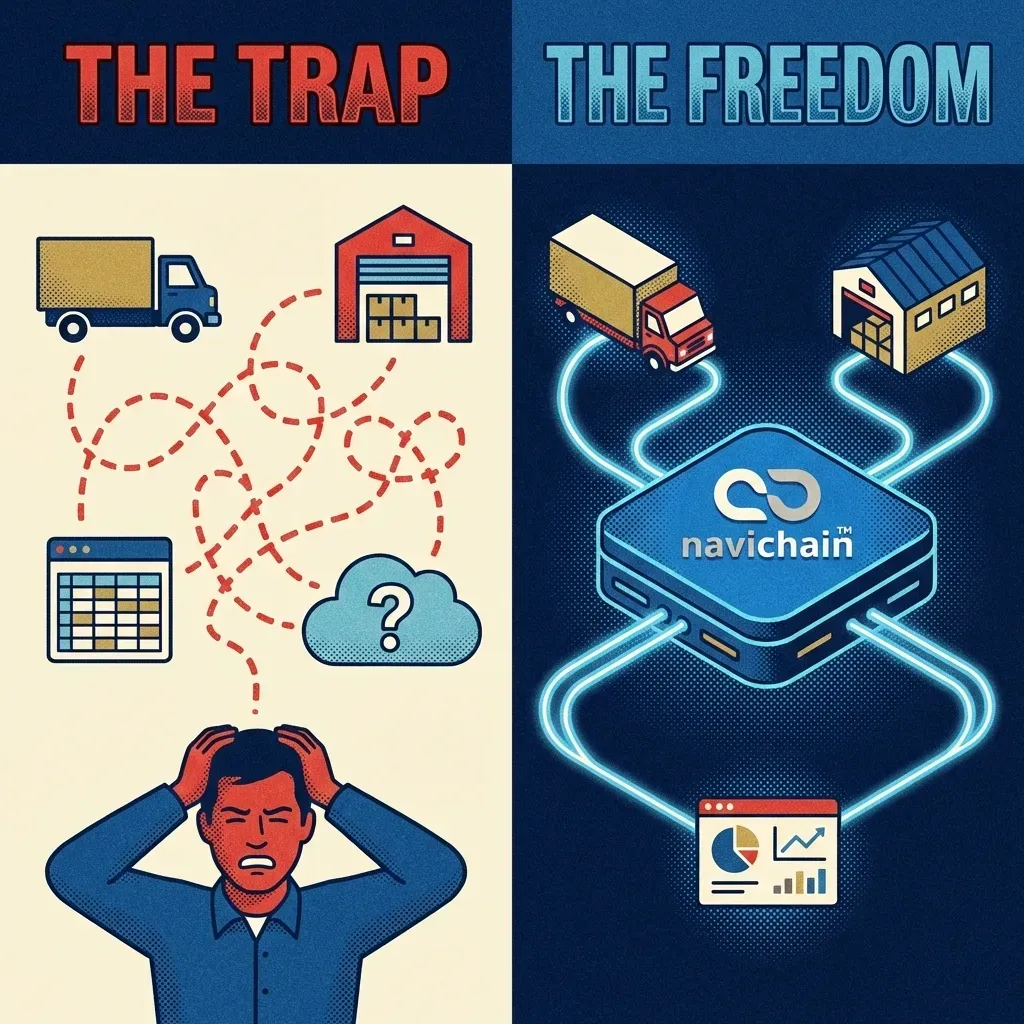
Navichain's platform architecture, hosted in Sweden, showcasing data sovereignty and integrated AI analytics.
Ready to optimise your supply chain?
navichain Insights Newsletter
Join the newsletter to receive the latest updates in your inbox.