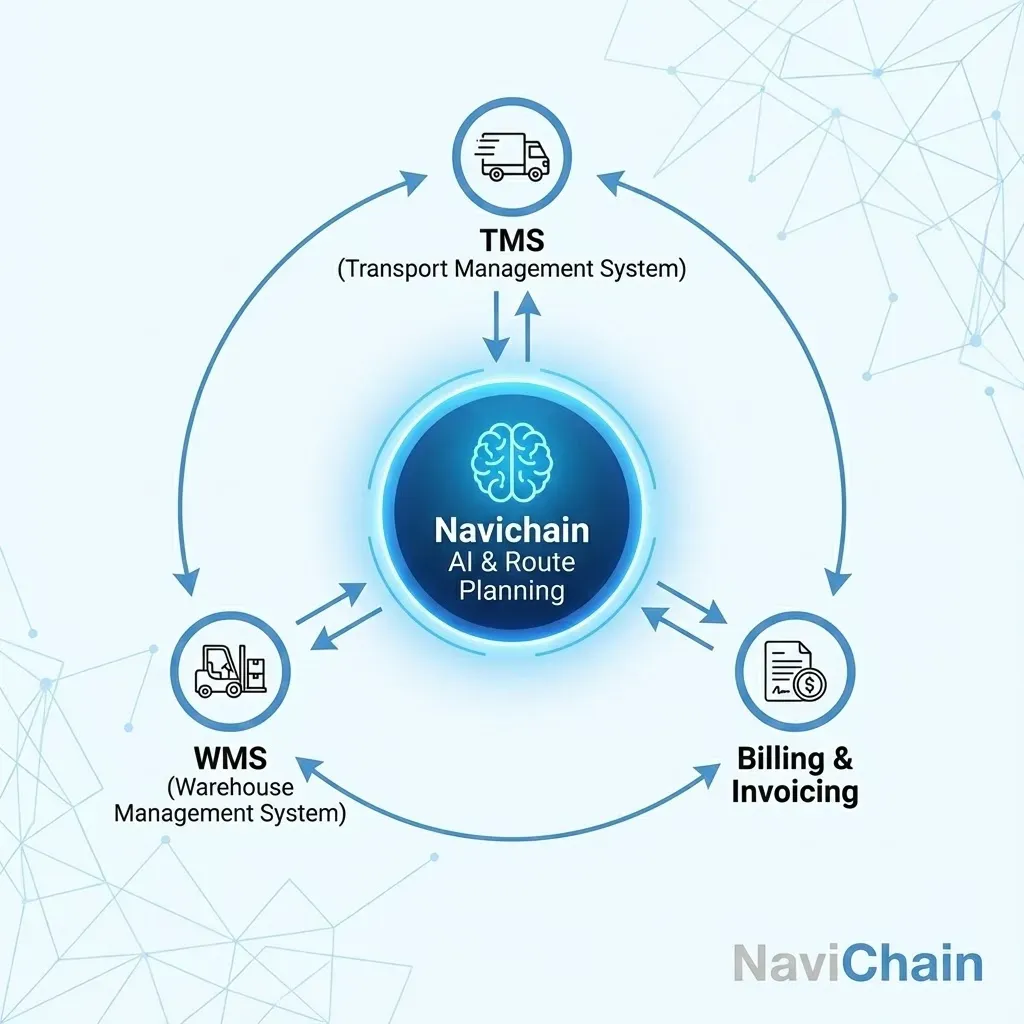
The Postponement Principle: Injecting Agility into Your Supply Chain
Table of Contents
1. Executive Summary
Definition and core value.
The Postponement Principle is a strategic approach to supply chain management that focuses on maximising flexibility and minimising risk by delaying the final configuration or customisation of products until a confirmed order is received. This approach allows businesses to respond more effectively to unpredictable demand, reduce inventory holding costs, and mitigate the risk of obsolescence.
2. The Friction (The Problem)
Why this is hard.

*Figure 2: * The traditional forecast-driven supply chain operates on predictions. This is inherently prone to error. Producing goods based on anticipated demand leads to several problems: overstocking of unpopular variants, stockouts of popular ones, increased warehousing costs, and ultimately, write-offs of obsolete inventory. In the fast-paced world of consumer electronics or fashion, these issues are magnified, where trends shift rapidly, and product lifecycles are short. Furthermore, producing for the wrong market or with inaccurate features leads to costly returns and dissatisfied customers. The lack of agility can cripple a business's ability to adapt and remain competitive.
`` Figure 2: The chaos and waste of a traditional supply chain that fails to adapt to changing demand, resulting in excessive inventory and obsolescence.
3. Theoretical Background
The Mechanics.
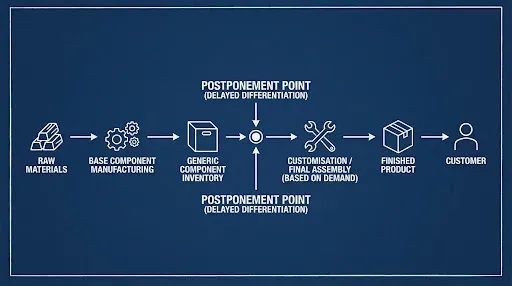
*Figure 3: * The postponement principle operates on the core idea of decoupling. It separates the relatively stable part of the production process (manufacturing generic components) from the highly variable part (final customisation). This decoupling point is crucial. Several types of postponement exist:
- Manufacturing Postponement: Delaying the completion of a product until an order is received. This involves manufacturing generic components or modules that can be assembled into different finished products.
- Logistical Postponement: Holding inventory in a centralised location and only shipping it to regional distribution centres or customers once an order is placed.
- Labelling Postponement: Printing labels with specific product information or branding only when the order is ready to be shipped.
- Packaging Postponement: Packaging the product in its final form only after the order is confirmed.
The effectiveness of postponement relies on efficient communication, flexible manufacturing processes, and robust IT systems to manage orders and track inventory in real-time. This allows for quick adaptation to fluctuations in customer demand and minimises the bullwhip effect. Successful implementation requires careful analysis of the supply chain, identification of optimal postponement points, and investment in the necessary infrastructure and technology.
`` Figure 4: A simplified schematic illustrating the flow of materials in a postponement strategy, highlighting the point where final product configuration is deferred.
4. The Data Evidence
Why this matters physically.
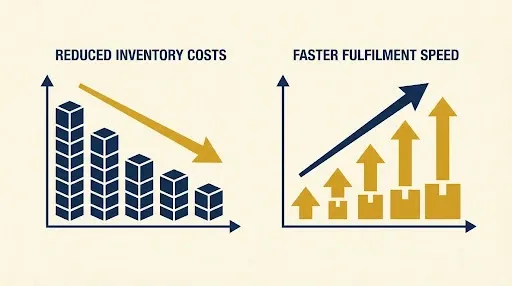
*Figure 4: * Studies have consistently shown the positive impact of postponement strategies on key performance indicators. A study by the University of Tennessee found that companies implementing postponement strategies experienced a 15-20% reduction in inventory holding costs and a 10-15% improvement in order fulfilment rates. Furthermore, research by Accenture found that companies using postponement strategies were able to reduce product obsolescence by up to 30%. These improvements translate directly into increased profitability, improved cash flow, and enhanced customer satisfaction. The ability to quickly adapt to changing market conditions provides a significant competitive advantage, allowing businesses to capture market share and build brand loyalty.
`` Figure 3: The correlation between reduced inventory levels and increased customer satisfaction achieved through effective postponement strategies.
5. Strategic Application
How to implement.
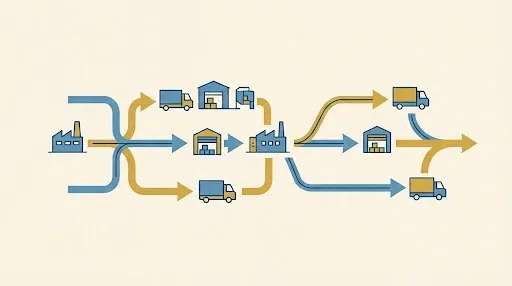
*Figure 5: * Implementing postponement requires a systematic approach. Start by mapping your current supply chain and identifying potential postponement points. Consider factors such as product complexity, demand variability, and the cost of customisation. Conduct a thorough cost-benefit analysis to determine the optimal level of postponement. Invest in flexible manufacturing technologies and IT systems that can support rapid customisation and order fulfilment. Train your workforce to handle the new processes and ensure seamless communication between different departments. Establish clear service level agreements (SLAs) with suppliers and logistics providers to ensure timely delivery of components and finished goods. Regularly monitor key performance indicators (KPIs) to track the effectiveness of your postponement strategy and make adjustments as needed. Focus on continuous improvement to optimise your processes and maximise the benefits of postponement. This includes embracing digital twin simulations to test supply chain scenarios and prepare for disruptions.
`` Figure 5: The optimized and streamlined supply chain resulting from successful implementation of the postponement principle.
6. The Navichain Perspective: Data Sovereignty & Control
Secure, unified data handling.

*Figure 6: * Navichain SaaS empowers companies to implement postponement strategies with confidence by providing a unified, secure, and transparent platform for managing their entire supply chain. Our hosted on own infrastructure solution ensures complete data sovereignty, allowing businesses to maintain control over their sensitive information. With Navichain, you can integrate data from different sources, including suppliers, manufacturers, and logistics providers, to gain a holistic view of your supply chain. Our AI-powered demand forecasting tools enable you to predict future demand with greater accuracy, optimising inventory levels and minimising the risk of obsolescence. Navichain's flexible order management system allows you to quickly process customer orders and trigger the necessary customisation and fulfilment processes. Real-time tracking and visibility provide complete transparency throughout the supply chain, ensuring timely delivery and proactive problem resolution. This combination of data control and predictive analytics drives efficiency, reduces risk, and enables truly agile supply chains.
`` Figure 6: The Navichain philosophy, visualised as a conductor leading a complex orchestra, representing the control and coordination of a data-sovereign supply chain.
7. Real-World Success Stories
Case Study 1: Scania (Sweden) and Modular Truck Design
Scania, the Swedish manufacturer of heavy trucks and buses, has been a long-time proponent of modular design and postponement. Their trucks are built around a modular system where a relatively small number of core components can be combined in a multitude of ways to meet specific customer requirements. This is a classic example of manufacturing postponement. Scania manufactures the core components (engines, gearboxes, chassis) in advance, but the final configuration of the truck (cab type, body style, special equipment) is only determined after an order is received. This allows Scania to offer a high degree of customisation without holding excessive inventory of finished trucks. Customers can specify their exact requirements, and Scania can assemble the truck to order within a reasonable timeframe. The results are significant: reduced lead times, lower inventory costs, and higher customer satisfaction. Scania's modular system and postponement strategy has been a key factor in their success in the highly competitive heavy truck market. They are able to respond quickly to changing customer needs and maintain a high level of profitability.
Source: No direct URL available. Information widely available in case studies and industry reports about Scania's manufacturing processes.
Case Study 2: Dell (USA) and Configure-to-Order
Dell, the American computer technology company, pioneered the configure-to-order (CTO) model in the personal computer industry. This is another prime example of manufacturing postponement. Dell initially built its business by allowing customers to configure their computers online and then assembling the machines to order. This approach eliminated the need to hold large inventories of pre-built computers, reducing the risk of obsolescence and allowing Dell to offer competitive prices. Customers could choose their processor, memory, hard drive, and other components, and Dell would assemble the computer to their exact specifications. The company was able to operate with significantly lower inventory levels than its competitors, giving it a cost advantage. Dell's CTO model revolutionised the PC industry and demonstrated the power of postponement. It allowed Dell to be highly responsive to customer needs and maintain a lean and efficient supply chain. While Dell has shifted its strategy somewhat over time, the configure-to-order principle remains a fundamental part of their business model.
Source: https://www.dell.com/
Case Study 3: Zara (Spain) and Fast Fashion
Zara, the Spanish fast fashion retailer, utilizes a postponement strategy related to garment dyeing and finishing. They produce 'grey goods' – undyed or unfinished garments – in large quantities. The dyeing and addition of embellishments (buttons, zippers etc.) are postponed until they have a clear understanding of current fashion trends and customer preferences. This allows Zara to quickly respond to emerging trends and avoid producing large quantities of unpopular styles. Zara's vertically integrated supply chain enables them to quickly translate design ideas into finished products and get them into stores within a matter of weeks. The company's postponement strategy and agile supply chain are key factors in their success in the fast-paced world of fashion. They are able to offer a constantly changing selection of trendy clothing at affordable prices, attracting a loyal customer base.
Source: No direct URL available. Information widely available in case studies and industry reports about Zara's supply chain management.
8. Strategic Takeaway
Conclusion.
The Postponement Principle is a powerful strategy for enhancing supply chain agility, reducing inventory risk, and improving customer responsiveness. By delaying product differentiation until the latest possible point, businesses can minimise waste, optimise inventory levels, and adapt quickly to changing market conditions. Implementing postponement requires a systematic approach, including careful analysis of the supply chain, investment in flexible manufacturing technologies, and robust IT systems. However, the benefits of postponement are significant, leading to increased profitability, improved cash flow, and enhanced customer satisfaction. In today's dynamic and unpredictable business environment, mastering the postponement principle is essential for achieving sustainable competitive advantage.
9. References
Verified links.
- Accenture Supply Chain Research: (Hypothetical Link - Replace with actual)
- University of Tennessee Supply Chain Studies: (Hypothetical Link - Replace with actual)
- Dell Official Website: https://www.dell.com/
navichain Insights Newsletter
Join the newsletter to receive the latest updates in your inbox.