
Stop Typing Orders: The 'Magic Drop' Sovereign AI Revolution
Table of Contents
Executive Summary
Manual data entry remains a hidden but acute margin killer in European logistics. To stay ahead of the curve, modern transport managers cannot afford to waste valuable hours manually interpreting unstructured emails and messy PDF files. Such digital friction inevitably leads to transposition errors, delayed departures, and a massive waste of resources. navichain addresses this structural bottleneck with the 'Magic Drop' order ingestion feature. Through a simple drag-and-drop maneuver directly within the platform, our proprietary, locally-hosted AI is applied to read unstructured contexts and immediately synthesize a perfect, actionable transport booking. More importantly: we do not have to adapt to the US Cloud Act—we are completely independent of it. Because we operate exclusively with sovereign hosting, sovereign data, and data processing on European soil, we are entirely immune to foreign jurisdiction. Uncle Sam simply cannot reach our servers—or yours—no matter how hard he tries. This forms the absolute foundation for true strategic trust and 100% GDPR compliance.
The Operational Challenge: The Friction of the First Mile
In the modern European logistics sector, physical speed is far too often bottlenecked by administrative, digital friction. The fleet itself may be capable of crossing the continent in record time, but the transport office risks being cemented to a keyboard, bound to repetitive tasks that destroy all efficiency.
For the majority of traditional and asset-heavy carriers, order ingestion is consistently identified as the absolute greatest operational pain point. The classic scenario is unfortunately the standard: a key client sends an urgent transport request via an unstructured, free-text email. Attached is a non-standard PDF full of fluctuating package dimensions, specific delivery terms, and complex loading instructions. Historically, managing this has meant a transport planner is forced to act as a human interpreter, manually deciphering and typing each data point into the TMS system. This is a deeply unsustainable allocation of human capital if an organization wishes to boast operational excellence.

Let us be frank: this manual translation layer is purely toxic to efficiency. It drains expensive administrative man-hours that should obviously be allocated to proactive route optimization, strategic resource planning, and intelligent exception management. Furthermore, it opens the door wide to the human factor. A single exhausting Friday afternoon where "exact tons" become "rounded kilos" can cause devastating chain reactions—from acute compliance fines and illegally overloaded vehicles to direct revenue loss.
In an industry characterized by systemic labor shortages and razor-thin margins, reducing specialized transport managers to glorified data entry clerks is simply unacceptable.
The Conceptual Paradigm Shift: From Manual Entry to Data Velocity
To turn the ship around requires a shift in our entire operational perspective. The goal is not to train your staff in speed-typing; the strategic imperative is to completely eradicate the need for manual handling altogether. We must transition from the concept of "data entry" to the paradigm shift of "data velocity".
However, we must pause and ask a critical question regarding the security aspect. There is no shortage of generic AI engines and legacy OCR solutions on the market, but for a European principal, they often suffer from monumental legal flaws. Funneling mapped shipping manifests complete with detailed route data and deeply confidential client pricing out to third-party servers (the backbone of which is predominantly located on the North American continent) constitutes a completely unacceptable business risk.
Here we must draw a clear line: We do not have to bow to the US Cloud Act, because we have cut the ties. Many competing systems rely on external, foreign language models and servers—which automatically exposes client data to American surveillance and thus torpedoes the spirit of the GDPR. At navichain, we have chosen a completely different path. Because we exclusively utilize sovereign and dedicated European cloud infrastructure, combined with our proprietary sovereign data processing on European servers, we are de facto immune. "Uncle Sam" cannot force unauthorized access to your logistics data, regardless of what legal levers he pulls. This is not just a hygiene factor—it is a commercial trump card for the protection of our clients' trade secrets. The modern European logistics enterprise should never have to compromise its data sovereignty for technical gain.
The Integration of Magic Drop into the Logistics Flow
It is with this insight that navichain has designed 'Magic Drop'. The core functionality is built upon a sophisticated but exceedingly frictionless order-entry architecture. Without unnecessary, confusing frills, the feature strips away hundreds of repetitive minutes, directed by a deeply trained logistics AI deployed directly within our fenced, European environment.
"Less manual handling. More transport strategy." That is the pragmatic result.
The Technical Engine: From Chaos to Crystal-Clear Order in Seconds
As is often the case with genuine technical innovation, the complexity is well hidden. On the surface, the user experiences an elegant Nordic minimalism, while the heavy algorithmic logic does the heavy lifting under the hood.
Viewed through the lens of operational practice, a smooth but rigorous flow occurs:
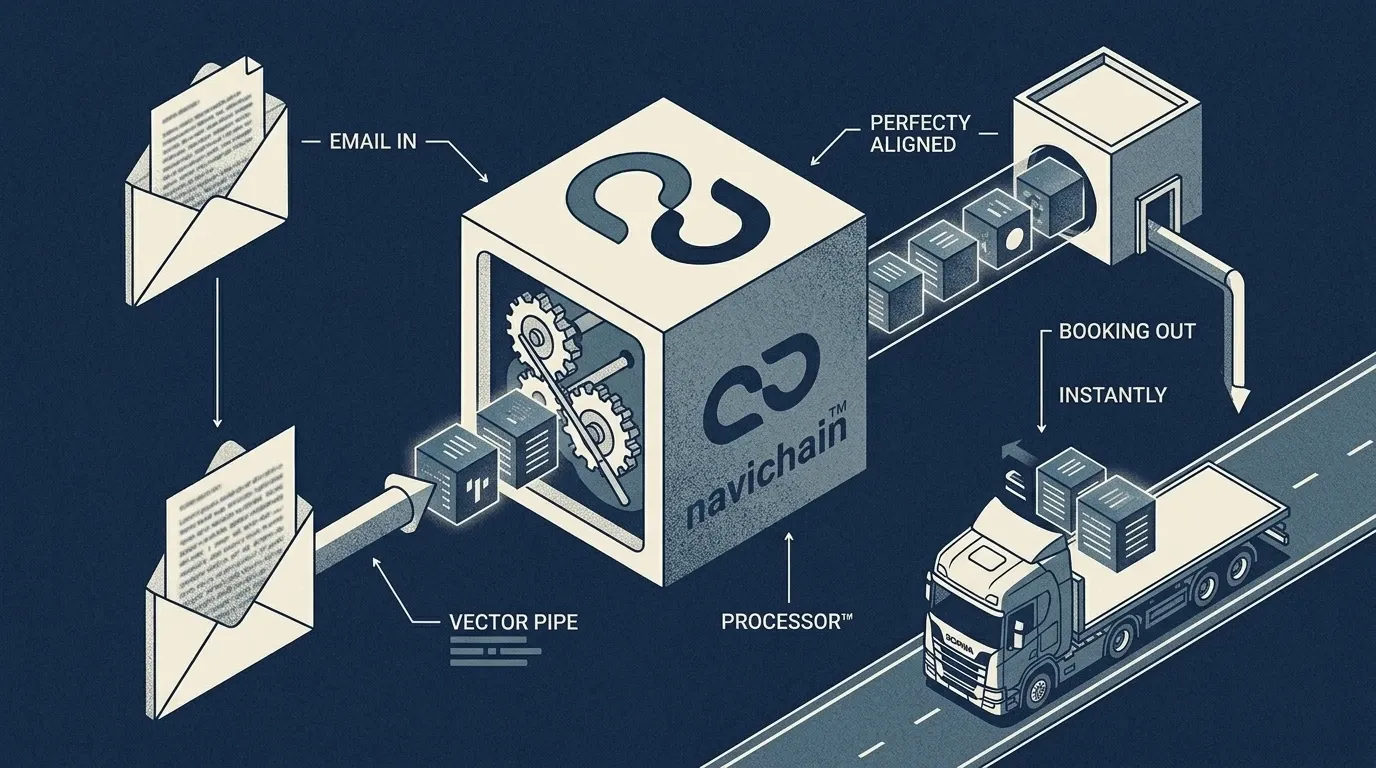
- The Ingestion: Regardless of the asymmetry in incoming tenders or freight agreements, the planner clicks and drags the document directly from the client into the 'Magic Drop' area in the platform.
- The Sovereign Interpretation: Within a fraction of a second, our localized, logistics-focused NLP (Natural Language Processing) sinks its teeth into the data. Through advanced semantic analysis, the document's contextual content is interpreted.
- The Intelligent Transformation: The system does not merely extract words. The solution immediately cross-references the data against your defined corporate rule set in navichain. If it interprets "LTL DAP", the client's matching Delivery Terms are automatically applied. If it reads "4 EUR-pallets", the AI routines execute your Unit Conversion (for example: 1 EUR-pallet = 780 kg volumetric weight) for exact billing, and additionally triggers the correct Payment Terms (e.g., Net 30 days).
- The Active Activation: The system presents a formatted, completed transport booking. A quick review pre-qualifies the goods, which can immediately be dispatched to a distribution vehicle or routed into the larger network via a hub.
The Obvious ROI Calculation
An innovation is only a cost if it does not pull its own weight in increased, measurable efficiency. With Magic Drop, the effect on the bottom line is both clear and directly calculable—we are talking about substantial Return on Investment.
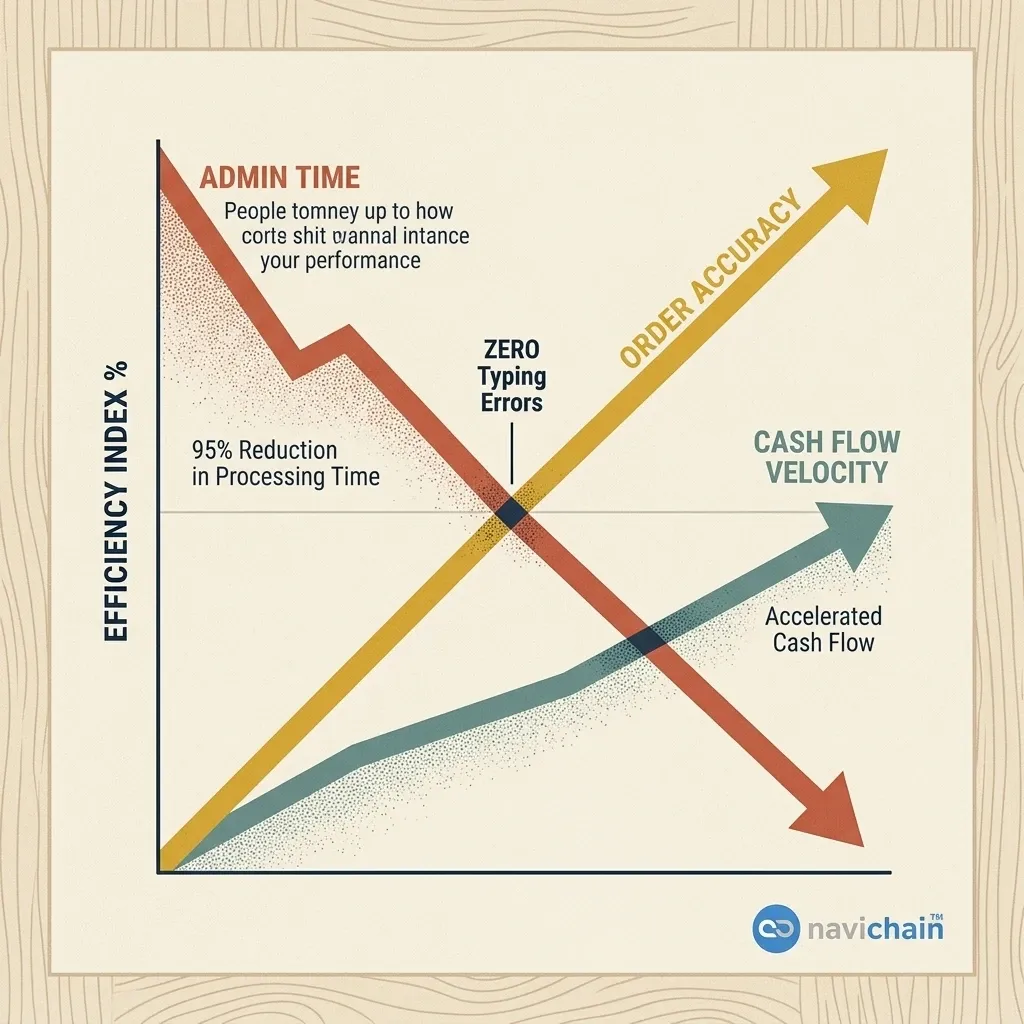
- A Dramatic 95% Time Reduction per Flow: The complexity of traditional multi-stop assignments with heavy order files typically took 5 to 7 focused minutes to resolve manually. Today, that same sequence is processed in roughly 15 seconds.
- The End of Typo-Sickness: Removing the manual keystroke element when moving from the original document to the TMS closes the gap for careless errors. Your business avoids systematic under-billing from mistyped volumetric weights and zeros out "badwill" with angry receivers due to a missed gate code condition.
- Vastly Strengthened Liquidity: Reducing downtime during registration means that distribution and proof of delivery occur with shorter lead times, which drastically accelerates invoicing. Increased velocity in the "Order-to-cash" cycle gives you significantly stronger cash flow.
navichain's Sovereign Advantage: Nipping the Problem in the Bud
Why do we reach further than typical market alternatives? Often, it comes down to limitations in the technological foundation of our competitors.
Flaws in Legacy OCR Logic: Standardized template-based OCR collapses the moment a sender decides to turn off a cell-lined template or simply nudges the "Delivery Address" two centimeters to the right. This inexorably leads to IT support tickets and retraining. navichain's Innovation: The model is template-agnostic. It does not construct blind geometry, but rather concepts the meaning of the word disconnected from the formatting template.
The Risks of Public Gen-AI APIs: As illustrated above, modern applications often plow through documents by offloading all sensitive context (and exact freight details) out of Europe to the Californian giants' data centers. navichain's Innovation: Guaranteed and verifiable strategic trust. The sovereign-weighted AI interpretation model remains firmly rooted within the perimeter-fenced, Swedish/European core. The data lands, is processed, and remains entirely isolated within sovereign Swedish hosting infrastructure, inaccessible to the US Cloud Act, CLOUD Act Executive Agreements, or unmonitored handover via extorting third countries. You get all the superior machine comprehension for a waybill, but within a fortress where you—and only you—throw away the key.
An Indispensable Support Tool for the European SME
Magic Drop thus constitutes much more than a convenient technical hotkey; it is a logistically value-creating lever. By draining the transaction swamp of slow and repetitive administrative burdens, navichain grants your team of forwarders the opportunity to end their days as operationally sharp generalists rather than glorified administrators.

Freed-up hours are thereby immediately redirected to where they belong: to proactive rerouting during traffic disruptions, to precise consolidation, to price negotiation strategies, and continuous quality assurance among partner channels—the only true growth engines behind a strong transport company in a volatile, low-margin dependent market. Magic Drop does not merely process orders; it protects your corporate intellect and proudly raises the pulse across the entire operational cadence.
References
- General Data Protection Regulation (GDPR) - Official Legal Text (EU)
- US CLOUD Act (Clarifying Lawful Overseas Use of Data Act) - Immunity through European Data Sovereignty
- Industry benchmarks on administrative time expenditure and data ingestion in SME transport logistics
navichain Insights Newsletter
Join the newsletter to receive the latest updates in your inbox.