Who Owns the Data? Strategic Trust in the NIS2 Era
Table of Contents
As logistics is formally classified as "High Criticality" infrastructure under the new NIS2 directive, the transport sector faces a reckoning. It is no longer just about moving goods; it is about securing the digital thread that controls them. But as hauliers digitize, a fundamental question arises: Who actually owns the data? This white paper explores the existential risks of public cloud dependence, the legal imperatives of the EU Data Act, and why "Strategic Trust" through self-hosted AI is the only viable path for the future.
Executive Summary
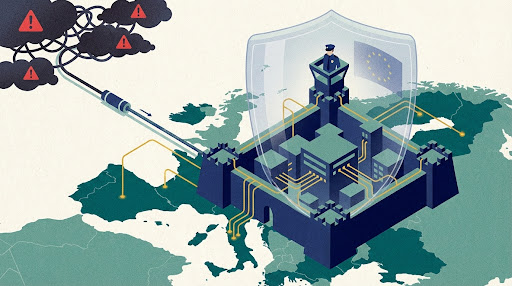
The digital transformation of the logistics industry has created unimaginable amounts of data—from telematics and route optimization to customer pricing models. But with increasing data volumes comes increased vulnerability. The new EU directive NIS2 tightens cybersecurity, incident reporting, and management liability requirements for critical operations, explicitly including transport and logistics.
Simultaneously, the EU Data Act is rewriting the rules on who has the right to access and monetize industrial data, while the US CLOUD Act continues to pose a sovereignty risk for European data stored with American hyperscalers.
This report argues that Data Sovereignty is not just a legal necessity, but a strategic survival issue. We present navichain's model for "Strategic Trust"—a solution built on self-hosted, open-weight AI models deployed entirely within a self-hosted, sovereign infrastructure for maximum data privacy and local execution that ensures your data remains yours, physically and legally within Europe.
Part 1: The Challenge - Who Holds the Keys?
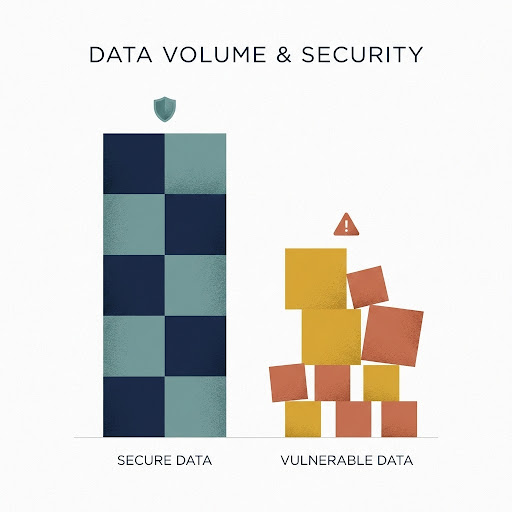
Data as a Business Asset – and Risk
For a modern haulier, data is as valuable as the fleet itself. * Operational Intelligence: Your historical route data contains the secret sauce of your pricing strategy. * Customer Relationships: Your CRM data maps the entire supply chain of your clients. * Financial Integrity: Your invoicing and factoring data is the lifeblood of your cash flow.
"Data as a business asset" is no longer a buzzphrase; it is reality. But when this data moves to the public cloud, fundamental uncertainty arises. If your provider shuts down, changes terms, or is compelled by a foreign government to grant access—what happens to your business?
NIS2: A New Reality for the Boardroom
The implementation of NIS2 (Network and Information Security Directive 2) fundamentally shifts the burden of responsibility. * High Criticality Sector: Transport is now designated as "High Criticality." This removes the historical ambiguity—if you move goods, you are critical infrastructure. * Management Liability: The C-suite (CEO, CTO, Board) can now be held personally liable for negligence in cybersecurity governance. You can no longer delegate this risk to the IT manager. * Supply Chain Security: You must not only secure your own systems but also guarantee the security of your digital supply chain. If your TMS provider is the weak link, you are non-compliant. * Incident Reporting: Companies must report significant cyber threats within 24 hours. This requires a level of visibility that many legacy systems simply cannot provide.
The Dark Side of the Cloud: Loss of Control and Compliance
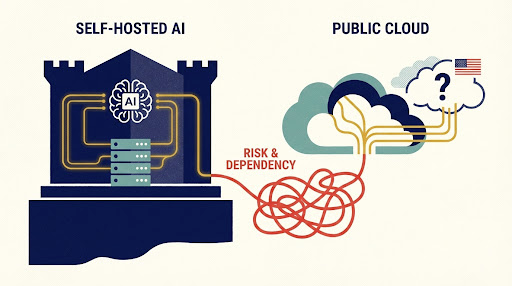
Many SaaS (Software as a Service) solutions are built on platforms like AWS, Azure, or Google Cloud. While technically robust, they entail a strategic risk for European entities. * US CLOUD Act: US legislation allows American federal law enforcement to compel US-based tech companies to provide requested data stored on servers, regardless of whether the data is stored within the US or on foreign soil. For a European logistics company handling sensitive infrastructure data, this creates a sovereignty gap. * Vendor Lock-in: Building your business-critical logic in a specific cloud provider's proprietary ecosystem makes it difficult and expensive to switch. You become a hostage to their pricing models and roadmap changes.
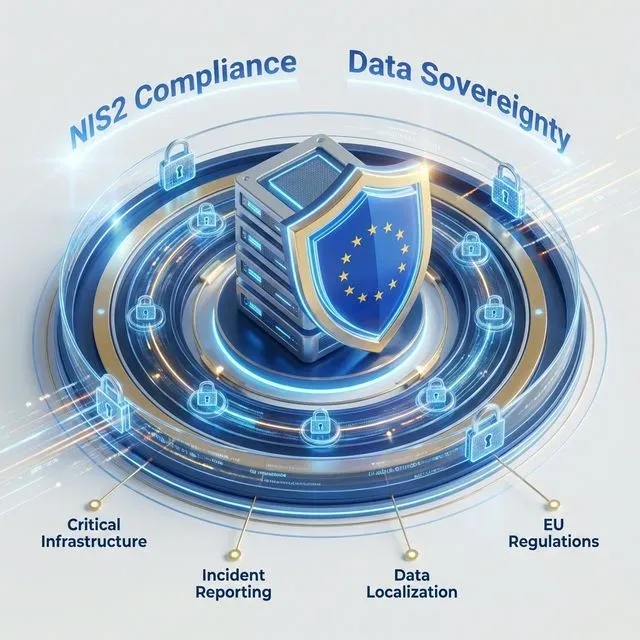
NIS2 places new, tough demands on data protection and accountability.
Part 2: The EU Data Act - Opportunity or Threat?
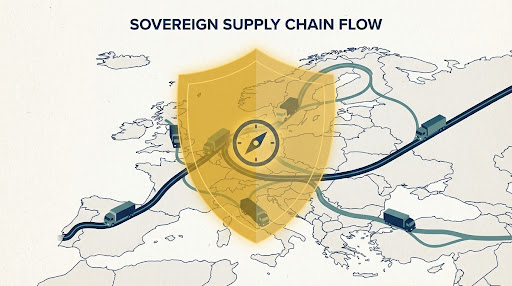
Unlocking Industrial Data
The EU Data Act, fully applicable from September 2025, aims to democratize access to data generated by connected products. For hauliers, this is a double-edged sword. * The Right to Access: You now have a legal right to access the data generated by your trucks (IoT sensors, telematics), even if the truck manufacturer previously hoarded it. This opens the door for independent predictive maintenance and optimization. * The Obligation to Share: Conversely, you may be required to make data available to other actors in the supply chain or to governments in "exceptional circumstances."
Protecting Trade Secrets
The challenge lies in balancing transparency with competitive advantage. Sharing "raw data" is one thing; sharing the proprietary insights derived from that data—your trade secrets—is another. A sovereignty-first approach ensures that you have the granular control needed to share exactly what is required by law, without exposing the intellectual property that constitutes your competitive edge.
Part 3: Our Angle - Strategic Trust
Self-Hosted & Open-weight AI models deployed entirely within a self-hosted, sovereign infrastructure for maximum data privacy and local execution: The Deal-Closer
In a world of uncertainty, trust is the hardest currency. For navichain, "Strategic Trust" is more than a promise—it is an architectural principle. We have chosen a path that goes against the current of "cloud-first" by prioritizing "sovereignty-first".
Total Data Sovereignty
Our philosophy is simple: We build, operate, and own our infrastructure. 1. No Third-Party Exposure: We do not rely on public cloud giants for the core function of our AI. This means your data is not subject to the US CLOUD Act or foreign surveillance. 2. European Hosting: All data is stored and processed within the EU/EEA, on servers we control, under strict European legislation. This significantly simplifies your compliance with GDPR and NIS2. 3. Open-weight AI models deployed entirely within a self-hosted, sovereign infrastructure for maximum data privacy and local execution: Our AI engine is not an API call to OpenAI or Anthropic. It is trained, run, and optimized internally by us. This means your trade secrets (e.g., pricing logic, route efficiency data) are never used to train someone else's general model.
Why This Matters to the Management Team
When the CTO asks about security and the CEO asks about risk, the answer is the same: Control. With navichain, you know exactly where your data is. You know that no one else has access to it. And you know that your business doesn't stand or fall at the whim of a foreign tech giant. That is strategic trust.
Part 4: Technical Enabler - Navichain Unified OS

An Architecture Built for Integrity
Navichain is not just a system; it is a Unified OS for logistics. Our platform is built from the ground up with security and integrity as cornerstones.
- Isolated Environments: Each customer's data is handled with strict multi-tenant isolation, ensuring no data leaks between tenants.
- Encryption Everywhere: All data is encrypted both at rest and in transit using industry-standard protocols, meeting NIS2 encryption requirements.
- Hardware Under Own Control: By controlling the server environment, we can guarantee performance and security at a level that general cloud services struggle to match for specific logistics applications.
Results in Practice
What does this means concretely for a haulier? * Compliance Secured: You can confidently show auditors and authorities that you have full control over your data storage, simplifying NIS2 audits. * Business-Critical Stability: You are not dependent on a transatlantic fiber cable functioning for your trucks to roll. * Competitive Advantage: Being able to guarantee your customers (cargo owners) that their delivery data is protected becomes a strong USP in your own sales conversations.
Conclusion
The question "Who owns the data?" has only one acceptable answer: You do.
In a time characterized by NIS2 requirements, the EU Data Act, and geopolitical uncertainty, the choice of technology partner is one of the most important strategic decisions a haulier owner can make. By choosing a partner that prioritizes Strategic Trust and offers a self-hosted, sovereign AI solution, you not only secure your data—you secure your future.
Navichain offers the safety and control required to navigate the new digital reality. We own the infrastructure, so you can own your business.
Ready to Secure Your Data Sovereignty?
Discover how navichain's self-hosted AI keeps you NIS2 compliant and in control.
navichain Insights Newsletter
Join the newsletter to receive the latest updates in your inbox.