The User Friction Barrier: Driving Mobile App Adoption for Data-Driven Success
Table of Contents
Executive Summary/Teaser
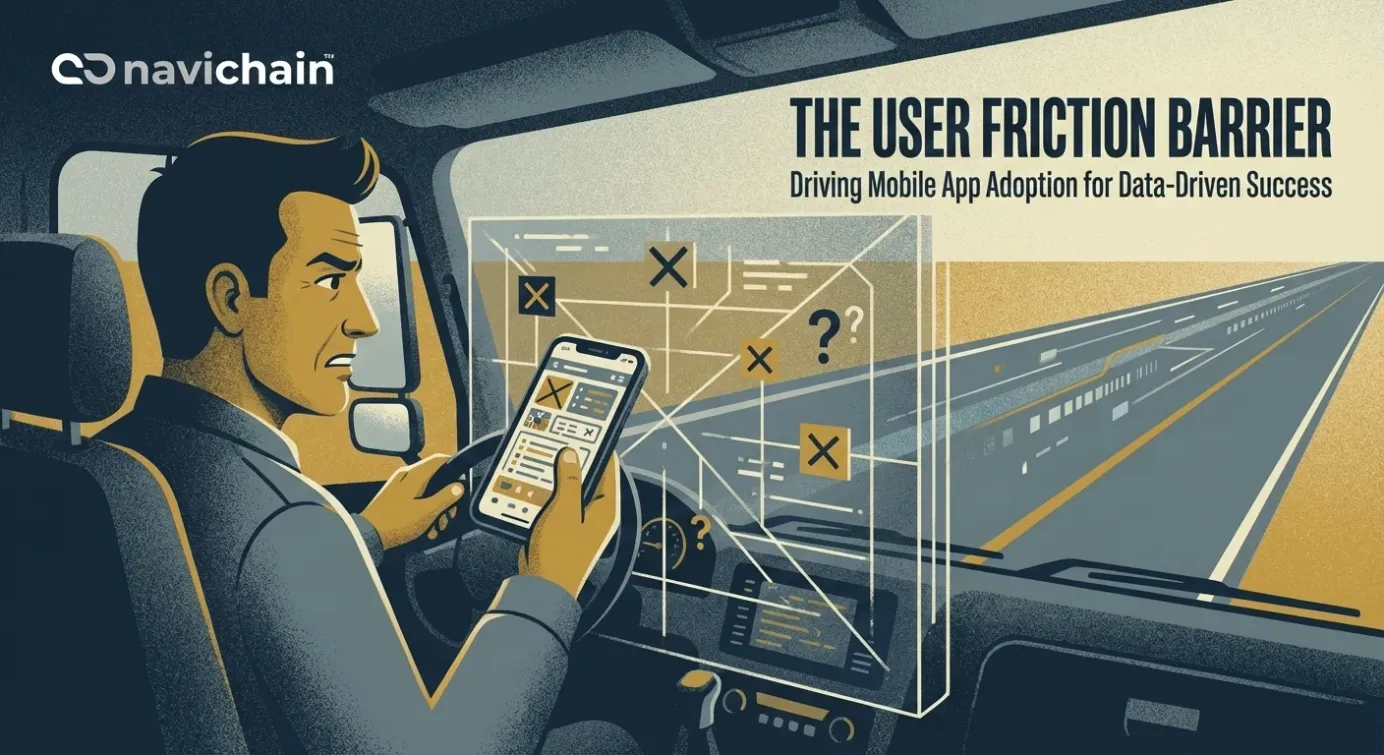
In a world where data-driven decisions are paramount for competitive advantage, organisations are increasingly reliant on mobile applications to collect and manage critical information from the field. However, for many businesses, this digital transformation faces an unexpected and costly challenge: the user friction barrier. This barrier arises when users, particularly those working in dynamic environments such as transport and logistics, find apps complex, time-consuming, and difficult to use. The result? Underutilisation, inaccurate data, and a diminished ROI on your digitisation efforts. This white paper examines the user friction barrier in detail, highlighting its consequences and introducing Navichain SaaS – a solution designed to create user-centric mobile applications that foster user adoption and ensure high-quality data. Read on to discover how you can transform your mobile initiatives from a challenge into a resounding success.
Phase 1: Context/Problem (The Current Pain)
In today's fast-paced business landscape, mobile applications have become indispensable tools for streamlining processes, improving communication, and making data-driven decisions. Within logistics, transport, and supply chain management, the use of mobile apps in the field is central to tracking deliveries, managing inventories, and optimising routes. However, the reality often falls far short of this ideal.
Many organisations are grappling with the "user friction barrier" – the users' reluctance or inability to fully embrace and utilise the mobile applications for which they are intended. This barrier stems from a multitude of causes:
- Complex User Interfaces: Apps overloaded with unnecessary features and difficult to navigate.
- Time-Consuming Data Entry: Manually completing lengthy forms, particularly under pressure.
- Lack of Training and Support: Inadequate training and support for users, leading to frustration and errors.
- Poor Experience on Mobile Devices: Apps that are not optimised for smaller screens or poor connectivity.
Consequently, drivers, warehouse operatives, and other field workers avoid using the apps, fill in information incompletely, or resort to manual methods.
Phase 2: Implications (Why it hurts business/ROI)
The user friction barrier has a direct and adverse impact on your business and ROI:
- Poor Data Quality: Incomplete, inaccurate, or delayed data undermines decision-making and reduces efficiency. Inaccurate data can lead to incorrect routes, delayed deliveries, inventory discrepancies, and dissatisfied customers.
- Reduced Productivity: Users waste time struggling with complex apps instead of focusing on their core tasks.
- Increased Costs: Manual methods are more expensive and time-consuming than automated processes. Inaccurate data can lead to costly errors and rectifications.
- Failed Digital Transformation: Investments in digital initiatives fail to deliver the anticipated returns because users do not adopt the new tools.
- Frustration and Dissatisfaction: Both among users struggling with the tools and among management who are not seeing the results they expected.
Phase 3: The Solution (Navichain SaaS Conceptual Approach)
Navichain SaaS is designed to break through the user friction barrier by placing the user experience at the forefront. Our platform focuses on:
- User-Centric Design: We work closely with our clients to understand user needs and workflows, creating intuitive and user-friendly applications.
- Smart Defaults and Automation: Minimise manual data entry by implementing intelligent default values, automating processes, and leveraging location-based technology and sensors. For example, automatically populate addresses based on GPS or predict the next step in a delivery based on historical data.
- Context Awareness: Adapt the application's behaviour and functionality based on the user's role, location, and other relevant factors. This ensures that users only see the information and features they need, when they need them.
- Gamification and Rewards: Motivate users to use the app and enter accurate data by introducing gamification elements and rewards.
- Continuous Improvement: We utilise data and feedback from users to continuously improve the application and ensure it continues to meet their evolving needs.
With Navichain SaaS, you can:
- Increase User Adoption: By creating applications that are easy to use and valuable for users.
- Improve Data Quality: By minimising manual data entry and ensuring that information is accurate and up-to-date.
- Boost Productivity: By freeing users from time-consuming tasks and allowing them to focus on their core competencies.
- Realise the Full ROI on your Digital Investments: By ensuring that your mobile applications deliver the anticipated results.
Conclusion
The user friction barrier is a genuine and costly challenge for organisations seeking to harness the power of mobile applications. Navichain SaaS offers a unique solution by focusing on the user experience and automation. By breaking through the user friction barrier, you can increase user adoption, improve data quality, and realise the full ROI on your digital investments. Contact us today to learn more about how Navichain SaaS can help you transform your mobile initiatives from a challenge into a resounding success.
navichain Insights Newsletter
Join the newsletter to receive the latest updates in your inbox.