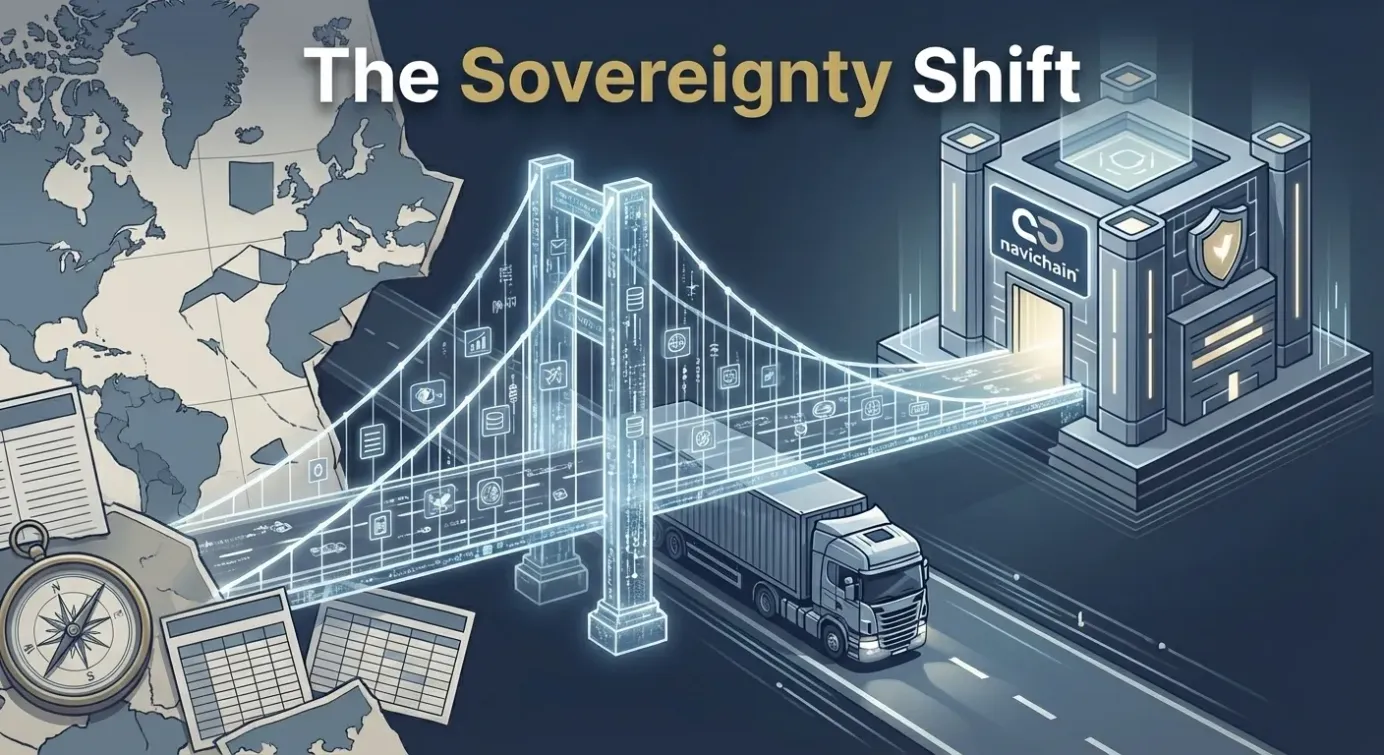
The Sovereignty Shift Why European Smes Are Reclaiming Supply Chain Control
Table of Contents
Supply chain complexity is stifling European SMEs, leaving them vulnerable to disruptions and hindering growth. This white paper explores how a paradigm shift toward data sovereignty and unified platforms is empowering businesses to regain control and unlock unprecedented efficiency. Discover how Navichain's innovative approach is revolutionising supply chain management for a more resilient and profitable future.
Disconnected data streams hinder real-time, actionable business insights.
Executive summary
Modern supply chains are increasingly complex, fragmented, and vulnerable. Traditional approaches to supply chain management, relying on disparate systems and manual processes, are no longer sufficient to meet the demands of today's dynamic global marketplace. This report delves into the challenges facing businesses in optimizing their supply chains, highlighting the inefficiencies, risks, and missed opportunities that result from outdated practices. We then introduce a strategic solution centered around a unified, AI-powered platform – Navichain – that enables end-to-end visibility, automation, and intelligent decision-making. By leveraging Navichain's SaaS platform and Unified OS, businesses can unlock significant improvements in efficiency, reduce costs, enhance resilience, and gain a competitive edge in the modern supply chain landscape. Fragmented data visibility creates supply chain blind spots and inhibits optimization.
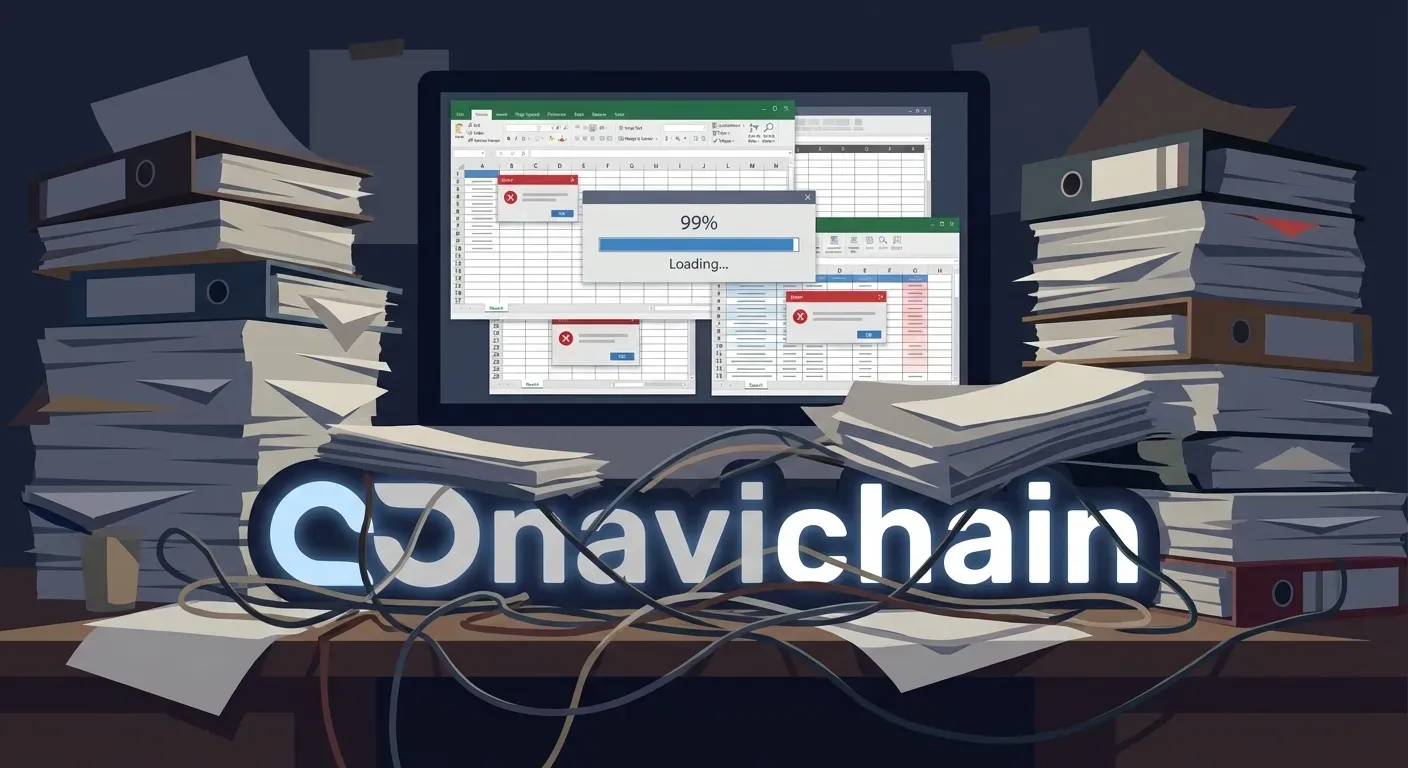
Siloed IT systems and lack of data integration contribute to critical blind spots in the supply chain.
Introduction
The global supply chain has become the lifeblood of modern commerce. It's the intricate network that connects raw materials to finished products, spanning continents and involving countless stakeholders. However, this complexity also presents significant challenges. Businesses are grappling with rising costs, increasing disruptions, and ever-evolving customer expectations. The traditional, siloed approach to supply chain management is no longer sustainable. Companies need a new paradigm – one that embraces visibility, agility, and intelligent automation. This report explores the critical issues facing supply chains today and presents a strategic solution for transforming them into a source of competitive advantage. We will examine how Navichain, with its AI-driven platform, empowers businesses to navigate the complexities of the modern supply chain and achieve unprecedented levels of efficiency and resilience. Fragmented supply chains breed cost, risk, and missed opportunity.
Section 1: The challenge: navigating the labyrinth of modern supply chains
The modern supply chain is far from a linear path. It's a complex web of interconnected processes, systems, and stakeholders. This inherent complexity presents a multitude of challenges that can significantly impact a business's bottom line and overall competitiveness.
1.1 the fragmentation fiasco: Silos and lack of visibility
One of the most pervasive challenges is the fragmentation of data and processes. Many organizations rely on a patchwork of disparate systems – ERPs, TMSs, WMSs, and spreadsheets – that don't communicate effectively with each other. This lack of integration creates information silos, hindering end-to-end visibility and making it difficult to track goods, manage inventory, and respond to disruptions in a timely manner.
- Increased Costs: Inefficient processes, redundant data entry, and manual reconciliation lead to higher operational costs.
- Delayed Decision-Making: Lack of real-time visibility prevents businesses from making informed decisions quickly, resulting in missed opportunities and increased risks.
- Poor Customer Service: Inability to track orders and provide accurate delivery information leads to customer dissatisfaction and lost sales.
- Inventory Management Issues: Lack of visibility into inventory levels across the supply chain results in stockouts, overstocking, and increased holding costs.
1.2 the disruption dilemma: Volatility and uncertainty
Global supply chains are increasingly vulnerable to disruptions, ranging from natural disasters and geopolitical events to economic downturns and unforeseen pandemics. These disruptions can have a cascading effect, causing delays, shortages, and price increases.
- Production Downtime: Disruptions to the supply of raw materials or components can halt production, leading to lost revenue and missed deadlines.
- Increased Lead Times: Delays in transportation and logistics can significantly increase lead times, impacting customer satisfaction and competitiveness.
- Price Volatility: Disruptions can cause prices to fluctuate wildly, making it difficult to manage costs and maintain profitability.
- Reputational Damage: Inability to fulfill orders and meet customer expectations can damage a company's reputation and erode customer loyalty.
1.3 the sustainability imperative: Environmental and social responsibility
Consumers and investors are increasingly demanding that businesses operate in a sustainable and socially responsible manner. This includes reducing carbon emissions, minimizing waste, and ensuring fair labor practices throughout the supply chain.
- Increased Regulatory Scrutiny: Governments are enacting stricter regulations related to environmental and social responsibility, increasing the compliance burden for businesses.
- Reputational Risk: Companies that fail to address sustainability concerns risk damaging their reputation and alienating customers.
- Missed Opportunities: Businesses that embrace sustainability can gain a competitive advantage by attracting environmentally conscious customers and investors.
- Increased Costs (Potentially): Implementing sustainable practices may require upfront investments, but can lead to long-term cost savings through reduced waste and improved efficiency.
1.4 the cost of inaction: A staggering price to pay
The consequences of failing to address these challenges are significant. Businesses that cling to outdated practices risk falling behind their competitors, losing market share, and ultimately, jeopardizing their long-term survival. The cost of inaction includes: * Lost Revenue: Inefficient processes, disruptions, and poor customer service can lead to lost sales and reduced profitability.
- Increased Costs: Higher operational costs, inventory holding costs, and transportation costs erode profit margins.
- Reduced Competitiveness: Inability to respond quickly to market changes and meet customer expectations puts businesses at a disadvantage.
- Increased Risk: Vulnerability to disruptions and regulatory scrutiny increases the risk of financial losses and reputational damage.
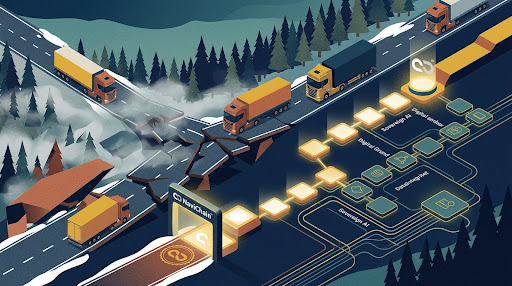
Disconnected systems create supply chain silos, hindering visibility and efficiency.
A visual representation of the impact of disconnected systems on supply chain performance, highlighting areas of inefficiency and potential for improvement.
Section 2: The context/data: decoding the supply chain paradox
The challenges outlined above are amplified by several key trends and paradoxes shaping the modern supply chain landscape. Understanding these dynamics is crucial for developing effective strategies.
2.1 the globalization paradox: Interconnectedness and vulnerability
Globalization has created unprecedented opportunities for businesses to expand their reach and access new markets. However, it has also made supply chains more complex and vulnerable to disruptions. The interconnectedness of global supply chains means that a single event in one part of the world can have a ripple effect across the entire network.
- Data Point: According to a recent report by the World Economic Forum, supply chain disruptions cost businesses an average of \$184 million per year.
- Analysis: This highlights the significant financial impact of disruptions and the need for businesses to build resilience into their supply chains.
2.2 the e-commerce explosion: Demand for speed and transparency
The rise of e-commerce has transformed consumer expectations. Customers now demand faster delivery times, greater transparency, and personalized service. This puts immense pressure on supply chains to be more agile, efficient, and responsive.
- Data Point: A study by McKinsey found that 70% of consumers consider delivery speed to be an important factor when making online purchases.
- Analysis: This underscores the critical role of logistics in the e-commerce landscape and the need for businesses to optimize their delivery processes.
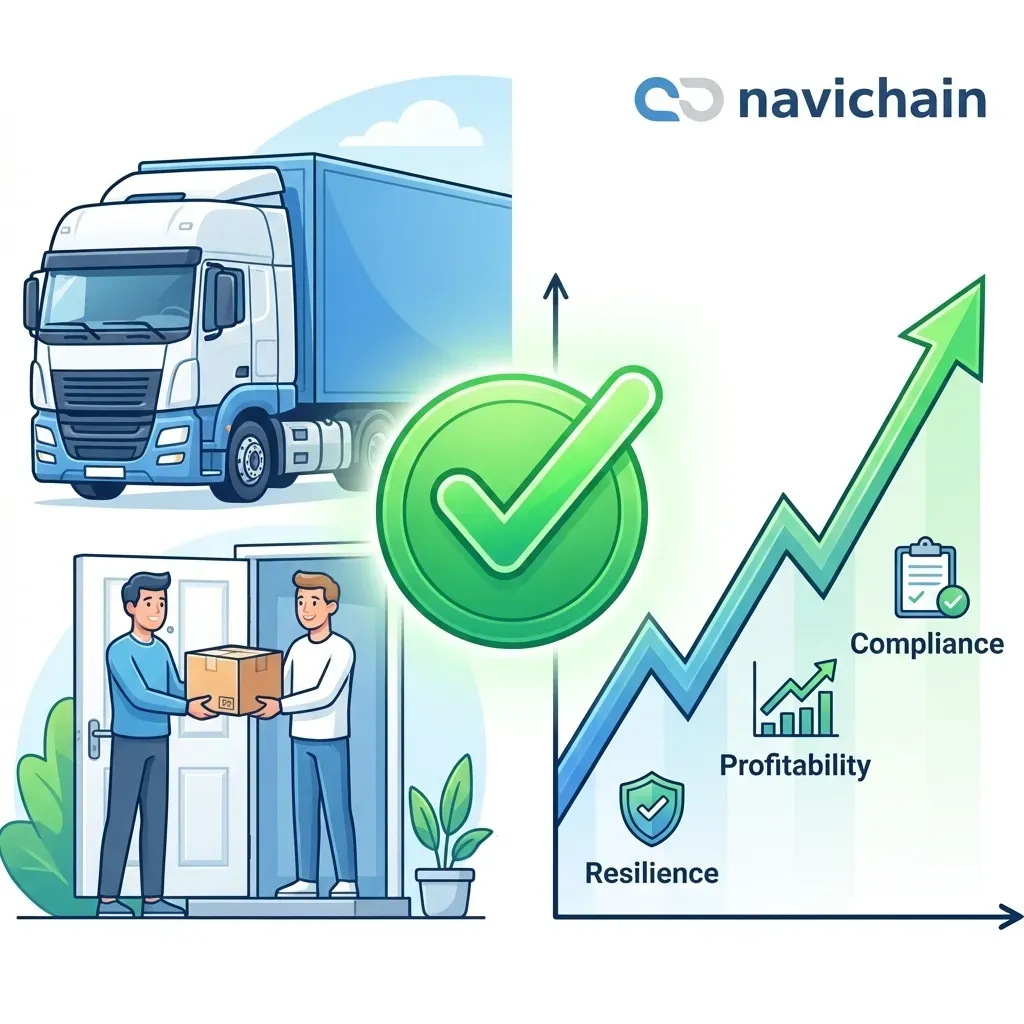
Illustrates the financial consequences of supply chain disruptions, emphasizing the importance of building resilience.
2.3 the data deluge: Information overload and Insight scarcity
Businesses are generating vast amounts of data from their supply chains, but often struggle to extract meaningful insights from this information. The lack of a unified platform and sophisticated analytics tools makes it difficult to identify trends, predict disruptions, and optimize performance.
- Data Point: Gartner estimates that only 30% of supply chain data is currently being used effectively.
- Analysis: This highlights the untapped potential of supply chain data and the need for businesses to invest in analytics capabilities.
2.4 the skills gap: Talent shortage and technological disruption
The rapid pace of technological change is creating a skills gap in the supply chain industry. Businesses are struggling to find and retain talent with the expertise needed to manage complex systems, analyze data, and implement new technologies.
- Data Point: The Association for Supply Chain Management (ASCM) estimates that there will be a shortage of 6 million supply chain workers in the US by 2030.
- Analysis: This underscores the importance of investing in training and development programs to equip the workforce with the skills needed to succeed in the future of supply chain.
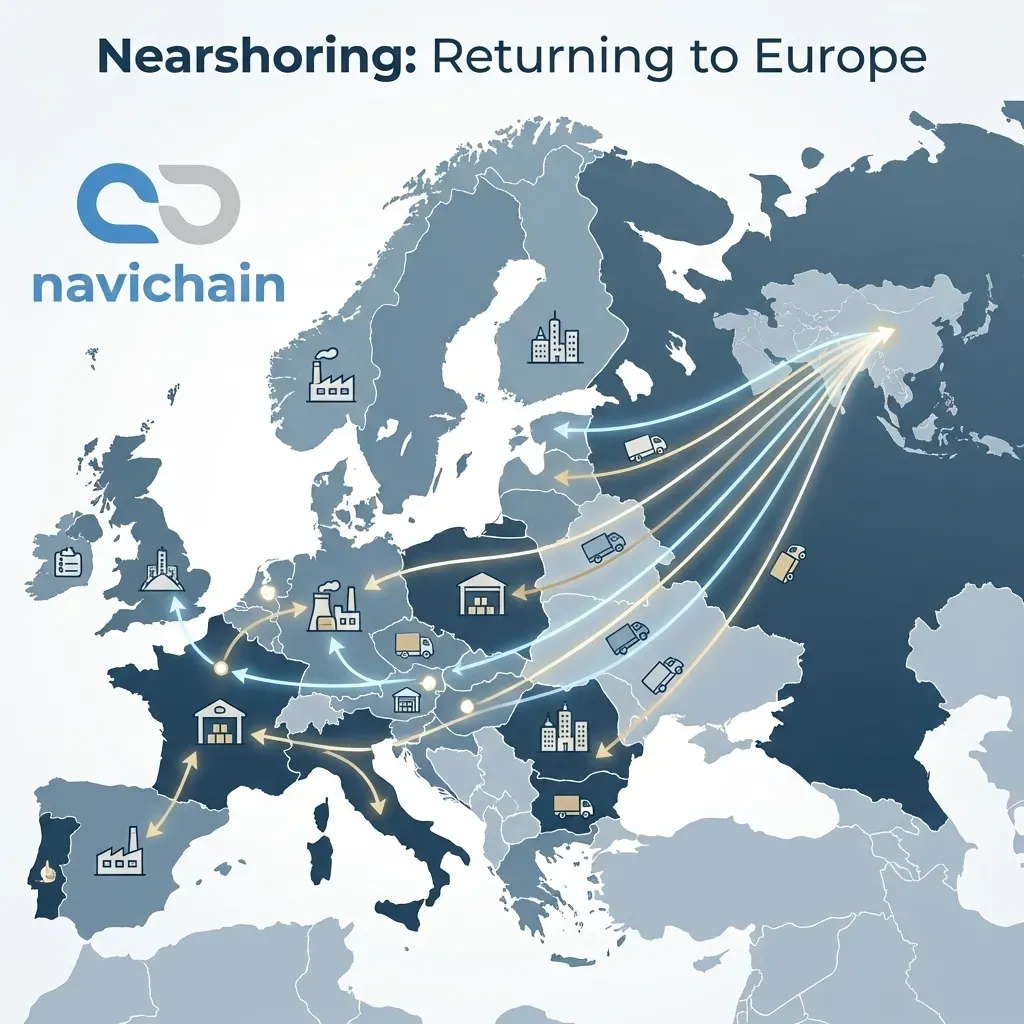
Navichain: Illustrating the interconnectedness that breeds both opportunity and vulnerability in global supply chains.
Section 3: The strategic solution: embracing a unified, ai-driven approach
To overcome the challenges and capitalize on the opportunities presented by the modern supply chain landscape, businesses need to adopt a strategic solution that embraces visibility, agility, and intelligent automation. This requires a shift from a reactive, siloed approach to a proactive, integrated approach.
3.1 the power of visibility: End-to-end transparency
Achieving end-to-end visibility is the foundation of a resilient and efficient supply chain. This means having real-time access to information about inventory levels, order status, transportation movements, and potential disruptions across the entire network.
- Data Integration: Connecting disparate systems and data sources to create a single source of truth.
- Real-Time Tracking: Using sensors, GPS, and other technologies to track goods and assets in real-time.
- Collaboration Platforms: Enabling seamless communication and collaboration between all stakeholders in the supply chain.
3.2 the agility advantage: Responding to change with speed and flexibility
Agility is the ability to respond quickly and effectively to unexpected events and changing market conditions. This requires a flexible and adaptable supply chain that can quickly reconfigure its operations to meet new demands.
- Diversification of Suppliers: Reducing reliance on single suppliers to mitigate the risk of disruptions.
- Flexible Manufacturing: Adapting production processes to accommodate changes in demand and product specifications.
- Dynamic Routing: Optimizing transportation routes in real-time to avoid delays and reduce costs.
Schematic illustrating the interconnectedness of a flexible and agile supply chain, highlighting key elements like diversified sourcing and dynamic routing.
3.3 the intelligence infusion: Leveraging AI and machine learning
Artificial intelligence (AI) and machine learning (ML) are transforming the supply chain by enabling intelligent automation, predictive analytics, and optimized decision-making. These technologies can help businesses to: * Predict Demand: Forecast future demand with greater accuracy, reducing the risk of stockouts and overstocking.
- Optimize Inventory: Optimize inventory levels across the supply chain, minimizing holding costs and improving service levels.
- Automate Processes: Automate repetitive tasks, freeing up human workers to focus on more strategic activities.
- Detect Anomalies: Identify potential disruptions and risks before they occur, enabling proactive mitigation.
3.4 the unified platform: A single source of truth
The key to unlocking the full potential of visibility, agility, and intelligence is a unified platform that integrates all aspects of the supply chain. This platform should provide a single source of truth for all data and processes, enabling seamless collaboration and optimized decision-making.
Section 4: The tech enabler (Navichain): unlocking supply chain potential
Navichain is a leading provider of supply chain management solutions that empowers businesses to transform their logistics operations and achieve unprecedented levels of efficiency and resilience. Navichain's comprehensive suite of solutions, built on a unified platform and powered by AI, enables end-to-end visibility, intelligent automation, and optimized decision-making.
4.1 Navichain SaaS: A cloud-based solution for scalability and flexibility
Navichain SaaS is a cloud-based platform that provides businesses with a scalable and flexible solution for managing their supply chains. The SaaS model eliminates the need for costly infrastructure investments and allows businesses to quickly deploy and scale their operations as needed.
- Reduced IT Costs: Eliminates the need for hardware, software, and IT personnel.
- Faster Deployment: Enables rapid deployment and onboarding.
- Scalability and Flexibility: Allows businesses to easily scale their operations up or down as needed.
- Automatic Updates: Provides access to the latest features and updates without requiring manual intervention.
4.2 unified OS: A single source of truth for supply chain data
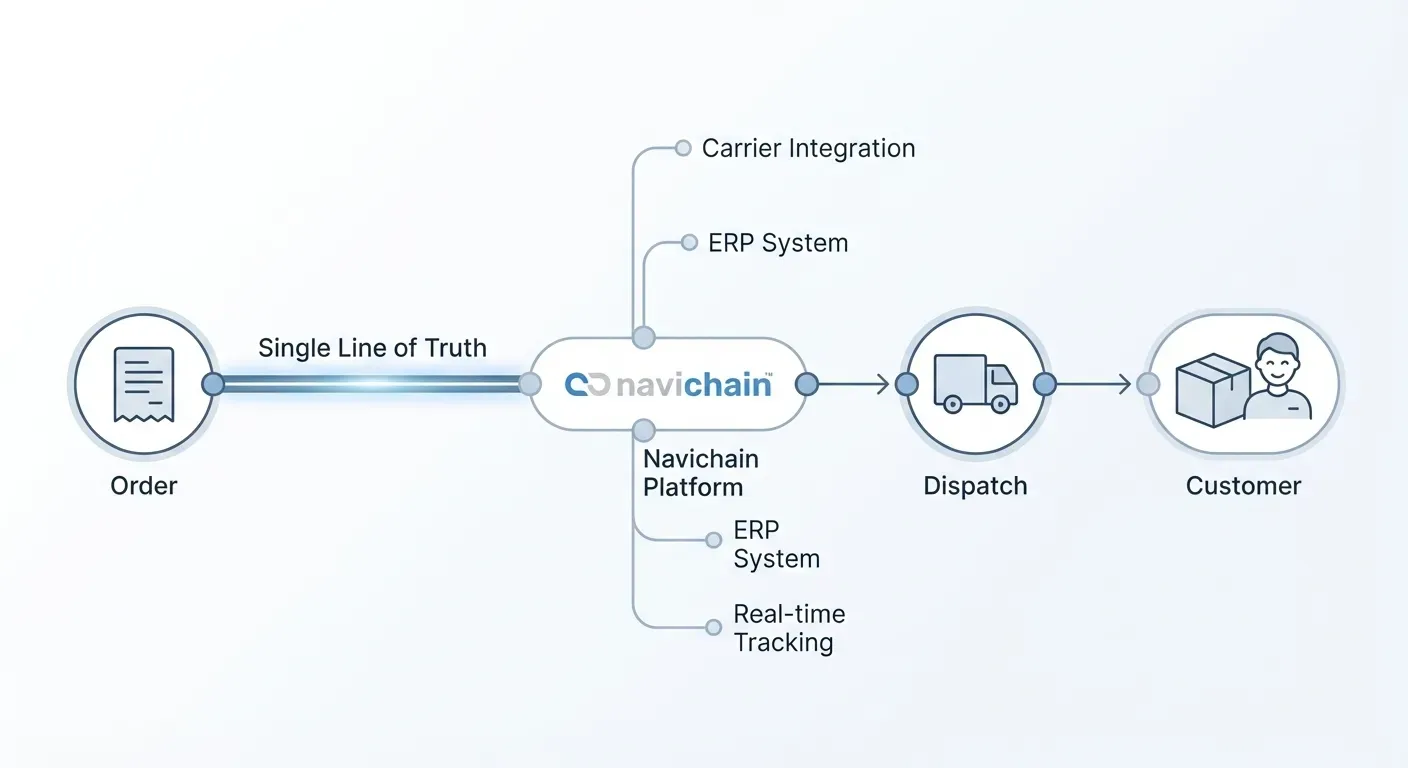
Navichain's Unified OS provides a single source of truth for all supply chain data, integrating disparate systems and data sources into a cohesive platform. This enables end-to-end visibility and facilitates seamless collaboration between all stakeholders.
- Data Integration: Connects to ERPs, TMSs, WMSs, and other systems to consolidate data.
- Real-Time Dashboards: Provides real-time visibility into key performance indicators (KPIs).
- Collaboration Tools: Enables seamless communication and collaboration between stakeholders.
Schematic illustrating Navichain's Unified OS connecting disparate supply chain systems to provide a single source of truth for data and enhanced visibility.
- Customizable Workflows: Allows businesses to tailor the platform to their specific needs.
4.3 ai-driven intelligence: Optimizing decisions and predicting disruptions
Navichain leverages AI and machine learning to provide intelligent automation, predictive analytics, and optimized decision-making. This enables businesses to: * Predict Demand: Forecast future demand with greater accuracy using machine learning algorithms.
- Optimize Inventory: Optimize inventory levels across the supply chain using AI-powered recommendations.
- Automate Processes: Automate repetitive tasks such as order processing and shipment tracking.
- Detect Anomalies: Identify potential disruptions and risks before they occur using AI-powered anomaly detection.
4.4 specific Navichain features and modules:
- Order Management: Streamline order processing, from order placement to fulfillment.
- Inventory Optimization: Reduce inventory holding costs and improve service levels.
- Transportation Management: Optimize transportation routes and reduce shipping costs.
Improved supply chain visibility leads to optimized decision-making and ultimately, better business outcomes with Navichain.
- Warehouse Management: Improve warehouse efficiency and accuracy.
- Supply Chain Analytics: Gain insights into supply chain performance and identify areas for improvement.
Section 5: Business outcomes: realizing the ROI of a transformed supply chain
By implementing Navichain's unified, AI-driven platform, businesses can achieve significant improvements in efficiency, reduce costs, enhance resilience, and gain a competitive edge.
5.1 ROI: Quantifiable benefits and cost savings
The return on investment (ROI) of implementing Navichain can be substantial. Businesses can expect to see: * Reduced Costs: Lower operational costs, inventory holding costs, and transportation costs.
- Increased Revenue: Higher sales due to improved customer service and faster delivery times.
- Improved Efficiency: Streamlined processes and reduced manual effort.
- Enhanced Resilience: Greater ability to withstand disruptions and adapt to changing market conditions.
5.2 efficiency gains: Streamlining operations and reducing waste
Navichain's platform helps businesses to streamline their operations and reduce waste by: * Automating Repetitive Tasks: Freeing up human workers to focus on more strategic activities.
- Optimizing Processes: Identifying and eliminating inefficiencies in the supply chain.
- Improving Communication: Facilitating seamless communication and collaboration between stakeholders.
- Reducing Errors: Minimizing manual data entry and reconciliation.
5.3 strategic resilience: Adapting to change and mitigating risk
Navichain's platform helps businesses to build strategic resilience by: * Providing End-to-End Visibility: Enabling businesses to quickly identify and respond to disruptions.
- Diversifying Suppliers: Reducing reliance on single suppliers to mitigate risk.
- Optimizing Inventory Levels: Ensuring that businesses have the right amount of inventory in the right place at the right time.
- Improving Collaboration: Facilitating seamless communication and collaboration between stakeholders.
Navichain helps businesses achieve greater agility and control over their supply chains, leading to improved resilience and optimized outcomes.
5.4 competitive advantage: Differentiating in the marketplace
By transforming their supply chains, businesses can gain a significant competitive advantage by: * Providing Superior Customer Service: Offering faster delivery times, greater transparency, and personalized service.
- Reducing Costs: Lowering prices and increasing profit margins.
- Improving Agility: Responding quickly to market changes and meeting customer demands.
- Enhancing Sustainability: Attracting environmentally conscious customers and investors.
Conclusion
The modern supply chain is a complex and dynamic environment that presents significant challenges for businesses. However, by embracing a unified, AI-driven approach, businesses can transform their supply chains into a source of competitive advantage. Navichain's comprehensive suite of solutions provides the visibility, agility, and intelligence needed to navigate the complexities of the modern supply chain and achieve unprecedented levels of efficiency and resilience. Don't let outdated practices hold you back. Embrace the future of supply chain management with Navichain and unlock your business's full potential.
References
- European Commission (2020). EU Strategy for Sustainable and Smart Mobility
- International Road Transport Union (IRU) (2023). The Future of European Road Transport
- McKinsey & Company (2022). Risk, resilience, and rebalancing in global value chains
- Gartner (2023). Top Supply Chain Technology Trends
Navichain visualizes interconnected nodes within a supply chain network, emphasizing transparency and control for SMEs.
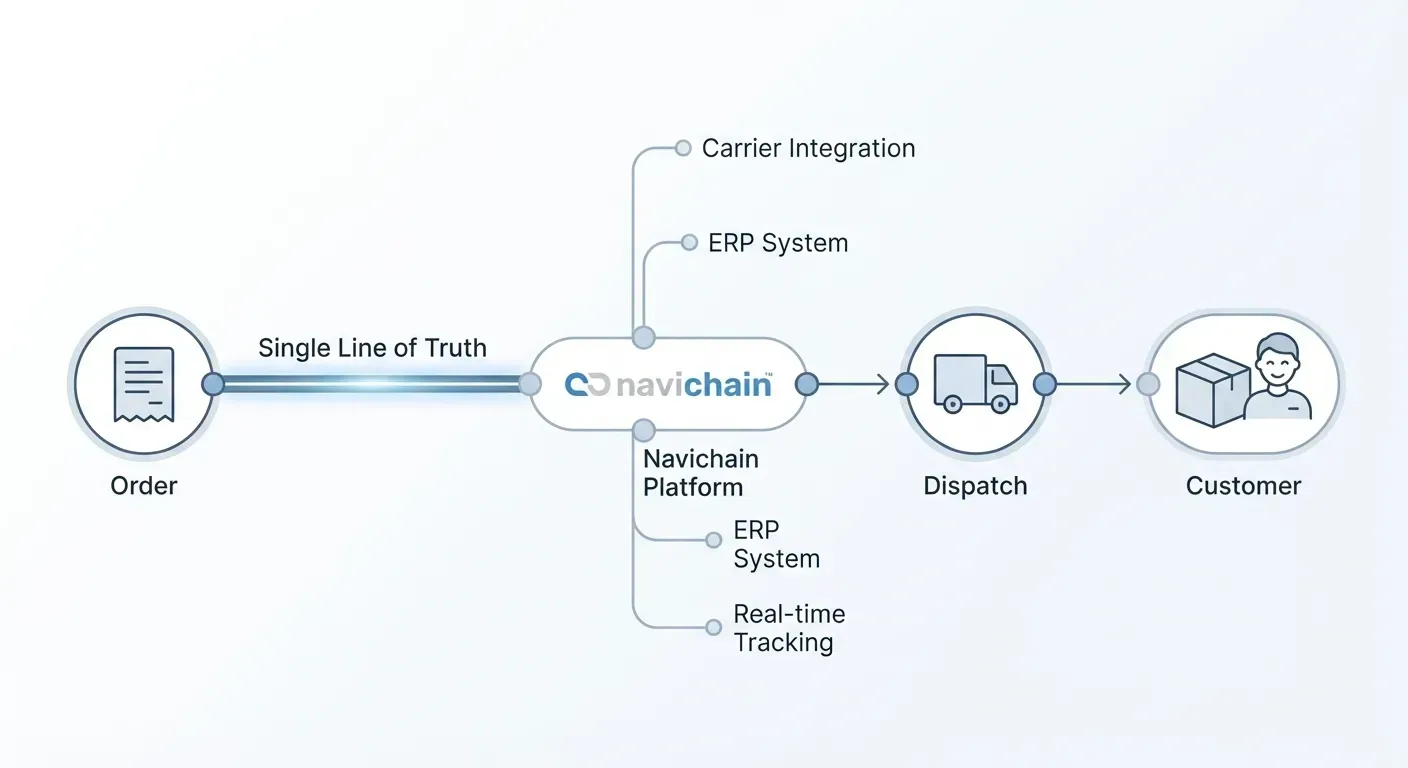
Navichain's visual representation highlights the interconnectedness and potential for enhanced transparency within SME supply chains.
Ready to optimise your supply chain?
navichain Insights Newsletter
Join the newsletter to receive the latest updates in your inbox.