The e-CMR Compliance Trap: Why Your Digital Strategy Is Increasing Your Data Risk
Table of Contents
The promise of e-CMR is undeniable, poised to unlock billions in savings for European SMEs. But in the dash to digitise logistics, are you unknowingly exposing sensitive client data to foreign legislation? Discover how a unified, self-hosted platform can deliver e-CMR compliance without compromising your data sovereignty.
The e-CMR Compliance Trap: Why Your Digital Strategy Is Increasing Your Data
The push for full e-CMR adoption is intensifying across Europe, promising to save SMEs billions in administrative costs. With over 30 countries having ratified the protocol, digital consignment is no longer an option but an operational imperative. However, this transition hides a critical strategic anomaly. In the rush to digitize, many SMEs are adopting platforms hosted by US-owned entities, unknowingly exposing their most sensitive client data to foreign legislation like the US CLOUD Act. This paper presents a strategic framework for adopting e-CMR that enhances rather than compromises data security. It argues that for European SMEs, digital compliance and data sovereignty are inseparable, requiring a new model based on a unified, Self-Hosted logistics platform.
The inevitable digital leap: E-cmr's unquestionable value
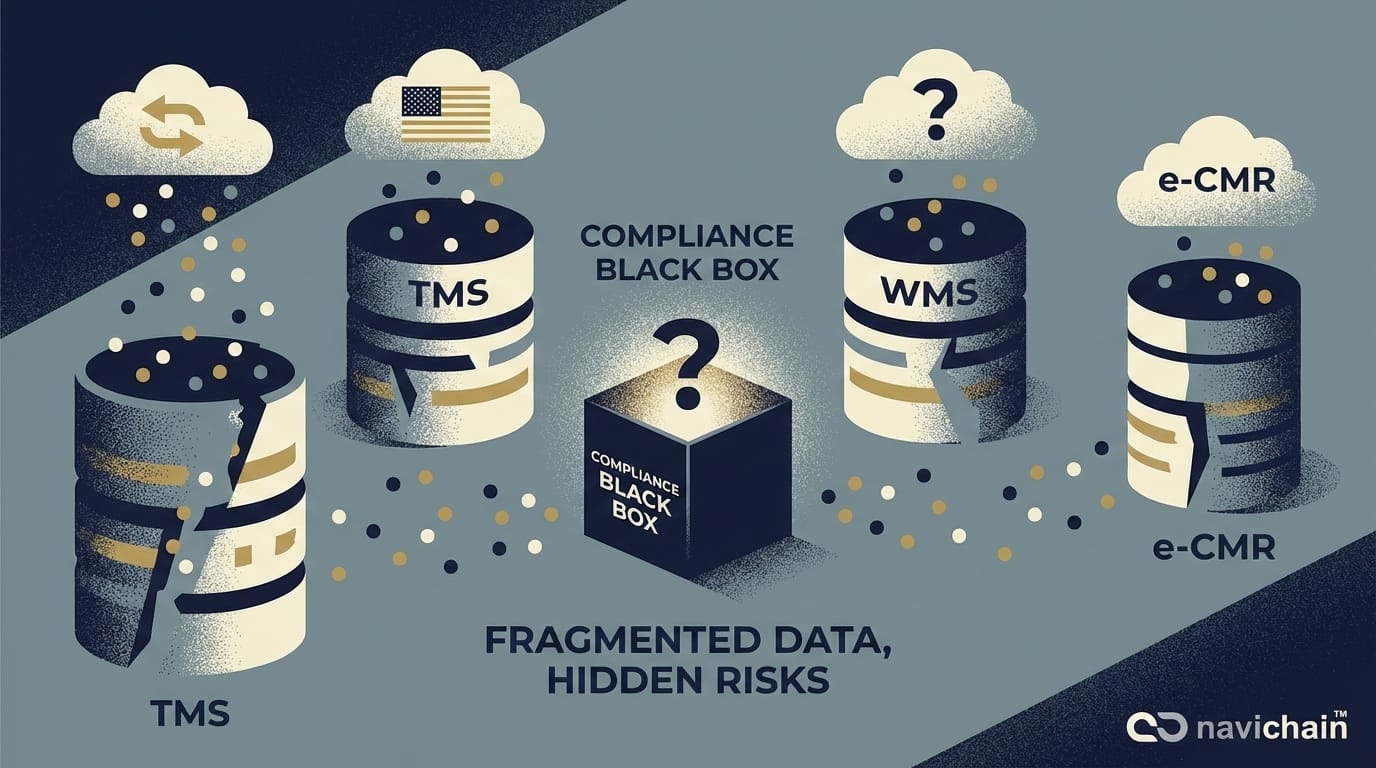
Fig 1: For decades, the physical CMR consignment note represented security but also inefficiency; e-CMR adoption addresses the latter, but can compromise the former if not implemented carefully.
For decades, the physical CMR (Convention relative au contrat de transport international de marchandises par route) consignment note has been the immutable, paper-based backbone of European road freight. It is a symbol of tangible, cross-border agreement, but also one of profound inefficiency. The associated costs of printing, distributing, archiving, and manually processing these multi-part forms are a significant operational drain on Small to Medium-sized Enterprises (SMEs) already battling thin margins. The introduction of the e-CMR protocol, which gives the digital consignment note the same legal standing as its paper counterpart, is arguably the most significant regulatory efficiency gain for the industry this century. The benefits are clear, quantifiable, and compelling: * Cost Reduction: Industry analysis, including data from the IRU (International Road Transport Union), suggests that processing an e-CMR is up to four times cheaper than a paper-based one. This translates to an estimated saving of over €4.5 per consignment.
- Administrative Acceleration: Digital transmission means instant access for all parties—sender, carrier, and consignee. This eliminates postal delays, reduces manual data entry errors, and accelerates the entire billing cycle. Cash flow, the lifeblood of the SME, is directly and positively impacted.
- Real-Time Transparency: A digital note enables real-time updates and proof of delivery (e-POD). This data can be fed directly into Transportation Management (TMS) and Warehouse Management (WMS) systems, providing a level of visibility that is impossible with paper. With over 34 countries, including the vast majority of the EU, having ratified the protocol, the transition is no longer a question of if but when. The EU's Electronic Freight Transport Information (eFTI) regulation further mandates that all member states must have the capacity to accept digital consignment notes. For a pragmatic Operations Director at a Scandinavian haulage company, the directive is simple: adopt e-CMR to stay competitive and compliant. But what if this straightforward decision to digitize compliance is a strategic Trojan horse?
The strategic anomaly: When compliance creates risk
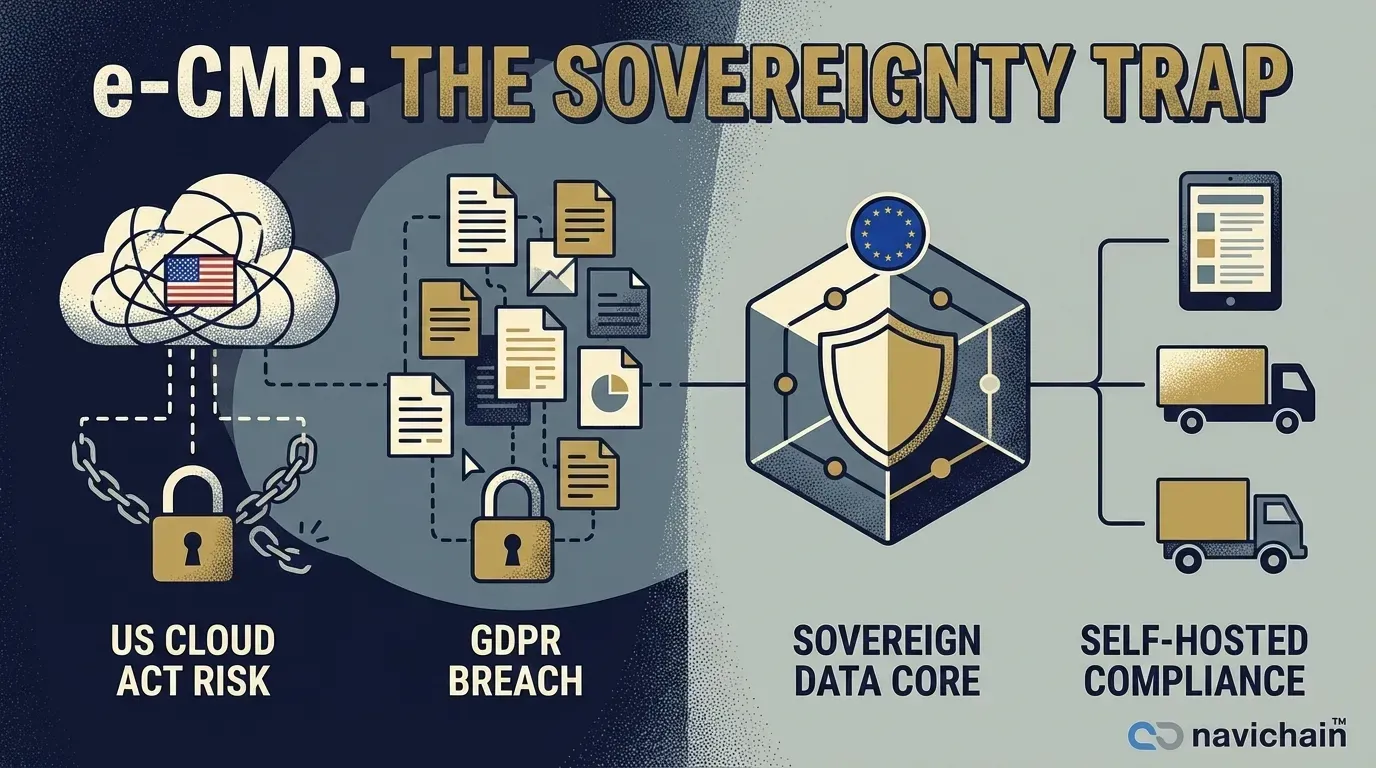
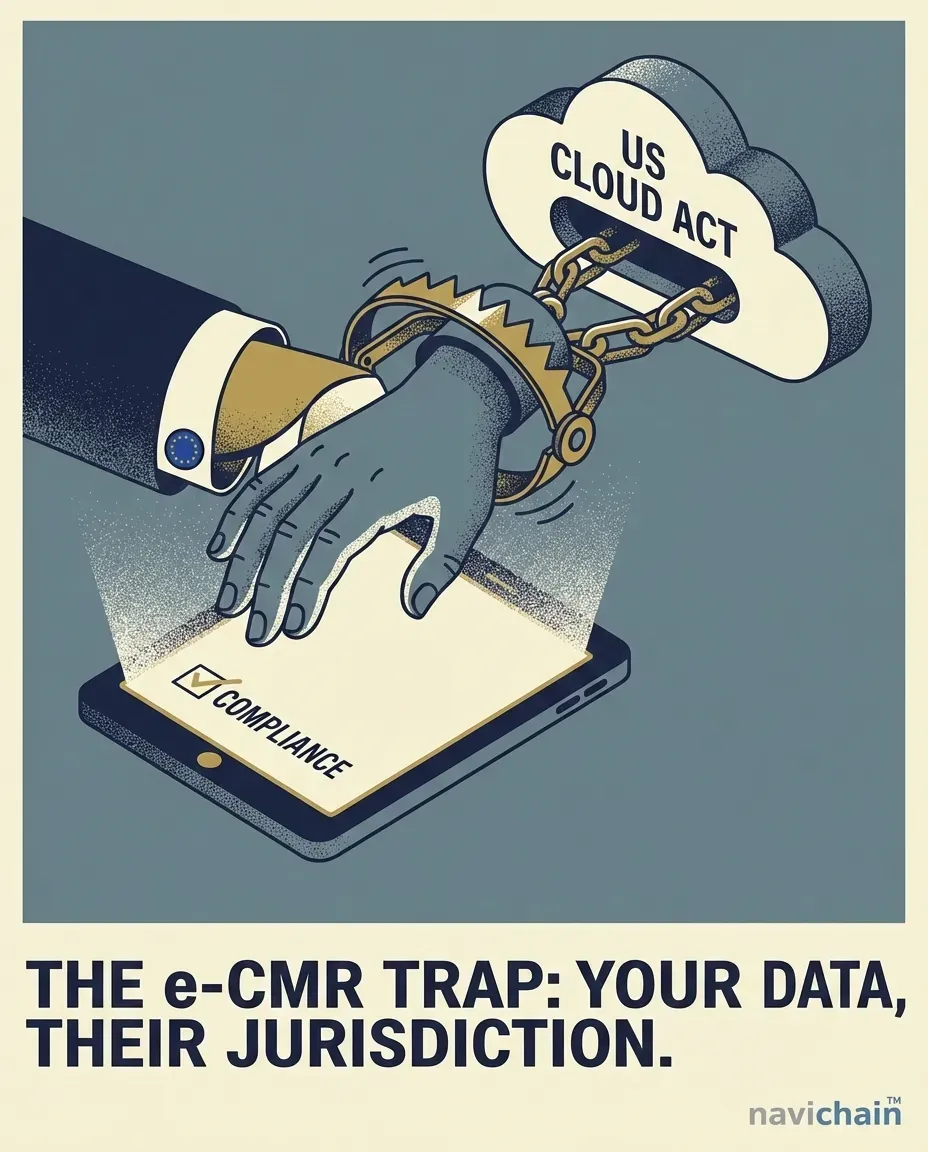
Fig 2: Here’s the critical conflict: 1. The central thesis of this paper is that for European SMEs, the urgent push to adopt e-CMR is a strategic trap. In solving the obvious challenge of paper, they are inadvertently creating a new, larger, and far more insidious one: the loss of data sovereignty over their core commercial and client data. This risk is not theoretical. It stems from a fundamental conflict between two powerful legal frameworks: the EU's General Data Protection Regulation (GDPR) and the US Clarifying Lawful Overseas Use of Data (CLOUD) Act.
Understanding the data in your e-cmr
Fig 1: It is a detailed legal and commercial document containing: This is highly sensitive, commercially valuable data.
First, we must be clear about what an e-CMR contains. It is not merely a delivery note. It is a detailed legal and commercial document containing: * The full names and addresses of the sender and consignee (your client list).
- A precise description of the goods being transported (your clients' products).
- The transport route and logistical details.
- Signatures and timestamps creating a legal chain of custody. This is highly sensitive, commercially valuable data. It is the blueprint of your business relationship with your clients. Under GDPR, much of this information is classified as personal data, and your company is the data controller or processor, legally responsible for its protection.

A visual representation of the data elements contained within an e-CMR, highlighting its sensitive legal and commercial nature.
The CLOUD Act: A long arm across the atlantic
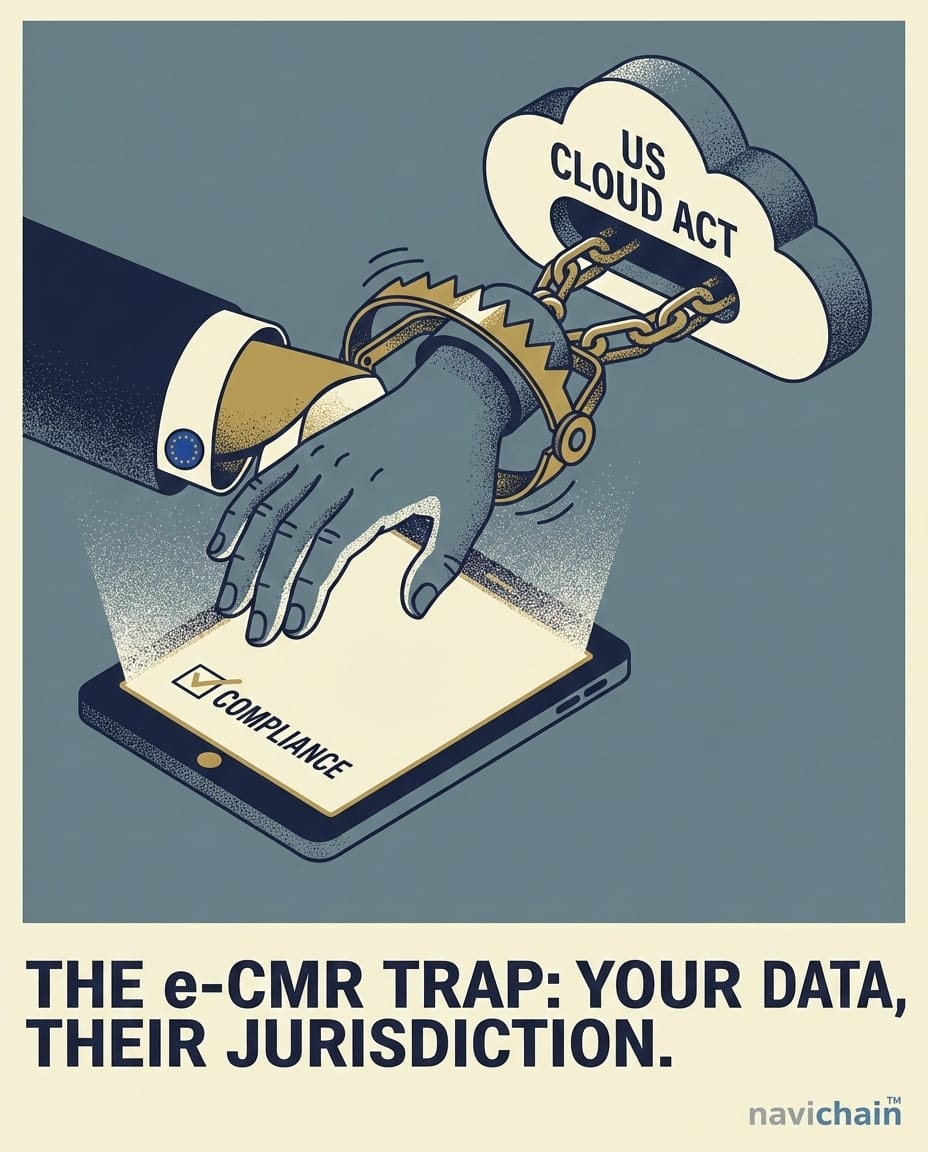
The problem arises when an SME, seeking a quick and often cheap e-CMR solution, signs up for a platform or software-as-a-service (SaaS) provider that is headquartered in the United States or uses US-owned cloud infrastructure (such as AWS, Google Cloud, or Microsoft Azure), even if the servers are physically located in Europe (e.g., in Dublin or Frankfurt). Here’s the critical conflict: 1. The US CLOUD Act (2018) gives US authorities the power to compel US-based technology companies to provide requested data stored on their servers, regardless of where in the world that data is physically located. 2. A US-based SaaS provider offering e-CMR services, even through a European subsidiary, is subject to this act. 3. This means that a US government agency could issue a warrant to your SaaS provider, demanding access to your—and your clients'—e-CMR data. Your provider would be legally obligated to comply, often without your knowledge or consent. This is not a hypothetical risk. The tensions surrounding transatlantic data flows led to the invalidation of the "Privacy Shield" data transfer agreement by the Court of Justice of the European Union (CJEU) in the Schrems II ruling. The court found that the surveillance powers of US law, including the CLOUD Act, do not provide adequate protection for EU citizens' data as required by GDPR.
The compliance paradox: Solving e-cmr, breaching GDPR
Fig 3: This creates a dangerous paradox for the European SME. This creates a dangerous paradox for the European SME. In an attempt to comply with the e-CMR protocol, you may be actively putting your company in breach of GDPR.
- GDPR (Article 44) strictly prohibits the transfer of personal data to a third country (like the US) unless that country ensures an "adequate level of protection."
- The Schrems II ruling effectively states that, due to laws like the CLOUD Act, the US does not provide this adequate protection.
- The Consequence: If your e-CMR data is hosted with a US-based provider, you are facilitating an unlawful data transfer. The potential fines for this breach are severe: up to 4% of your global annual turnover or €20 million, whichever is higher. Your seemingly simple choice of an e-CMR provider has suddenly become a multi-million-euro gamble. You have solved the paper problem but created a systemic, existential risk to your business. The very act of digital compliance has made you non-compliant on a much more serious scale. This risk is compounded by the fragmented nature of most SME technology stacks. Your e-CMR data may live in one system, your TMS in another, and your WMS in a third—all potentially on different cloud platforms with different legal jurisdictions. This creates a compliance "black box" where it is impossible to trace your data flow or guarantee its security.
The strategic imperative: Data sovereignty as the foundation
The only viable path forward is to redefine the goal. The objective is not simply "e-CMR compliance." The objective must be "sovereign digital compliance." Data Sovereignty is the principle that data is subject to the laws and governance structures within the nation or region where it is collected and processed. For a Swedish or European SME, this means your operational data—including every e-CMR, every transport order, and every warehouse record—must be stored and processed exclusively within the European Union, on infrastructure owned and operated by a European entity, shielding it from extraterritorial laws like the CLOUD Act. Choosing a platform based on data sovereignty is not a technical detail; it is the foundational strategic decision for any European logistics company in the digital age. It is the only way to simultaneously: 1. Achieve e-CMR Compliance: Digitize your consignment notes legally and efficiently. 2. Guarantee GDPR Compliance: Ensure your client and operational data never leaves the EU's legal jurisdiction, nullifying the Schrems II risk. 3. Protect Commercial Secrets: Safeguard your client lists and shipping data from foreign government and industrial espionage. This approach turns a regulatory burden into a competitive advantage. You can confidently assure your clients—many of whom are also struggling with GDPR compliance—that their data is secure with you, building a layer of trust that non-sovereign competitors cannot offer.
From diagnosis to design: The blueprint for a resilient logistics operating system
Fig 2: What is required is a holistic approach: a strategic blueprint for a modern logistics platform designed to solve these challenges from the ground up.
We have established that the digitization of compliance, specifically e-CMR, is fraught with hidden data sovereignty risks. The ad-hoc adoption of disparate, non-sovereign tools is no longer a viable strategy. What is required is a holistic approach: a strategic blueprint for a modern logistics platform designed to solve these challenges from the ground up. This blueprint is defined by three core principles that any effective, modern logistics platform for European SMEs must embody. These are the strategic imperatives for building a resilient, compliant, and competitive operation.
Principle 1: Unified operational fabric
The problem of data silos is a direct contributor to compliance risk. If your e-CMR system is a standalone application, it cannot effectively communicate with your core operations. This creates data fragmentation, manual re-entry, and a fractured audit trail. The first principle is the necessity of a single, integrated system where Transportation Management (TMS), Warehouse Management (WMS), Billing Management, and Order Management function as one cohesive unit. This "central nervous system" for your logistics operation ensures that an e-CMR is not just a digital document, but a live, integrated data point that automatically updates ETAs, triggers billing, and confirms inventory from a single source of truth.
Principle 2: Sovereign data architecture
This principle is the critical, non-negotiable foundation. To solve the compliance paradox, true operational resilience for European SMEs requires "data sovereignty." This is more than just selecting a server in an EU data center. It means your operational data must be stored and processed on Self-Hosted infrastructure that is owned, operated, and legally domiciled within your own region's jurisdiction (e.g., within Sweden or the EU). This architecture must guarantee that your data is fully compliant with GDPR and, crucially, is legally shielded from extraterritorial laws like the US CLOUD Act. This is the only way to ensure your client lists and consignment data remain your own.
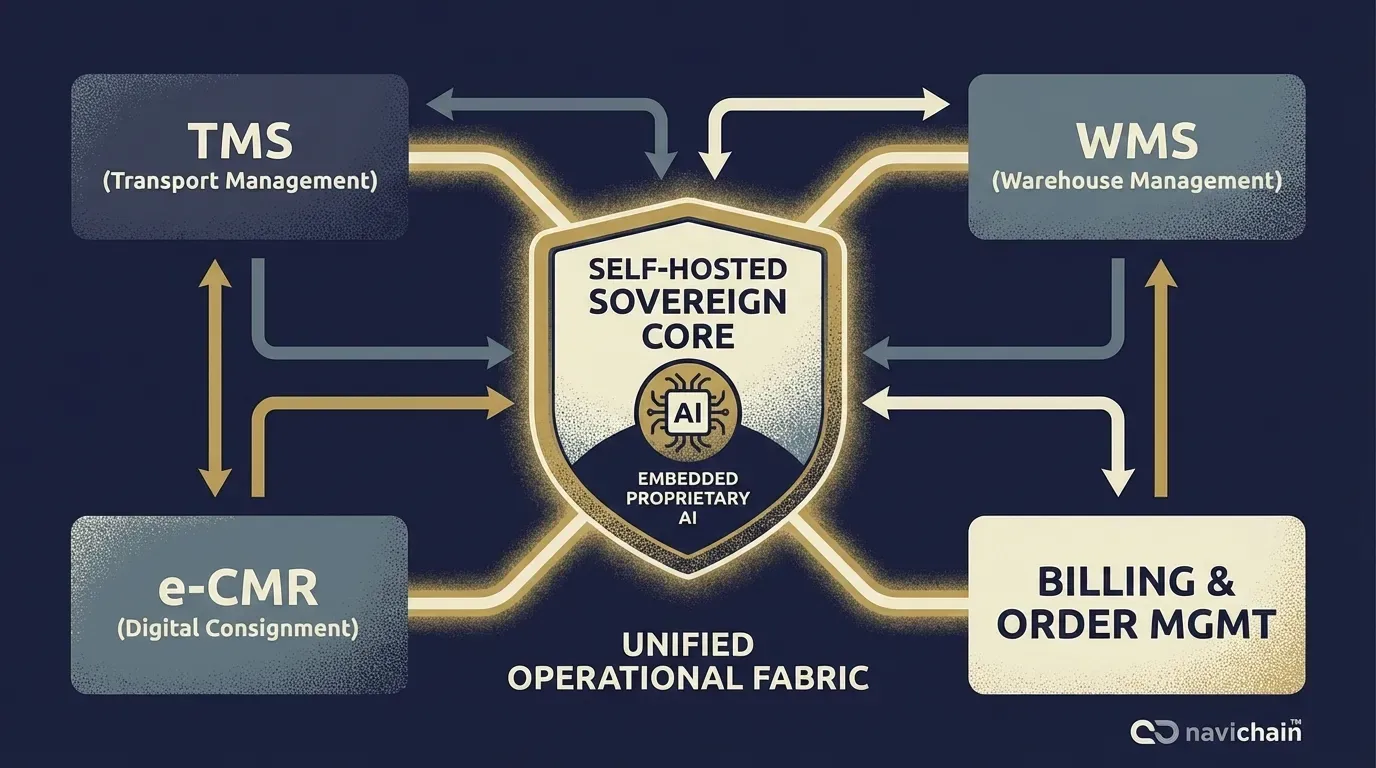
Schematic illustrating the interconnectedness of TMS, WMS, Billing, and Order Management within a unified, sovereign logistics platform.
Principle 3: Embedded analytic intelligence
Once you have a unified operational fabric (Principle 1) built on a secure, sovereign foundation (Principle 2), you unlock the true promise of digitization. The third principle is the necessity of an embedded intelligence or Integrated AI layer that can analyze this unified, secure data. With the rise of e-CMR, you are no longer just collecting documents; you are collecting structured data. An embedded AI can analyze this data in real-time—within the secure sovereign environment—to optimize routes, predict maintenance, identify anomalies in billing, and uncover efficiencies that are invisible when data is trapped in silos. This is how you move from basic compliance to data-driven strategic advantage.
Fig 3: Once you have a unified operational fabric (Principle 1) built on a secure, sovereign foundation (Principle 2), you unlock the true promise of digitization.
References/sources
- International Road Transport Union (IRU). (2024). e-CMR. Retrieved from https://www.iru.org/what-we-do/facilitating-trade-and-transit/e-cmr (Provides current status, benefits, and ratification list for the e-CMR protocol.)
- EUR-Lex. (2020). Regulation (EU) 2020/1056 on electronic freight transport information (eFTI). Retrieved from https://eur-lex.europa.eu/legal-content/EN/TXT/?uri=CELEX:32020R1056 (The EU regulation mandating the acceptance of electronic transport documents, including e-CMR.)
- Court of Justice of the European Union. (2020). Judgment in Case C-311/18 (Schrems II). Retrieved from https://curia.europa.eu/jcms/upload/docs/application/pdf/2020-07/cp200091en.pdf (The landmark ruling invalidating the EU-US Privacy Shield and highlighting the risks of US surveillance laws.)
- US Department of Justice. (2018). The CLOUD Act. Retrieved from https://www.justice.gov/opa/press-release/file/1046331/download (Official text and explanation of the Clarifying Lawful Overseas Use of Data Act.)
- European Data Protection Board (EDPB). (2020). Frequently Asked Questions on the judgment of the CJEU in Case C-311/18 - Data Protection Commissioner v Facebook Ireland Ltd and Maximillian Schrems. Retrieved from https://edpb.europa.eu/our-work-tools/our-documents/other/frequently-asked-questions-judgment-court-justice-european-union_en (Provides official guidance on the implications of the Schrems II ruling for data transfers.) Fig 4: We have established that the digitization of compliance, specifically e-CMR, is fraught with hidden data sovereignty risks.
Enabling the blueprint: The navichain SaaS unified logistics platform
Fig 4: The navichain SaaS platform is designed from the ground up to be the concrete realization of this exact framework.
This white paper has outlined a strategic blueprint for achieving sovereign digital compliance, built on the principles of a Unified Operational Fabric, Sovereign Data Architecture, and Embedded Analytic Intelligence. The navichain SaaS platform is designed from the ground up to be the concrete realization of this exact framework. We directly embody the principles required for European SMEs to thrive securely in the digital age: * For 'Unified Operational Fabric': navichain SaaS is not a collection of separate modules. It is a single, unified logistics operating system that natively integrates Transportation Management (TMS), Warehouse Management (WMS), Asset Management, Billing, and Order Management. Your e-CMR data flows seamlessly from creation to billing, creating the single source of truth described in Principle 1.
- For 'Sovereign Data Architecture': This is our core differentiator. The entire navichain SaaS platform is Self-Hosted on our own infrastructure in Sweden. Your data stays in Sweden, under Swedish and EU jurisdiction. This guarantees full GDPR compliance and, critically, provides complete immunity from the reach of foreign legislation like the US CLOUD Act. This is the non-negotiable foundation of trust and risk management from Principle 2.
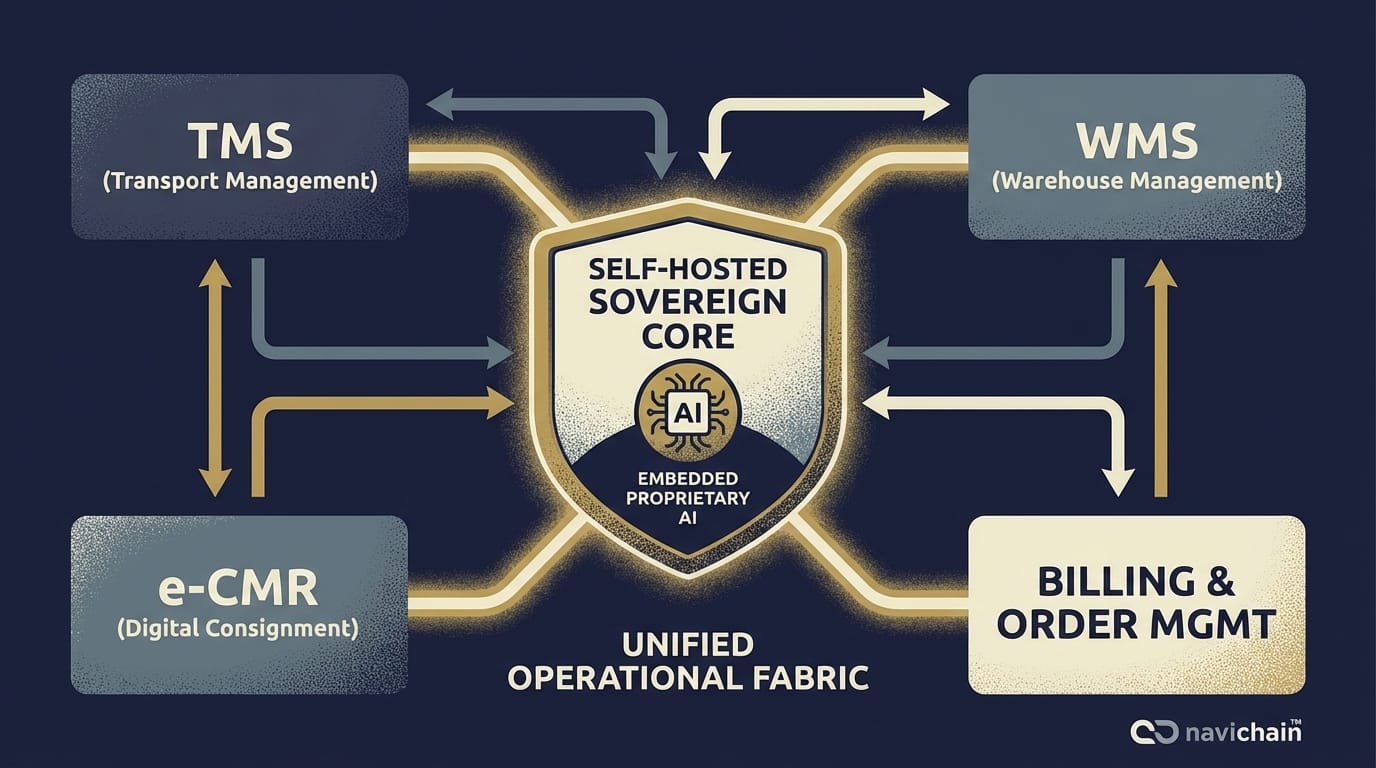
The navichain SaaS platform empowers businesses to realize the strategic blueprint for sovereign digital compliance, integrating key operational elements for enhanced data control and security.
- For 'Embedded Analytic Intelligence': Our platform features a integrated AI that runs on our own secure Swedish infrastructure. This allows you to perform deep, secure data analysis on your unified operational data—including your e-CMR records—to unlock unique efficiencies, optimize operations, and make smarter decisions, all without your data ever leaving its sovereign, protected environment. Our mission is to democratize logistics technology for SMEs. We believe you shouldn't have to choose between digital efficiency and data security. The navichain SaaS platform empowers you to achieve both, turning regulatory compliance from a strategic risk into your greatest competitive advantage.
The navichain SaaS platform provides a unified, sovereign, and intelligent logistics operating system, ensuring data security and regulatory compliance for European SMEs.
The navichain platform provides a holistic view of your logistics operations, facilitating secure, compliant, and efficient data management for European SMEs.
Ready to optimise your supply chain?
navichain Insights Newsletter
Join the newsletter to receive the latest updates in your inbox.