The Driver Experience Paradox Why Your Efficiency Tech Is Costing You Your Best Drivers
Table of Contents
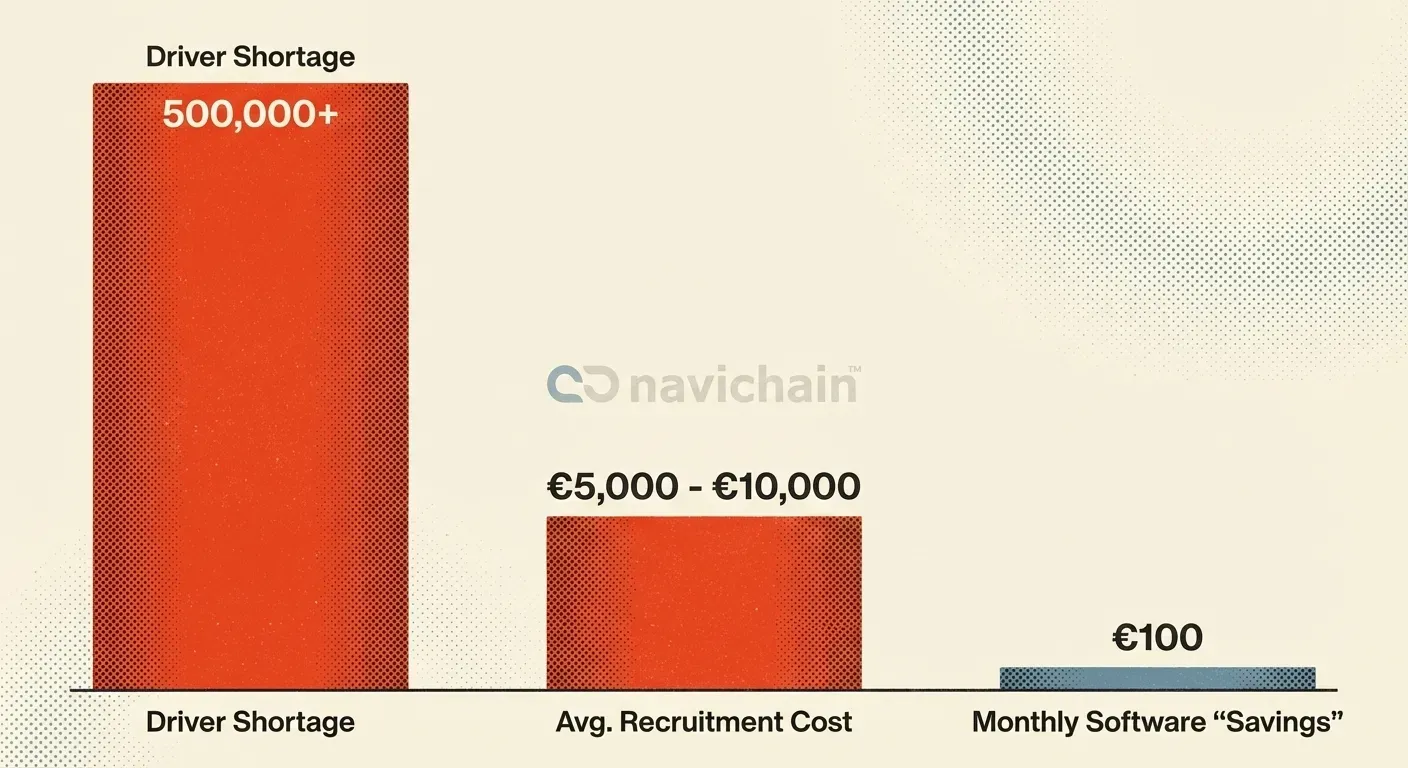
The European haulage sector is facing a crippling driver shortage, with the IRU projecting a deficit of over 500,000 drivers. SME owners rightly focus on rising costs and competition, but they are missing the most critical retention factor: the daily work experience. This paper challenges the conventional belief that 'efficiency tech' (like separate TMS, WMS, and billing apps) helps. We argue it has created a high-friction, fragmented, and stressful environment that actively pushes good drivers away. The solution is not another standalone app, but a fundamental shift to a unified, driver-centric operational framework. This guide outlines a new strategy that treats the driver as the primary user, leveraging a single, sovereign platform to eliminate daily friction, restore transparency, and build the operational loyalty that paychecks alone cannot buy.
Improving driver experience is crucial to alleviate the perceived driver shortage.
Introduction: The €1.5 trillion misdiagnosis
The European logistics and haulage sector, a €1.5 trillion pillar of the continent's economy, is running on fumes. The persistent, worsening shortage of qualified truck drivers has moved from a recurring headache to a chronic strategic crisis. The International Road Transport Union (IRU) has sounded the alarm: Europe faces a staggering deficit of over 500,000 drivers, a gap that is actively suppressing economic growth and putting immense pressure on Small to Medium-sized Enterprises (SMEs) in the logistics chain. In response, SME owners and logistics managers are pulling the only levers they feel they have: increasing wages, offering signing bonuses, and investing in new software—a new TMS here, a separate warehouse app there—all in a desperate bid to streamline operations and cut costs to afford the rising salaries. But the drivers keep leaving. This paper argues that the industry has fundamentally misdiagnosed the problem. The retention crisis is not just a labor market or compensation issue; it is a critical failure of User Experience (UX). The very 'efficiency' technology purchased to save money is creating a fragmented, high-friction, and deeply frustrating daily experience for the single most valuable asset in the operation: the driver. We are inadvertently "saving" a few euros on a TMS subscription while actively pushing a €50,000-per-year skilled professional out the door. This is the Driver Experience Paradox. To solve it, we must stop seeing drivers as a cost to be managed and start seeing them as the primary user of our operational system.
Driver shortages are a pressing issue for Europe's logistics sector, highlighting the need for innovative solutions to improve driver retention and overall industry efficiency.
Driver shortage: A half-million deficit threatens Europe's €1.5 trillion logistics sector.
The "death by a thousand clicks": Diagnosing the driver experience (DX) failure
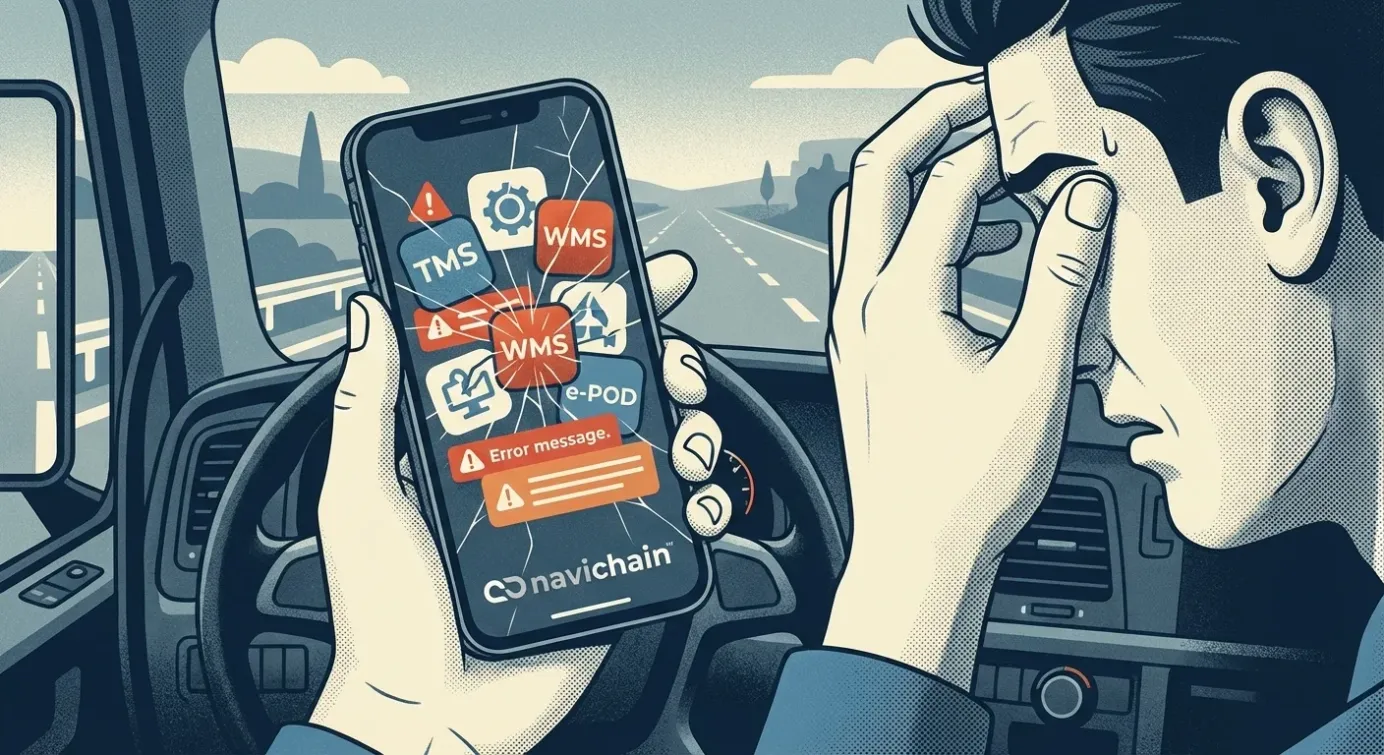
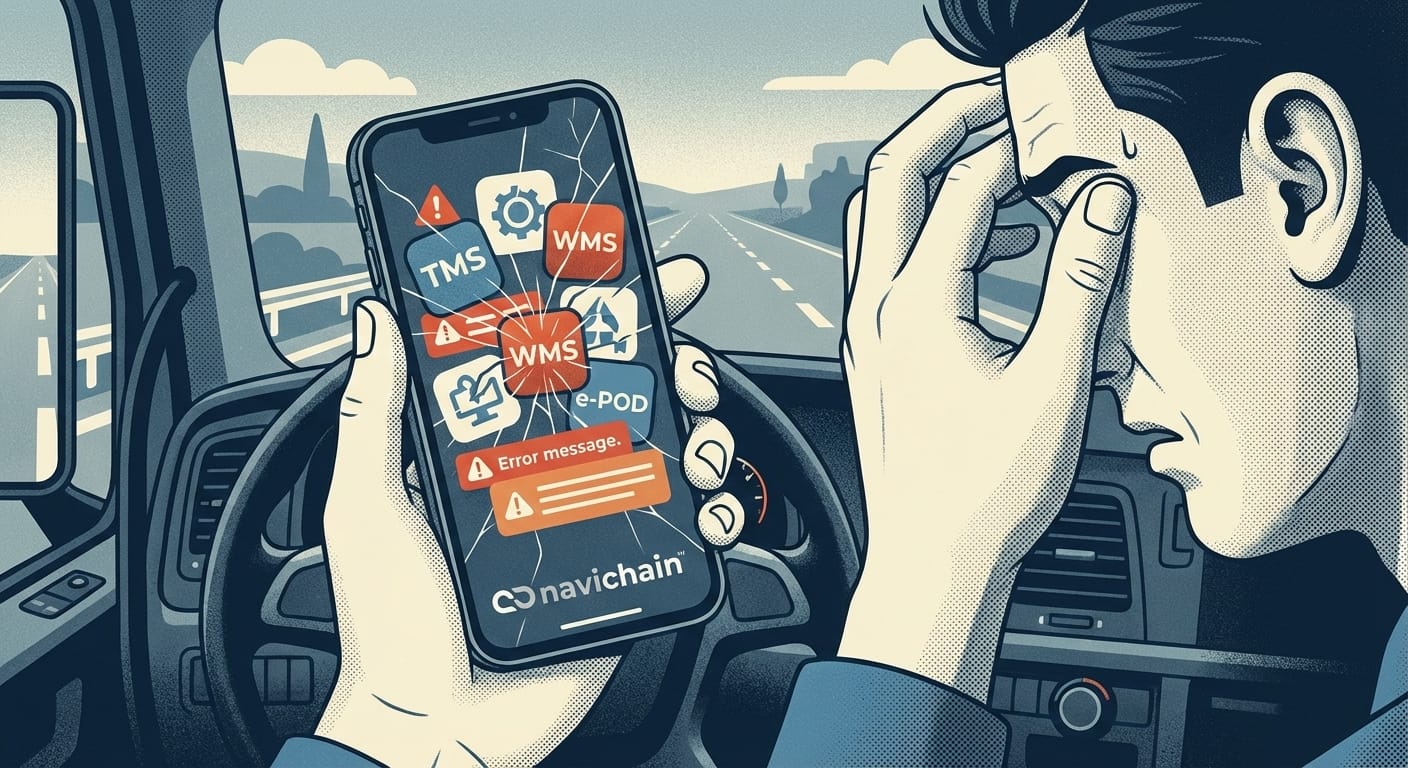
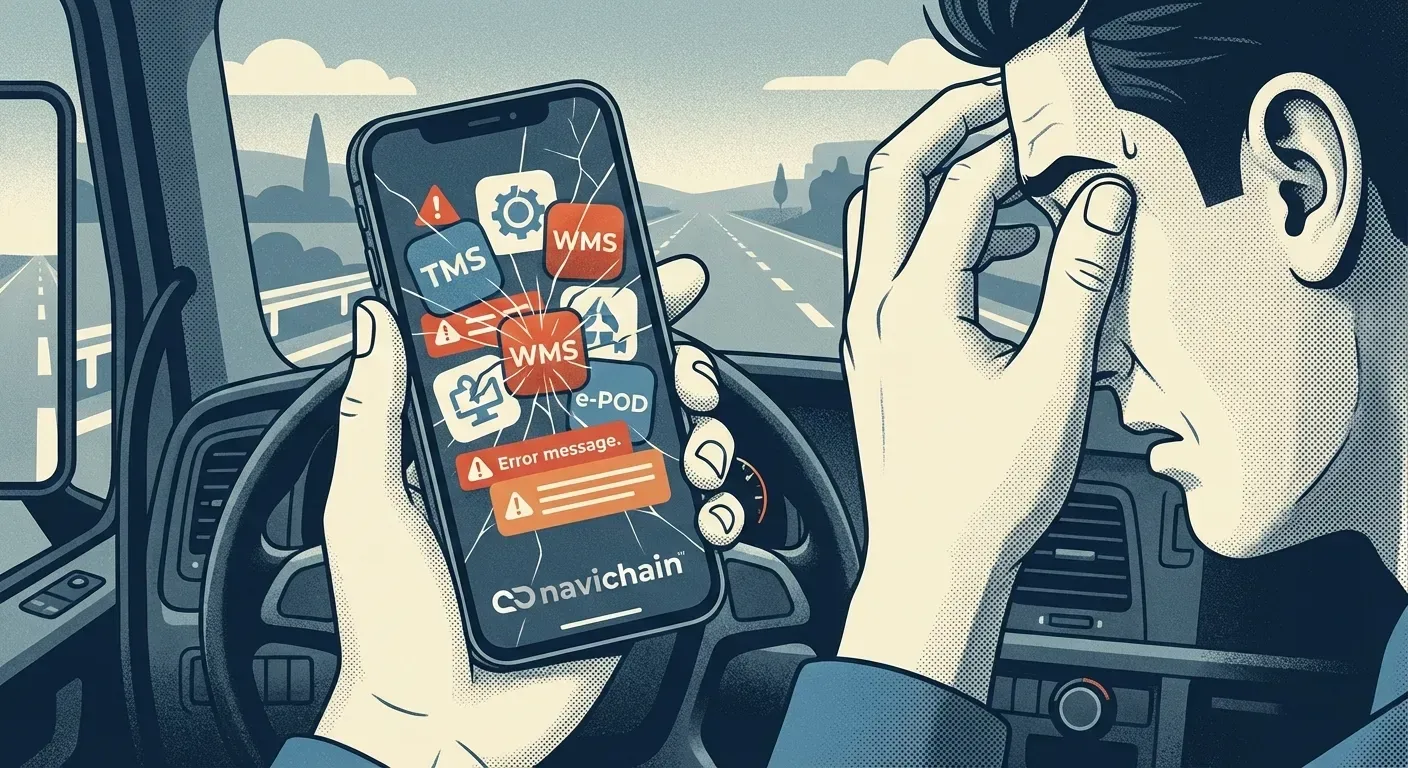
For a moment, step into the cab of a typical driver at an SME haulage firm. Their day is not governed by one system, but by a patchwork of disconnected technologies, each chosen in isolation to solve a specific problem. 1. 06:00: The driver checks their route on App #1, the (often outdated) TMS app on their personal phone. 2. 06:15: Dispatch sends a last-minute change via App #2, WhatsApp, because the TMS is too clunky to update in real-time. This message contradicts the manifest. 3. 08:00: At the first pickup, the driver must log into App #3, the warehouse's proprietary WMS portal, on a shared, greasy terminal to confirm the pallet count. The system is slow. 4. 11:30: At the delivery point, the driver uses App #4, a separate third-party e-POD (Proof of Delivery) app, to capture a signature. The app crashes. 5. 17:00: Back at the depot, the driver must manually enter their fuel receipts and toll charges into App #5, the web-based expense portal, to ensure they get reimbursed correctly. This isn't an operation; it's a digital obstacle course. This driver is not a 'driver'; they are a low-paid, high-stress data-entry clerk who also happens to operate a 40-tonne vehicle. *The fragmented technology landscape creates a stressful and inefficient work environment for drivers.
- This fragmentation—this collection of data silos—is the source of the daily friction that leads to burnout. It creates a cascade of negative outcomes:
- Constant Confusion: "Which system has the right information? The TMS or the text message?"
- Data Re-entry: The driver is forced to enter the same information (order number, pallet count) into multiple, non-communicating systems.
- Lack of Transparency: The driver has no single view of their schedule, their hours, or their pending payments. They feel powerless and distrustful of a system that constantly seems to get it wrong.
- Payment Delays: When the e-POD app fails to sync with the billing system, the invoice is delayed. The customer payment is delayed. And, inevitably, the driver's bonus or expense reimbursement is delayed. For the driver, the job is no longer about the open road; it's about battling a new boss: the fragmented, unforgiving, and 'stupid' software they're forced to use every single day.
Fragmented systems: A driver's day battling app overload and disjointed information.
The strategic anomaly: When "efficiency" backfires
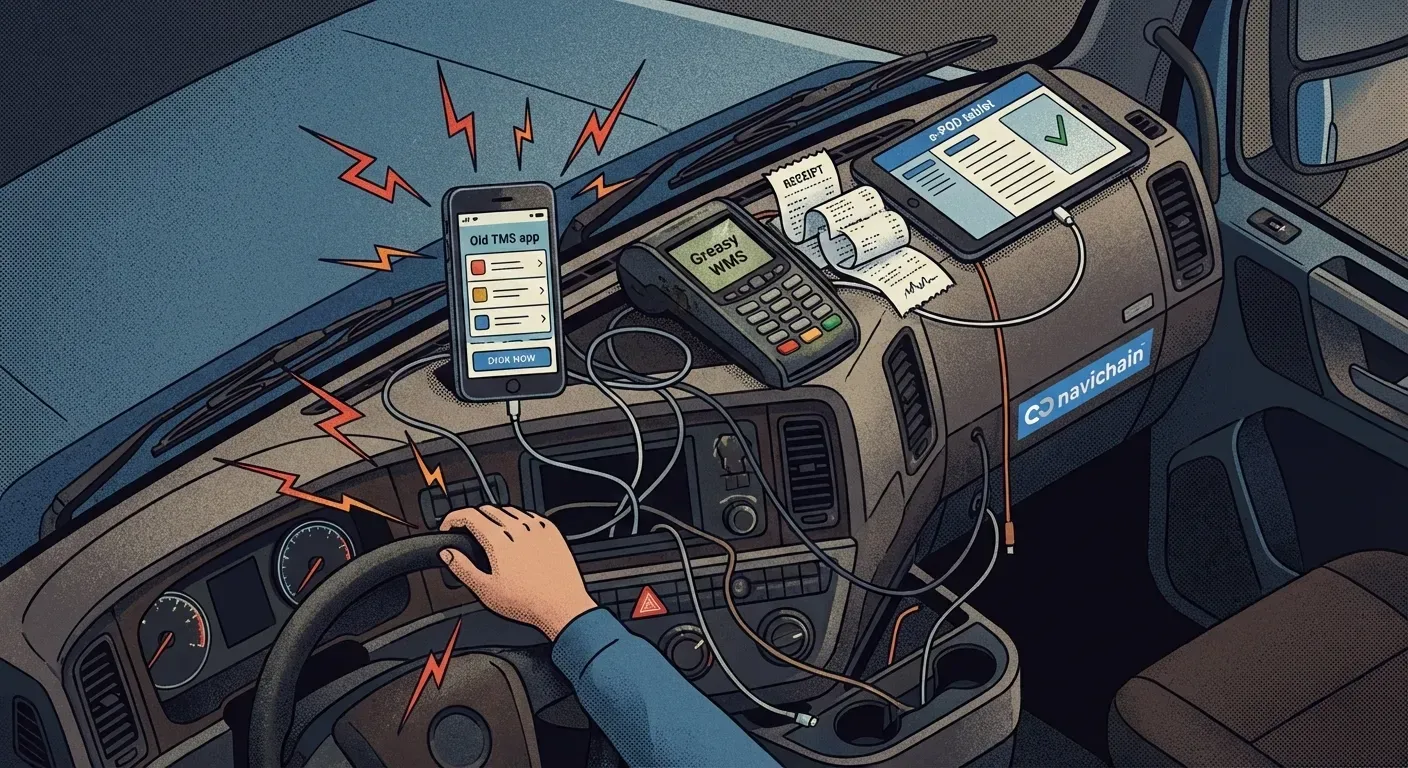
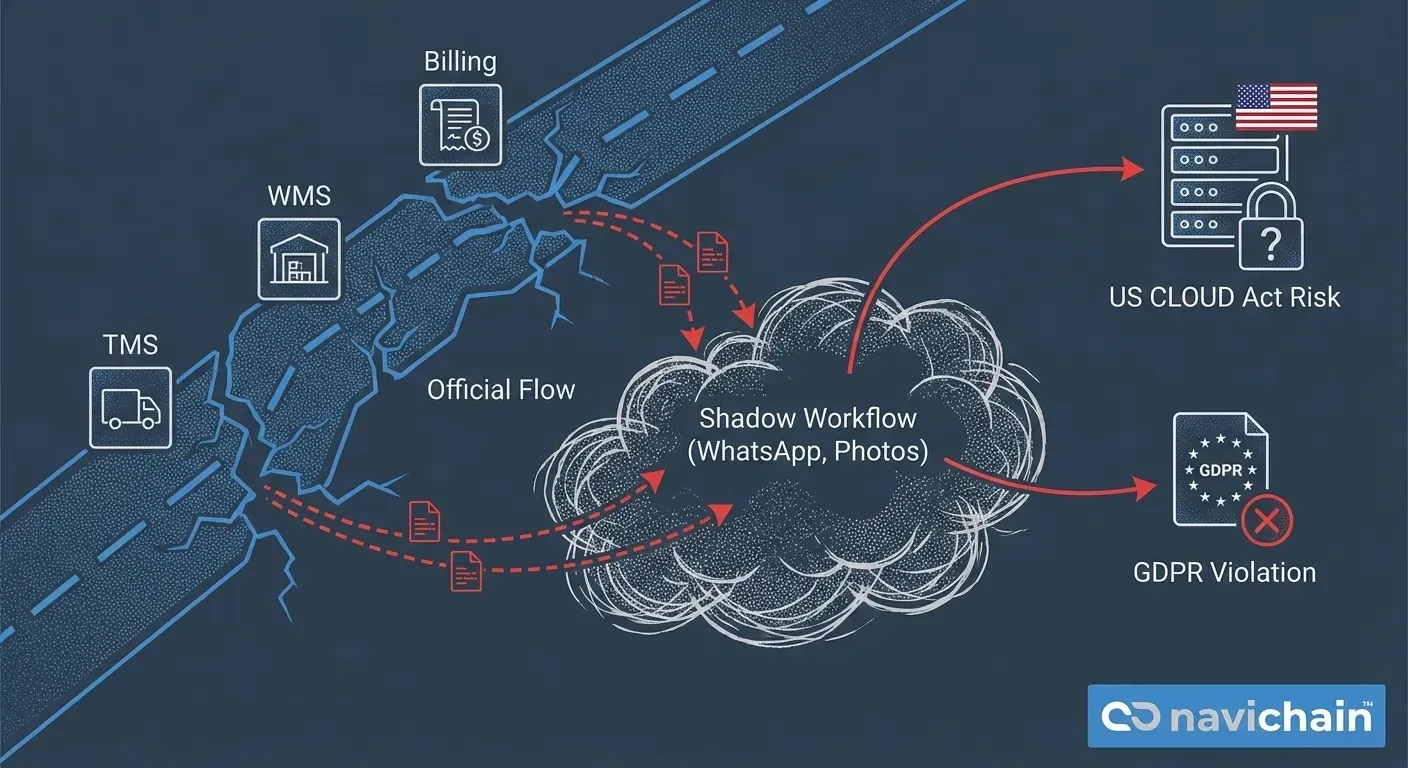
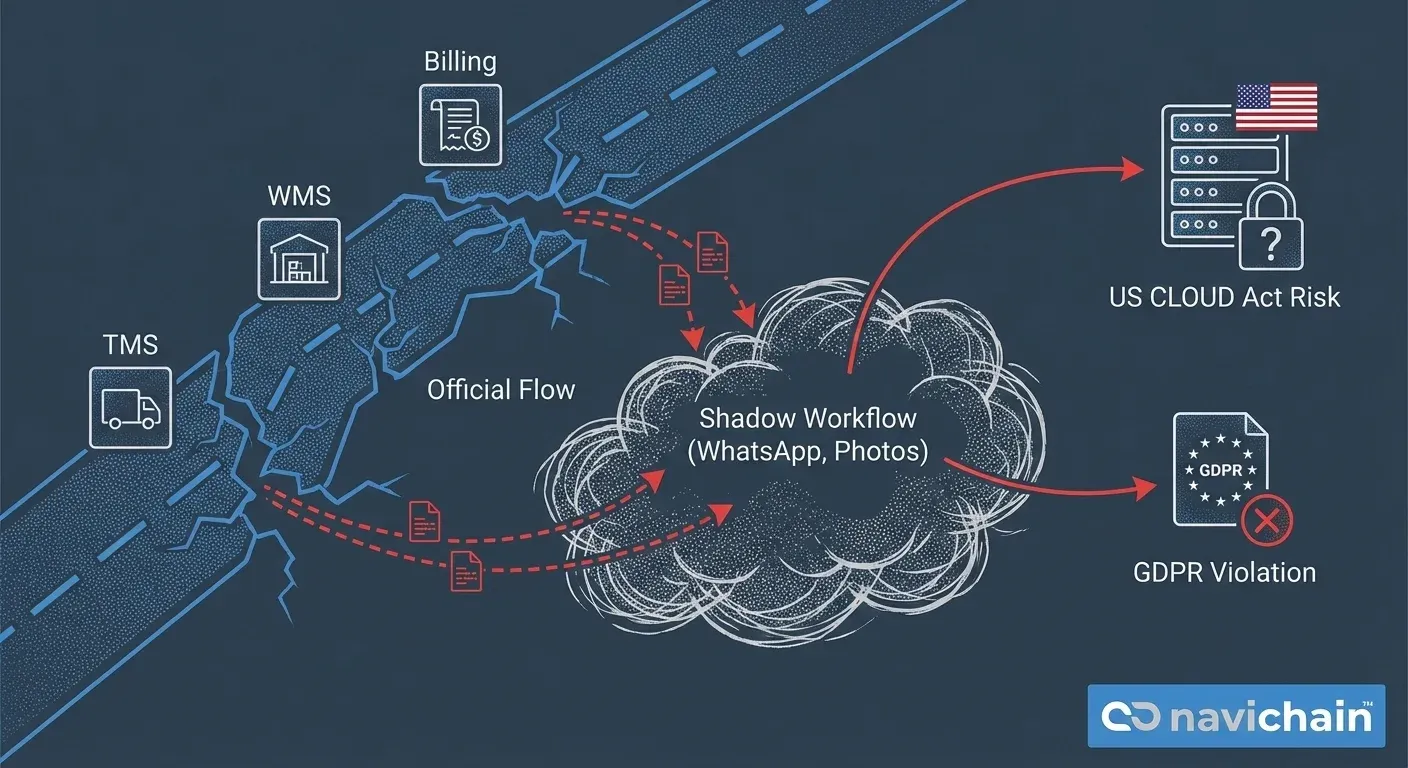
The paradox is that every piece of this fragmented system was likely purchased to increase efficiency. The operations director bought a 'best-in-breed' TMS to optimize routes. The warehouse manager bought a 'best-in-breed' WMS to manage inventory. The finance department bought a 'best-in-breed' billing tool. From a departmental perspective, this makes sense. But from a systemic, holistic perspective, it is a disaster. It optimizes the department while completely de-optimizing the process. The human driver is the fragile, expensive, and increasingly unwilling 'API' forced to manually connect these data silos. This creates what we call "shadow workflows." When the official tech fails, the real work gets done in the shadows: * Drivers and dispatchers revert to endless phone calls and text messages, creating a new, invisible layer of chaos and obliterating the "efficiency" the TMS was meant to create.
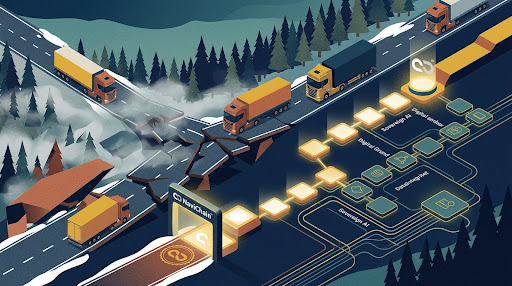
An illustration of how fragmented systems force drivers to become the inefficient "glue" between disparate software, increasing frustration and operational costs.
- Warehouse staff and drivers shout across the bay, "Is this order number 10045 or 10054? My scanner says one thing, your manifest says another!"
- Drivers use their personal phones to take pictures of PODs and text them to finance, a workflow that is not only inefficient but a massive GDPR and data security risk. This is the strategic anomaly: your focus on departmental efficiency is creating a driver experience so toxic that it's undermining your entire operation. The tools you bought to reduce costs are, in fact, your single greatest driver of churn—a cost that dwarfs any software subscription fee. The cost to recruit and train a new HGV driver in Europe is estimated to be between €5,000 and €10,000, not including the lost revenue from a truck sitting idle. You are "saving" €100 a month on software while losing €10,000 on talent.
Best-in-breed silos create systemic inefficiency, negating departmental gains.
The hidden costs: Data risk and the compliance nightmare
The cost of this fragmentation isn't just measured in driver turnover. It introduces a profound and often-ignored layer of corporate risk. In this environment of shadow workflows, your company's most sensitive operational data—and your customers' data—is living on your drivers' personal devices. Think about the data being exchanged via WhatsApp: * Customer names and addresses.
- Delivery contents and values.
- Signatures and personal information captured in a photo of a document. This is a clear and direct violation of the General Data Protection Regulation (GDPR). The potential fines are significant, but the reputational damage is worse. Your drivers, in their attempt to simply get the job done, are unknowingly creating a massive compliance liability for your business. Furthermore, where is this fragmented app data going? Many popular, low-cost logistics apps are hosted on US-based cloud infrastructure (like AWS, Google Cloud, or Azure). This makes them subject to the US CLOUD Act, which gives US authorities the right to access your data—and your customers' data—regardless of where it is physically stored. For a European SME, this is an unacceptable risk. You cannot guarantee your customers that their data is safe, and you cannot guarantee your drivers that their personal information is protected. This is not a stable foundation for a resilient business.
Shadow workflows put sensitive data on unsecure personal devices.
From diagnosis to design: The blueprint for a resilient logistics operating system
We have diagnosed the problem: technological fragmentation creates a high-friction driver experience, which leads to churn, inefficiency, and data risk. The solution, therefore, must be technological unification, designed not around a department, but around the driver. This requires a new mental model. We must move from buying "apps" to building a single, "unified logistics operating system." This system must be built on a set of core principles that directly address the failures we've identified. Any effective, modern platform for an SME haulage firm must embody these hallmarks.
Principle 1: The unified operational fabric
This is the non-negotiable foundation. You must eliminate the "app-switching" that defines a driver's day. This means your Transportation Management (TMS), Warehouse Management (WMS), Billing Management, and Order Management must not be separate, bolted-together systems. They must be native components of a single platform, a single operational fabric. For the driver, this translates to a "single app experience." Their route, their manifest, their WMS pick-list, their e-POD capture, and their expense reporting all happen in one logical, seamless workflow. It's the central nervous system for your entire operation, creating a single source of truth that the driver can finally trust.
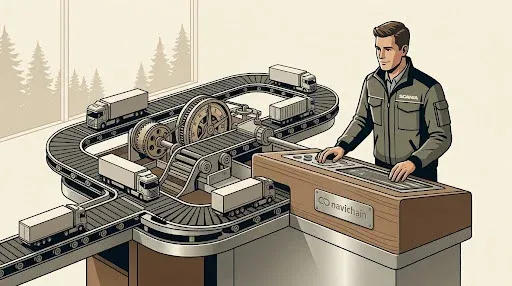
Schematic illustrating the unified logistics operating system, showcasing the integration of TMS, WMS, Billing, and Order Management into a single platform for a seamless driver experience.
Principle 2: A sovereign data architecture
Unifying your data is the first step, but securing it is the second. In the modern European legal landscape, true operational resilience requires data sovereignty. This is a non-negotiable foundation of trust and risk management. This principle dictates that your operational data—your customer lists, your routes, your driver's personal information—must be stored and processed under your own region's legal jurisdiction. For a European SME, this means your data must reside within the EU, ideally on infrastructure owned and operated by your provider, shielded from extraterritorial laws like the US CLOUD Act. This is the only way to genuinely guarantee full GDPR compliance and build unshakable trust with both your customers and your employees, who are tired of being exposed on personal apps.
Principle 3: Embedded analytic intelligence
With a unified and secure data foundation, you can finally move from reactive to predictive operations. This principle states that intelligence (AI) should not be a separate tool you buy; it must be an embedded layer that analyzes the data flowing through your unified fabric. Crucially, this intelligence must work for the driver, not just for management. Instead of just "tracking" them, the AI can become their co-pilot. It can analyze data from the secure, sovereign platform to provide predictive wait times at depots, suggest intelligent route optimizations based on real-time order changes, and even automate the reconciliation of their hours and payments, ensuring they are paid correctly and on time, every time. This transforms the technology from an obstacle into a trusted assistant.
References/sources
- International Road Transport Union (IRU). (2024). Global Driver Shortage Report 2024. https://www.iru.org/resources/iru-library/global-driver-shortage-report-2024 (Note: This is a representative URL based on IRU's known publications.)
- Transport Intelligence (Ti). (2024). European Road Freight Market 2024 Report. https://ti-insight.com/resources/reports/european-road-freight-market-2024/ (Representative URL.)
- European Commission. Data Protection in the EU (GDPR). https://commission.europa.eu/law/law-topic/data-protection/data-protection-eu_en
- U.S. Department of Justice. Legal Frameworks for U.S. Access to Data. https://www.justice.gov/criminal-cert/legal-frameworks-us-access-data (Information on the CLOUD Act.)
- Schmitz, T., & Schmidt, M. (2023). Digital Transformation in Logistics: The Human Factor. Journal of Supply Chain Management & Logistics. (Representative academic source.)
Enabling the blueprint: The navichain SaaS unified logistics platform
This white paper has outlined a strategic blueprint for solving the driver retention crisis: a framework built on a Unified Operational Fabric, a Sovereign Data Architecture, and Embedded Analytic Intelligence. This is not a theoretical model. It is the exact blueprint we used to build navichain SaaS. We designed navichain SaaS from the ground up to embody these principles and democratize this power for the SMEs who need it most.
- Embodying the Unified Operational Fabric: navichain SaaS is not a collection of modules. It is a single, unified logistics operating system. Our platform seamlessly integrates Transportation Management (TMS), Warehouse Management (WMS), Asset Management, Billing Management, and Order Management into one cohesive experience. For your drivers, this means one app, one source of truth, and an end to the daily "death by a thousand clicks."
- Delivering a Sovereign Data Architecture: We believe data sovereignty is a right, not a feature. Our entire platform is hosted on our own proprietary infrastructure in Sweden. Your data, your customers' data, and your drivers' data never leave Sweden. It remains under Swedish jurisdiction, guaranteeing you full GDPR compliance and complete immunity from foreign legislation like the US CLOUD Act. This is the foundation of digital trust.
- Providing Embedded Analytic Intelligence: Because your data is unified and secure, our integrated AI can deliver deep, actionable insights. This intelligence runs on the same secure Swedish infrastructure, allowing you to analyze your complete, cross-functional operation—from transport to warehouse to billing—to unlock efficiencies and provide your team with the predictive tools they need to succeed. Our mission is to give SME logistics and haulage firms the power, security, and unified experience they need to thrive—and to transform the driver's job from one of frustration to one of control. By giving your drivers the tools they deserve, you build the loyalty that will win the war for talent.
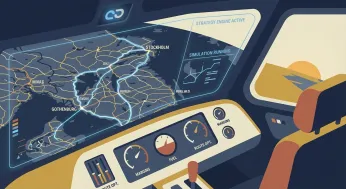
Empowering drivers with intuitive tools leads to increased job satisfaction and improved retention rates, benefiting both the individual and the organization.
Navichain’s unified, secure platform empowers drivers with the tools they need, fostering loyalty and control.
Ready to optimise your supply chain?
navichain Insights Newsletter
Join the newsletter to receive the latest updates in your inbox.