The ''Best-of-Breed'' Trap: Why Disconnected Systems Are Draining Profit from
Table of Contents
The ''''Best-of-Breed'''' Trap: Why Disconnected Systems Are Draining Profit
Introduction: The high cost of financial friction
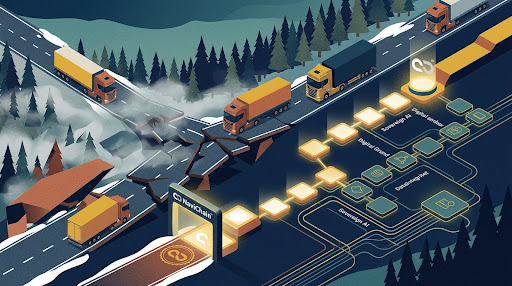
Fig 1: For Small to Medium-sized Enterprises (SMEs) in the European haulage sector, 2025 continues to be a period of intense pressure.
For Small to Medium-sized Enterprises (SMEs) in the European haulage sector, 2025 continues to be a period of intense pressure. A cooling in consumer demand and falling freight rates have squeezed already thin profit margins, which industry analysts place between 2-4%. In this environment, operational efficiency is not just a goal; it is the primary driver of survival. Yet, a significant—and often accepted—source of profit drain exists in the back office: financial friction. This friction is the gap between performing a service and getting paid for it. It's the manual, error-prone process of data re-entry, where information from a Transport Management System (TMS) or a driver's app must be manually keyed into an accounting application to generate an invoice. The user's challenge is universal: "Our accounting application lacks the ability to tie in operational data. How can we handle our customer invoicing outside the accounting system and still get the accounting done?" The costs of this disconnect are staggering and well-documented: * High Processing Costs: Industry benchmarks from firms like Ardent Partners and VAO show that the cost for an SME to manually process a single invoice ranges from €14 to €20. An automated process, by contrast, costs less than €4.
- High Error Rates: Manual data entry is a recipe for errors. A 2024 analysis by AFS Logistics found that 4.5% of all LTL invoices contained errors, a figure that other industry reports claim can be as high as 20%. The single biggest cause? Inaccurate accessorial charges (42.8% of all errors). This is precisely the kind of operational data that accounting systems lack.
- Delayed Cash Flow: Manual processing is slow. What could be a 3-day automated process often stretches to 10 or 15 days. For an SME, this delay in cash flow can be crippling, impacting everything from payroll to fuel payments. The common temptation is to find a simple 'connector' or API to bridge the gap. This is a tactical fix for a strategic-level problem. The root cause of the pain is not the lack of a single integration; it's the adherence to an outdated technology model that was never designed for the modern, data-driven logistics industry.
Deconstructing the problem: The 'best-of-breed' trap
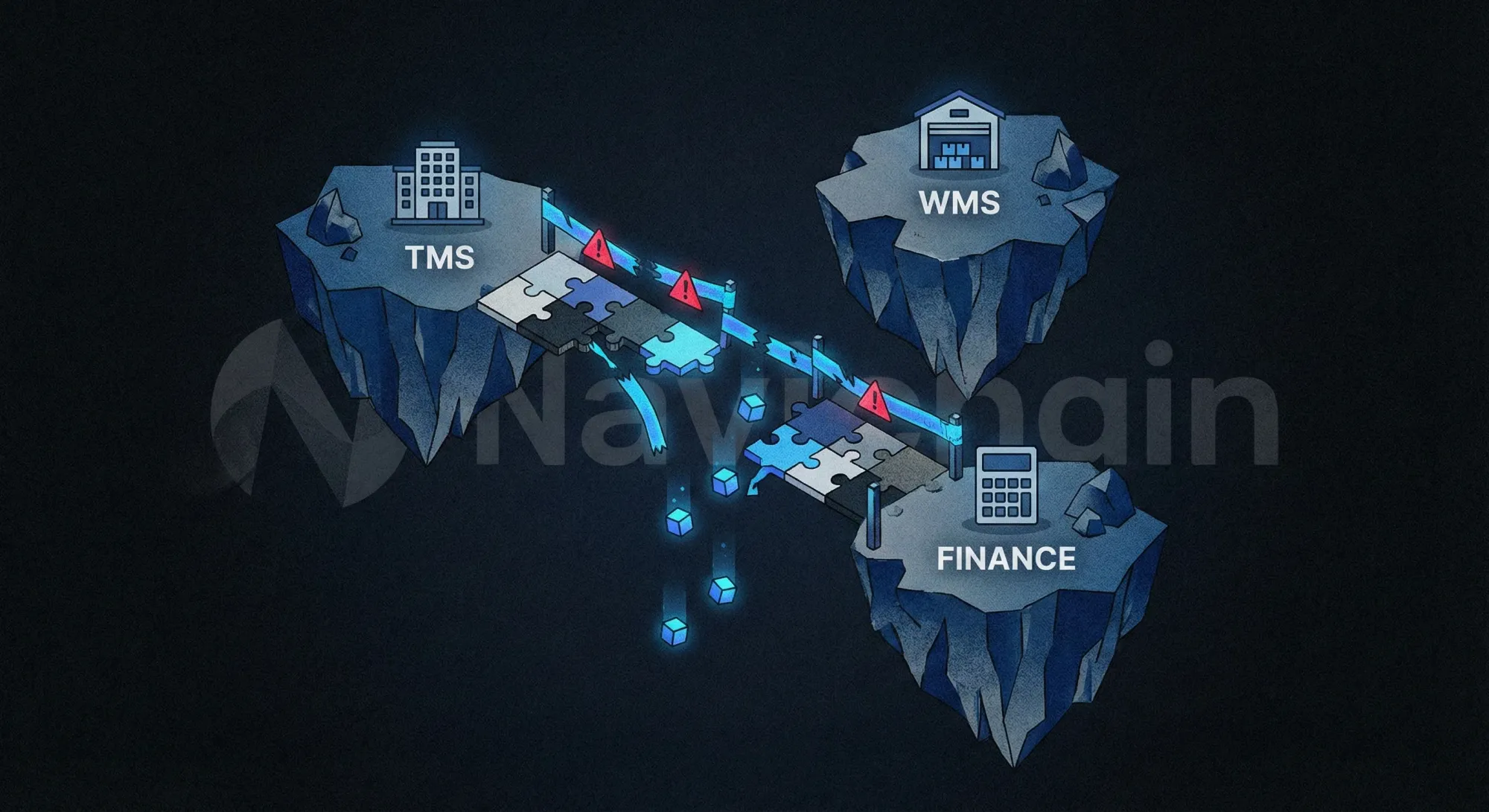
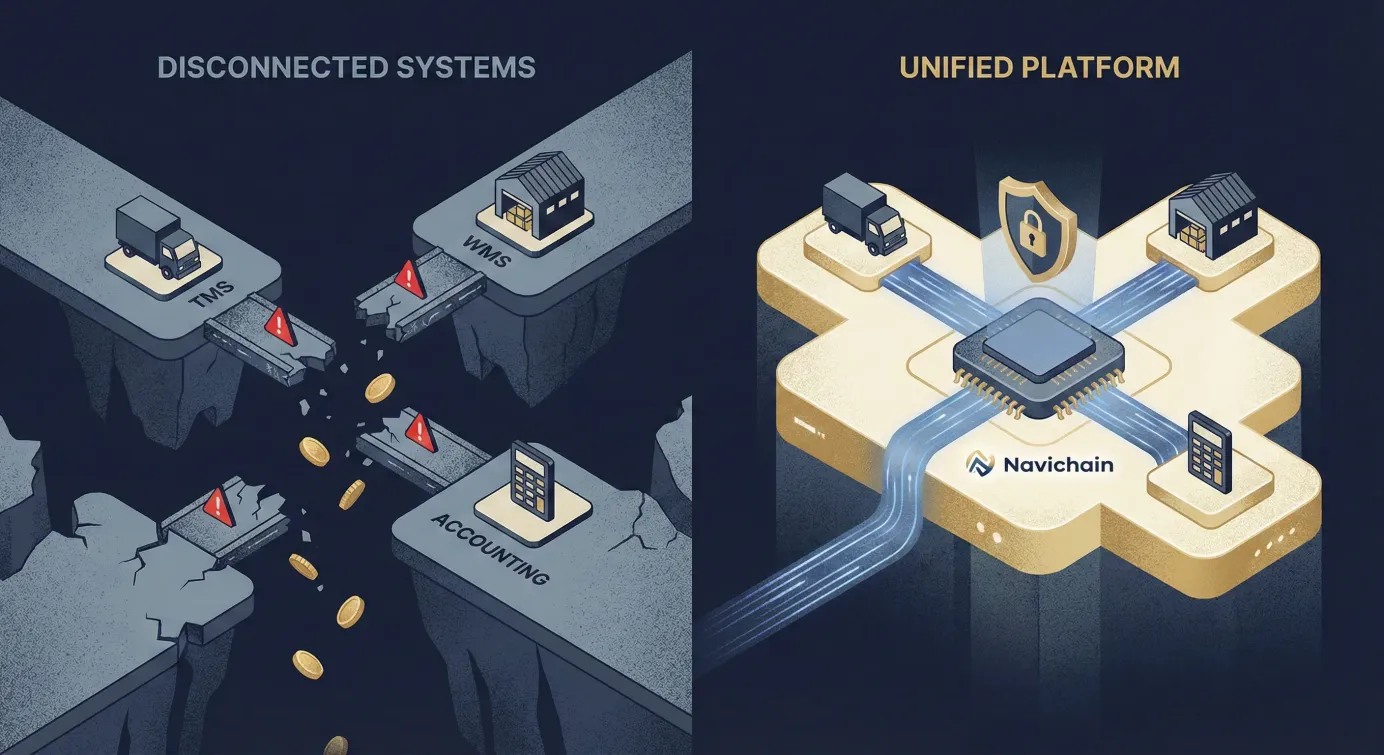
Disconnected systems lead to fragmented data, increased errors, and ultimately, lost profit for SMEs.
For decades, the accepted wisdom for SME digitalization was the 'best-of-breed' approach. The strategy was simple: purchase the "best" standalone TMS, the "best" WMS, and the "best" accounting software (like Visma, Fortnox, or Sage). On paper, this allows a company to pick the market leader for each function. In reality, it creates a fragmented, brittle, and expensive technology landscape. This strategy has created three critical, profit-draining challenges for SMEs.
1. the 'islands of data' dilemma
When your TMS, WMS, and accounting systems are all separate, you don't have a single business; you have a collection of data silos. Operations knows a job is complete (via the TMS), but Finance has no idea (via the accounting tool). This gap is the birthplace of all manual work.
- An operations manager must print a "jobs completed" report.
- An administrator must take that report and manually re-key the data into the finance system.
- Crucial details, like waiting time, fuel surcharges, or pallet-handling fees (the very 'accessorials' that cause 42.8% of invoice errors), are often missed or entered incorrectly. This process is the definition of operational friction. It builds delay, cost, and risk into the core of your business. As a result, management can never get a real-time, accurate picture of the company's financial or operational health. They are always looking at data that is days or even weeks old.
2. the brittle integration fallacy
The logical next step for many SMEs is to hire a consultant to build a custom integration or "connector" between the systems. This, too, is a trap. These point-to-point integrations are like digital bandages: they are expensive to build, fragile to maintain, and prone to breaking. What happens when your TMS provider issues a mandatory software update? The API changes, and your custom integration breaks. What happens when your accounting software updates its data fields? The integration breaks. The SME is now spending time and money not on optimizing its business, but on simply maintaining the fragile links between its siloed systems. This model creates dependency and hidden IT overhead, diverting resources that could be used for growth.
3. the unseen compliance & security crisis
This is the most critical and least-discussed consequence. When data is fragmented, it is insecure. To make this 'best-of-breed' model work, sensitive operational and financial data (customer lists, pricing, delivery details) must be constantly copied, exported to Excel, emailed, and moved between systems. Each of these steps is a potential data breach and a GDPR compliance nightmare. Furthermore, many 'best-of-breed' cloud applications are hosted by US-based corporations (like Amazon Web Services, Microsoft Azure, or Google Cloud). This creates a direct and often misunderstood legal conflict for European companies.
- The EU's GDPR strictly regulates how and where European citizen data can be stored and processed.
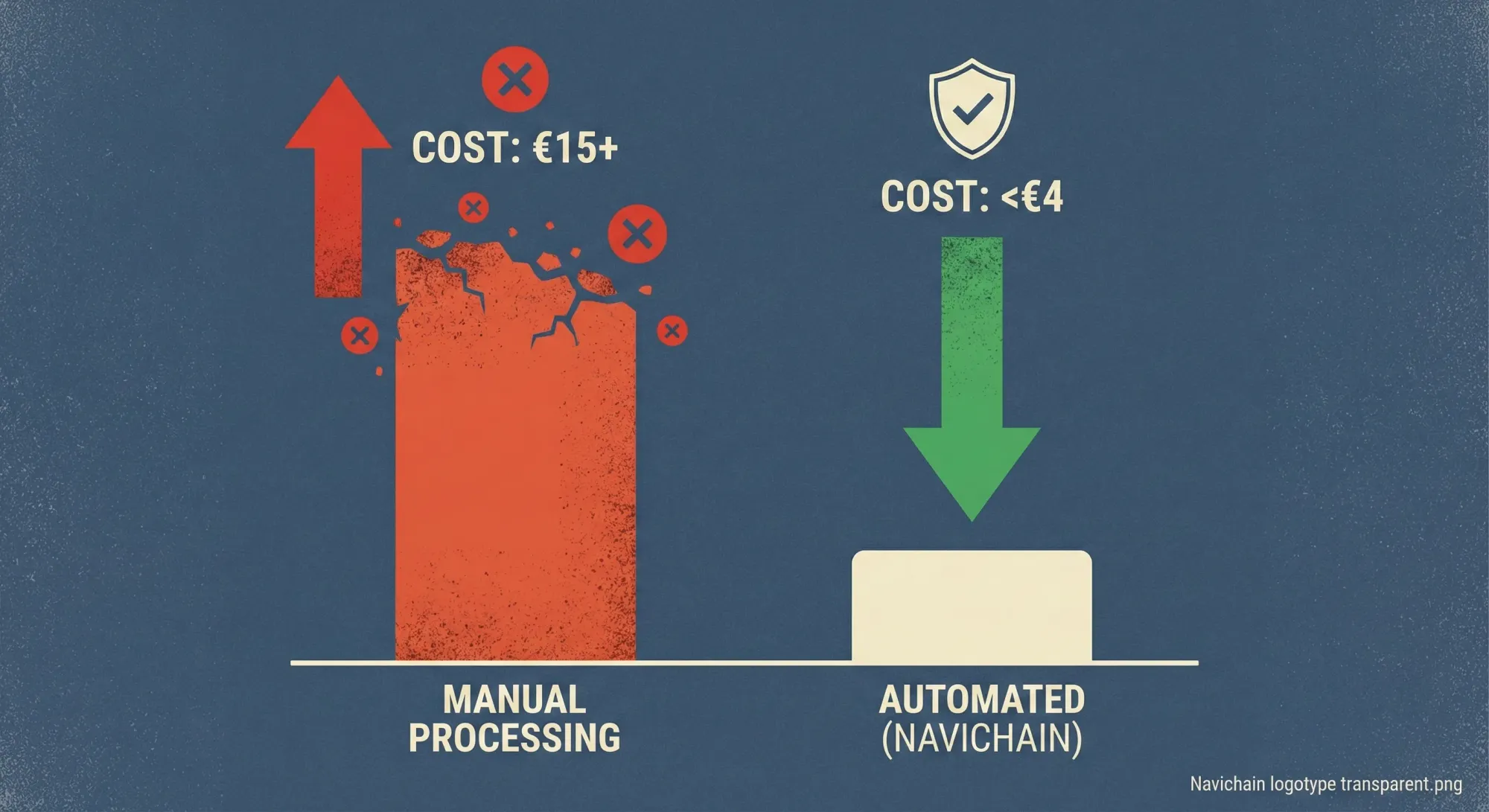
Data fragmentation increases the risk of breaches and complicates GDPR compliance for European logistics SMEs.
- The US CLOUD Act allows US authorities to compel US-based tech providers to hand over data, even if that data is stored on servers physically located in the EU (like in Dublin or Frankfurt). As the European Data Protection Board has clarified, these two laws are in direct conflict. An EU SME using a US-hosted cloud provider is in an impossible position: it may be forced to choose between violating GDPR (and facing massive fines) or defying a US warrant. For a pragmatic SME owner, this is an unacceptable and unnecessary strategic risk.
The path forward: The unified logistics operating system
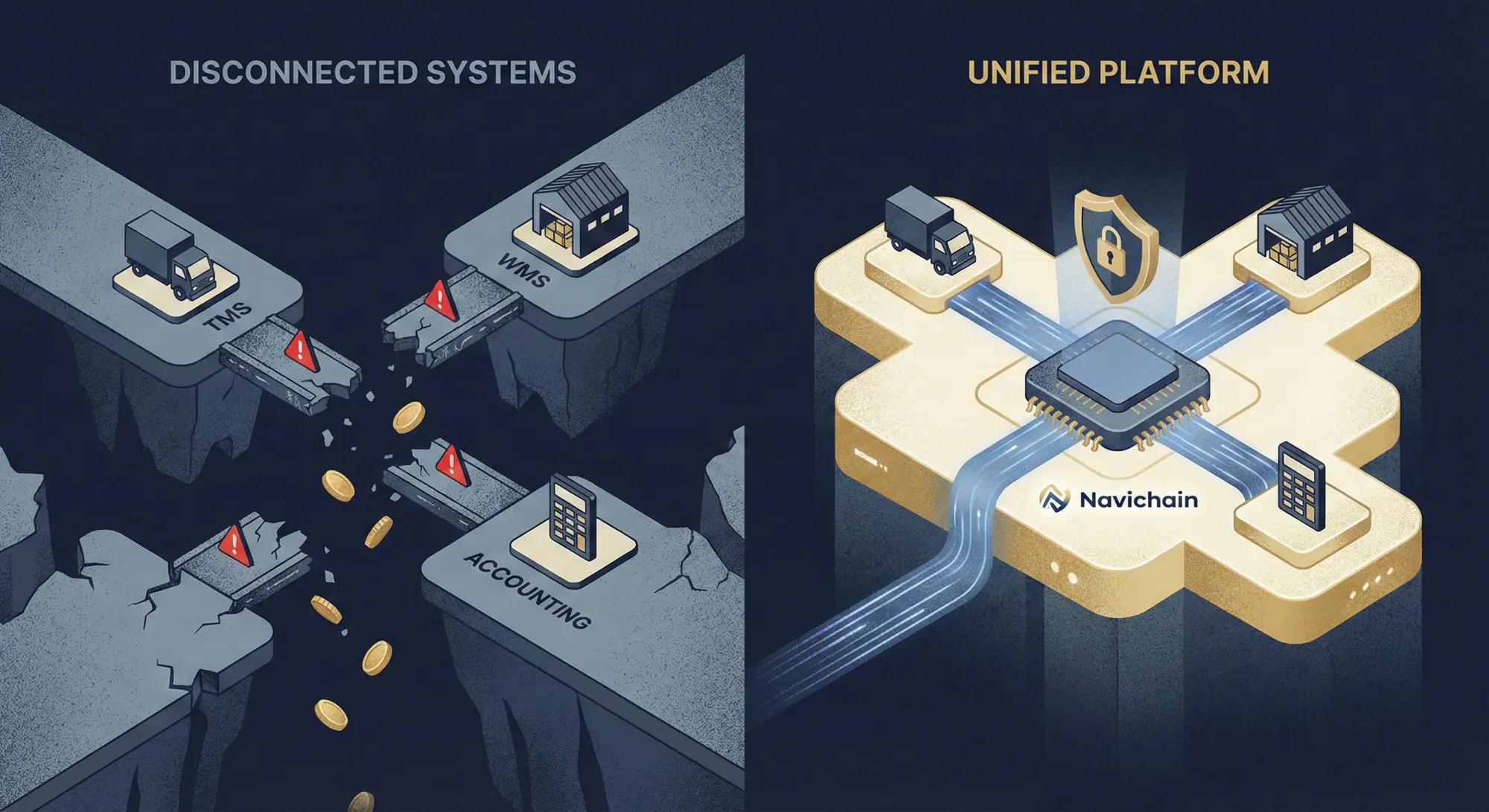
Fig 3: The solution is not to build better bridges between the data islands.
The solution is not to build better bridges between the data islands. The solution is to eliminate the islands altogether. The strategic shift required is from a fragmented, 'best-of-breed' architecture to a Unified Logistics Operating System. This is a single platform, built on a single database, where all core functions—Transportation Management (TMS), Warehouse Management (WMS), Asset Management, Billing, and Order Management—work as one. This unified model is not a new idea, but its power for SMEs is only just being realized. It directly solves the three core challenges of the 'best-of-breed' trap.
From 'order-to-cash' friction to financial flow
In a unified system, the "order-to-cash" cycle is no longer a multi-step, manual process. It is a single, seamless, automated flow. Consider this workflow: 1. Order: A customer order is entered once into the system. 2. Plan: The order is planned onto a truck (TMS function). 3. Execute: The driver completes the delivery and captures proof of delivery (POD) and any accessorial charges (e.g., '2 hours waiting time') directly in their app (Mobile TMS function). 4. Invoice: The moment the driver hits 'Complete', the system—which shares the same data—automatically generates a 100% accurate invoice, complete with the correct POD and all accessorial line items. It then pushes this invoice to the customer portal and, via a secure, pre-built connection, sends the final journal entry to the company's external accounting application (e.g., Visma). There is no re-keying. There are no data silos. The invoice error rate plummets because the invoice is generated from the original operational data, not from a human's interpretation of it. Cash flow accelerates from weeks to days, or even hours.
From brittle integrations to a single source of truth
Instead of managing four vendors and three fragile integrations, the business manages one platform. Updates are seamless because all modules are part of the same system. The IT overhead and complexity vanish, replaced by simplicity and reliability. More importantly, management gets what was previously impossible: a single source of truth. A director can log in and see, on one screen, the real-time status of all active deliveries, warehouse inventory levels, and—critically—the exact revenue and profit generated by those activities today. This allows for agile, data-driven decisions instead of reactive guesses based on outdated reports.
From diagnosis to design: The blueprint for a resilient logistics operating system
To adopt this strategy, SME leaders must look for a platform built on three non-negotiable principles. This is the blueprint for a modern, resilient, and compliant logistics operation.
Principle 1: Unified operational fabric
The platform must be a single, integrated system, not a collection of acquired products. It must act as the company's 'central nervous system,' with TMS, WMS, Billing, and Order Management all stemming from a single, unified database. This is the only way to create a single source of truth and enable true 'order-to-cash' automation.
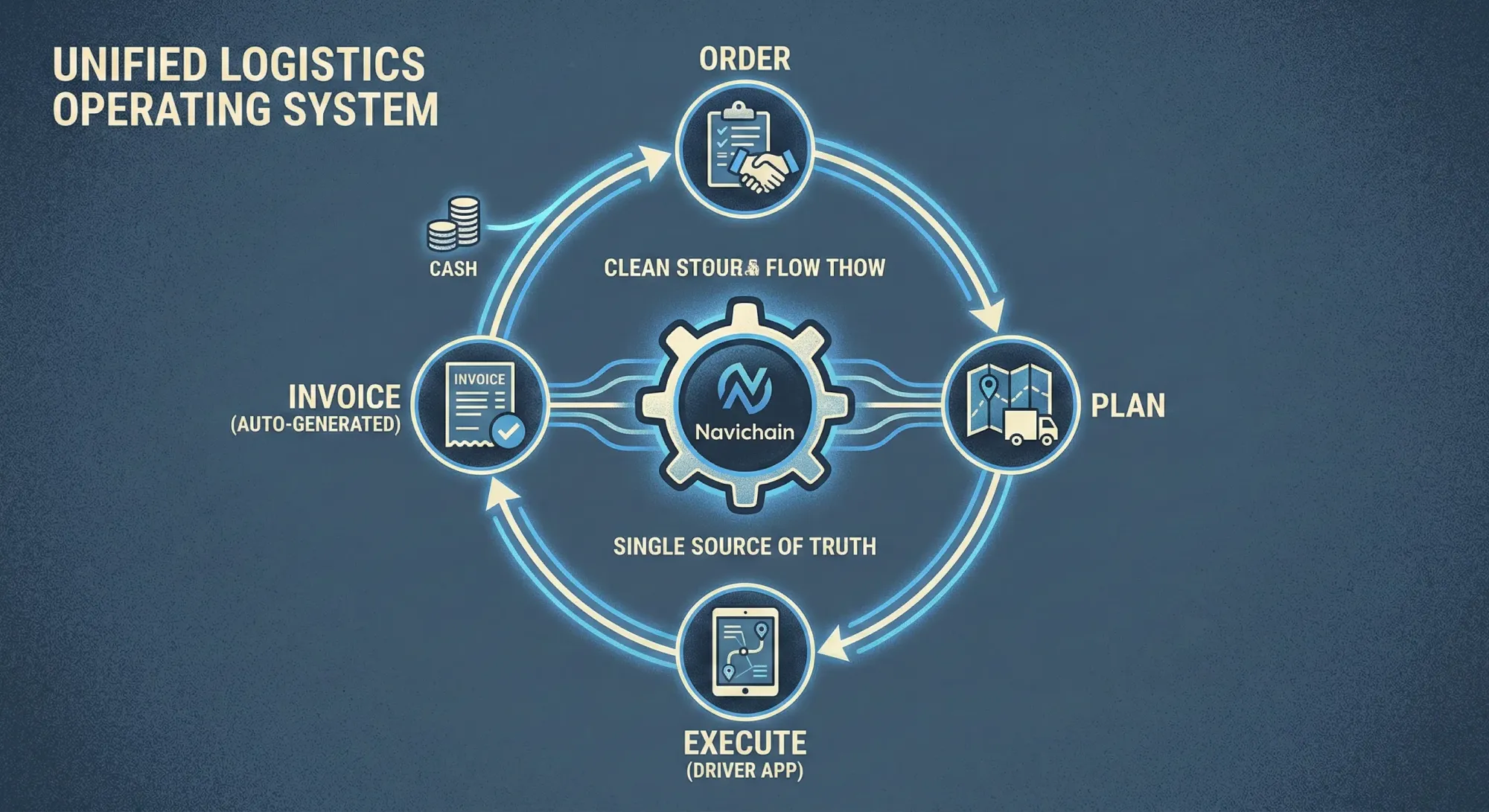
Schematic illustrating the interconnected nature of a unified logistics platform, integrating TMS, WMS, billing, and order management for seamless data flow and real-time visibility.
Principle 2: Secure data architecture and control
For a European SME, data control is not optional. The platform must be architected to guarantee data sovereignty. This means the provider must ensure that all client data is stored and processed exclusively within the EU/EEA, on infrastructure that is not subject to foreign laws like the US CLOUD Act. The ideal solution is a Self-Hosted platform within a secure EU jurisdiction (like Sweden), which provides clients with complete, unambiguous control over their own data and ensures straightforward, defensible GDPR compliance.
Principle 3: Embedded analytic intelligence
Once you have all your operational and financial data unified (Principle 1) in a secure environment (Principle 2), you unlock the final, transformative capability: Integrated AI. A true unified platform will have an embedded intelligence layer that runs within this secure environment. This AI can analyze 100% of your data—data no siloed system could ever see—to find deep, actionable insights. It can identify which customers are truly the most profitable (not just the highest revenue), optimize routes based on real-world profitability data, or predict cash flow with incredible accuracy. This is not 'Big Data'; it is your data, made intelligent.
References/sources
- VAO (2025). The Price of Manual Invoice Processing vs Invoice Processing Automation: Complete Cost Breakdown. Available at: https://www.vao.world/blogs/invoice-processing-automation
- AFS Logistics (2024). Industry statistics on LTL invoice errors. Available at: https://afs.net/blog/stats-incredible-common-ltl-invoice-errors/
- Transporte 3 (2025). The European Road Freight Rate Development Benchmark Q1 2025. Available at: https://transporte3.com/wp-content/uploads/2025/05/The-European-Road-Freight-Rate-Development-Benchmark-Q1-2025.pdf
- International Road Transport Union (IRU) (2025). IRU secretary general announces Eurasian road freight deliverables by 2050. Available at: https://www.trend.az/business/transport/4111766.html
- Wire (2025). What the CLOUD Act Really Means for EU Data Sovereignty. Available at: https://wire.com/en/blog/cloud-act-eu-data-sovereignty
- activeMind.legal (2020). U.S. CLOUD Act vs. GDPR. Available at: https://www.activemind.legal/guides/us-cloud-act/
Fig 4: To adopt this strategy, SME leaders must look for a platform built on three non-negotiable principles.
Enabling the blueprint: The navichain SaaS unified logistics platform
This white paper has outlined a strategic blueprint for SME resilience, profitability, and compliance. navichain SaaS was purpose-built to be the engine that enables this blueprint. Our platform is designed to embody these three core principles, moving beyond the fragmented 'best-of-breed' model to deliver a truly unified logistics operating system for SMEs. 1. Embodying the Unified Operational Fabric: navichain SaaS is not a collection of separate tools. It is a single, integrated platform where Transportation Management (TMS), Warehouse Management (WMS), Asset Management, Billing Management, and Order Management work as one. This creates the 'central nervous system' that automates your order-to-cash cycle, eliminates manual re-entry, and provides a single source of truth for your entire operation. 2. Delivering Secure Data Architecture and Control: We address the critical data sovereignty challenge head-on. As our key differentiator, the entire navichain SaaS platform is hosted on our own secure infrastructure (Self-Hosted) in Sweden. By keeping your data strictly within Swedish/EU jurisdiction, we ensure maximum data security, straightforward GDPR compliance, and complete freedom from the legal complexities of international data transfers like the US CLOUD Act. Our clients maintain full control over their operational information. 3. Leveraging Embedded Analytic Intelligence: Because your data is unified and secure on our platform, our integrated AI can deliver transformative insights. Running on this same secure Swedish infrastructure, our AI analyzes your unified operational and financial data to unlock unique efficiencies, identify hidden profit centers, and give you the competitive intelligence previously only available to the largest corporations. Our mission is to democratize logistics technology, offering a seamless, powerful, and affordable solution that helps SMEs in the logistics sector thrive by breaking down data silos and building a foundation of operational efficiency and data control.", "wordCount": 2148

The navichain SaaS platform provides a unified view of logistics operations, fostering efficiency and data-driven decision-making for SMEs.

Navichain's integrated AI analyzes unified operational and financial data to unlock efficiencies and provide competitive intelligence for logistics SMEs. The platform's secure Swedish infrastructure ensures data integrity and empowers smarter decision-making.
Ready to optimise your supply chain?
navichain Insights Newsletter
Join the newsletter to receive the latest updates in your inbox.