
Sustainability Reporting: The End of Greenwashing with Real Data
Table of Contents
For years, sustainability reporting in logistics has been an exercise in creative writing. Companies have relied on broad industry averages and spend-based estimates to guess their Scope 3 emissions. Ideally, this was a starting point; realistically, it was often greenwashing. But with the enforcement of the Corporate Sustainability Reporting Directive (CSRD) and the adoption of the ISO 14083 standard, the grace period is over. The new legal standard is "Limited Assurance," meaning your carbon data will soon be audited with the same rigor as your financial statements. It's time to stop guessing and start measuring.
Executive Summary
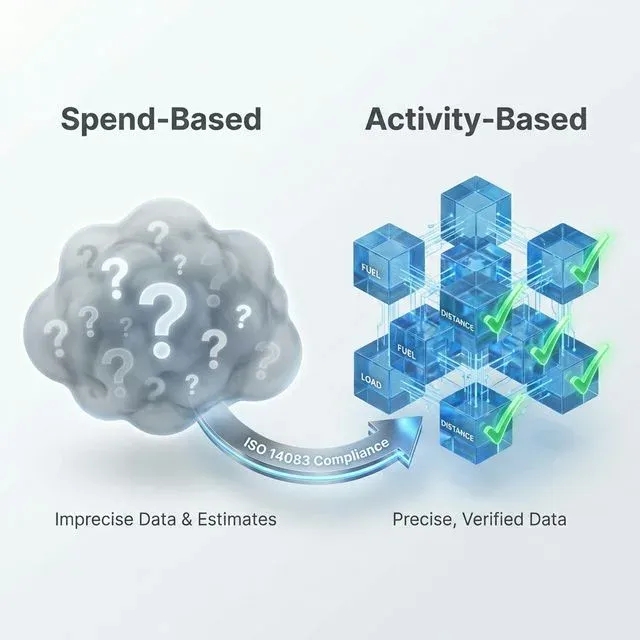
The shift is fundamental: we are moving from Spend-Based Accounting (guessing emissions based on how much money you spent on transport) to Activity-Based Accounting (measuring emissions based on actual fuel, distance, and load factors).
This white paper explores why this transition is critical for CFOs and Logistics Directors. We analyze the risks of sticking to estimates—from audit failures to accusations of greenwashing—and present a technical path forward using Primary Data. By integrating direct operational feeds from your Transport Management System (TMS), you can achieve ISO 14083 compliance automatically, turning a compliance burden into a competitive advantage.
Part 1: The Compliance Trap - Why Estimates No Longer Work

The Problem with "Spend-Based" Accounting
Historically, many companies calculated their logistics footprint using a simple formula: Total Transport Spend (€) x Industry Average Emission Factor (kg CO2e / €). While easy, this method is dangerously flawed. * Inflation Distorts Data: If fuel prices rise, your "emissions" rise, even if you didn't burn a single extra liter of diesel. Conversely, negotiating a better rate effectively "lowers" your reported emissions without any actual environmental benefit. * No Incentive for Efficiency: Investing in a newer, cleaner fleet often costs more upfront. Under a spend-based model, this investment would ironically make your carbon footprint look worse.
Enter CSRD and "Limited Assurance"
The Corporate Sustainability Reporting Directive affects over 50,000 companies in the EU. Its most biting provision is the requirement for Limited Assurance. This means an external auditor must verify your sustainability data. * The Audit Risk: Auditors are trained to skepticism. When they ask for the source of your Scope 3 data and you point to a generic "industry average" from a database, they will flag it as a risk. They want to see the audit trail: Which truck? Which route? How much fuel? * Reputational Suicide: In an era of litigious NGOs and cynical consumers, being caught under-reporting emissions due to "bad estimates" is a PR nightmare. "Greenwashing" is no longer just a marketing slur; it is a legal liability.
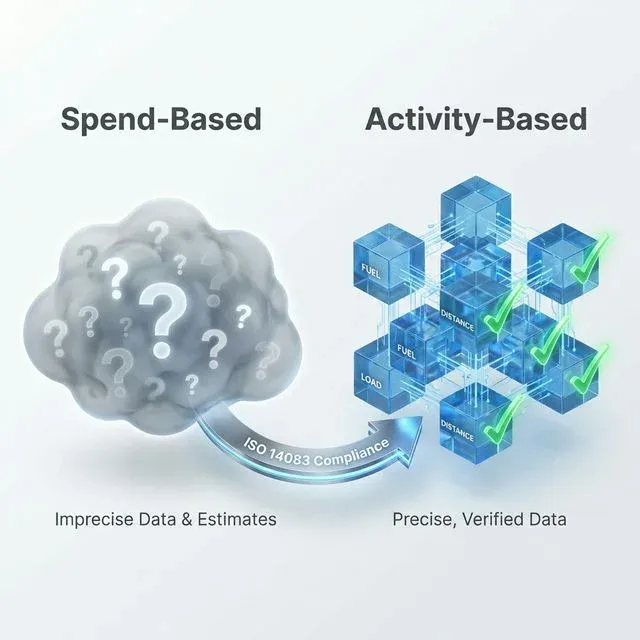
Using estimates leaves a massive margin of error that is unacceptable in a CSRD audit.
Part 2: The New Gold Standard - ISO 14083 & Primary Data
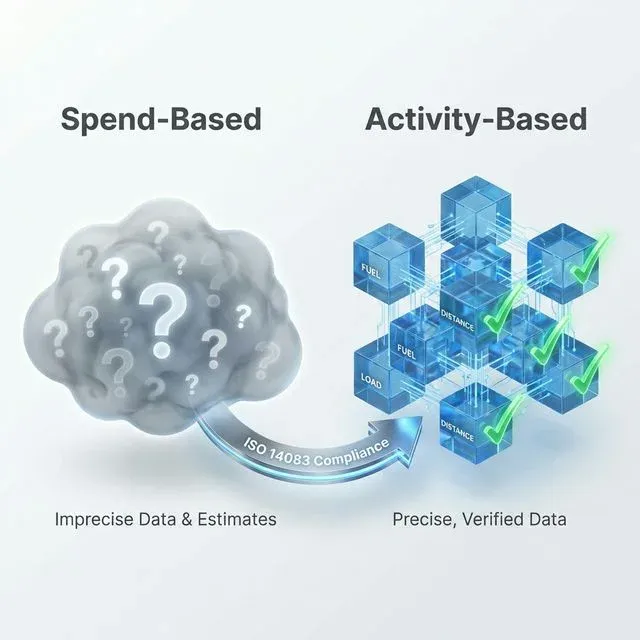
What is ISO 14083?
Released in 2023, ISO 14083 is the first unified global standard for quantifying greenhouse gas emissions in transport chains. It explicitly prioritizes Primary Data. * Primary Data: Quantification based on direct measurement (e.g., actual fuel consumption, actual distance, specific vehicle profile). * Secondary Data: Modeled data or default values.
The standard dictates that you must use Primary Data whenever possible. Relying on Secondary Data is a fallback, not a strategy.
Activity-Based Accounting: The "Real Data" Approach
To comply with ISO 14083, you need to track the physical activity, not the financial transaction. 1. Vehicle Specifics: Not just "a truck", but a "Euro 6 Diesel 40-ton Combination". 2. Actual Distance: Not the "as the crow flies" distance, but the actual odometer kilometers driven, including detours. 3. Load Factor: A fully loaded truck has a very different carbon profile per ton-km than a half-empty one. 4. Energy Source: Is it HVO100? Biogas? Electric? Activity-based accounting captures the specific emission factor of the energy utilized.
Part 3: Navichain's Solution - Automated Primary Data

From Chaos to Granularity
Navichain does not treat sustainability as an afterthought or a yearly spreadsheet exercise. It is baked into the operational core of the TMS. * Native Integration: Because navichain manages the transport order execution, we already know the vehicle, the driver, the route, and the cargo weight. * Granular Allocation: We don't just calculate the emissions for the whole trip; our AI allocates those emissions down to the individual shipment level based on share of weight and distance (ton-km allocation), fully compliant with EN 16258 and ISO 14083.
Audit-Ready Reports at a Click
Instead of a panicked scramble at the end of the fiscal year, navichain provides continuous, real-time reporting. * Drill-Down Capability: An auditor can look at your total annual Scope 3 emissions and drill down to a specific month, a specific carrier, or even a specific delivery. * Data Lineage: Every CO2 figure is traceable back to a specific operational event (e.g., "Trip ID 12345, Truck XYZ, 500km"). This transparency is what "Limited Assurance" demands.
Part 4: The Strategic Upside

Efficiency = Sustainability
The beauty of activity-based accounting is that it aligns your financial and environmental goals. * Identifying Waste: When you measure real data, you spot real inefficiencies. A driver with high fuel consumption? A route with excessive empty miles? These are both carbon hotspots and margin killers. * Winning Contracts: Forward-thinking transport buyers (your customers) are also under CSRD pressure. If you can provide them with highly accurate, primary-data-based carbon reports for their shipments, you solve their compliance headache. You become a strategic partner, not just a vendor.
Conclusion
The era of "good enough" data is over. As regulators tighten the screws and the market demands transparency, the choice between Spend-Based Estimates and Activity-Based Real Data is the choice between risk and resilience.
Navichain empowers you to make that transition seamlessly. By automating the collection of primary data, we ensure that your sustainability reporting is as robust, accurate, and audit-proof as your financial reporting.
Don't let greenwashing accusations derail your business. Embrace the power of Real Data.
Is Your Data Audit-Ready?
Stop guessing and start measuring with navichain's ISO 14083 compliant engine.
navichain Insights Newsletter
Join the newsletter to receive the latest updates in your inbox.