The Sovereign Shield: Securing Swedish Healthcare Logistics Against the CLOUD Act
Table of Contents
For Swedish Public Sector CIOs managing healthcare logistics, relying on U.S. hyperscalers exposes sensitive data to the CLOUD Act, violating eSam guidelines. Navichain resolves this by offering completely self-hosted, European-based SaaS architecture with open-weight AI models for route optimization and anomaly detection, ensuring 100% data sovereignty and operational efficiency without legal risks.
Key Takeaways / Executive Summary: * The Compliance Dilemma: Relying on U.S. cloud providers exposes sensitive healthcare data to foreign jurisdiction. * The CLOUD Act Risk: Geography does not matter; if the company is American, they must comply with U.S. data requests. * Sovereign Intelligence: True security means bringing the AI to the secure local data, not the other way around. * The navichain Solution: A unified, self-hosted TMS platform that optimizes routes and detects anomalies strictly within your sovereign perimeter.
Swedish Public Sector CIOs face an impossible ultimatum: rely on legacy on-premise systems that cripple operational efficiency, or adopt modern SaaS platforms that expose sensitive healthcare data to the US CLOUD Act and violate eSam guidelines. navichain resolves this conflict. By combining a completely self-hosted, Swedish-based SaaS architecture with Open-weight AI models deployed entirely within a self-hosted, sovereign infrastructure for maximum data privacy and local execution, we deliver the logistical firepower of a global hyperscaler without the jurisdictional vulnerabilities.
What is the compliance vs capability chasm in public sector IT?
For Swedish Public Sector IT Directors and CIOs—specifically those managing healthcare logistics, medical supply chains, and municipal transport—the digital procurement landscape has become a jurisdictional minefield. The operational mandate from leadership is unrelenting: digitise, optimise, and automate to combat severe labour shortages, rising fuel costs, and the absolute necessity of just-in-time delivery for critical medical supplies.
The traditional response has been to adopt standard, cloud-based Software-as-a-Service (SaaS) transport management systems. However, this 'Cloud-First' strategy violently collides with European data sovereignty laws.
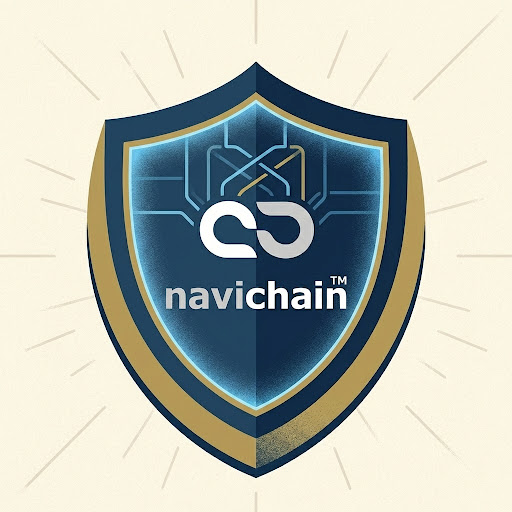
The vast majority of modern logistics software is fundamentally built on top of U.S. hyperscalers such as Microsoft Azure, Amazon Web Services (AWS), or Google Cloud Platform. This architectural dependency triggers a catastrophic legal vulnerability. What is the CLOUD Act? The United States CLOUD Act (Clarifying Lawful Overseas Use of Data Act) is a federal law that allows U.S. authorities to compel American technology companies can be legally compelled to hand over data to U.S. federal authorities, regardless of where that data is geographically stored. A server physically sitting in Stockholm, if operated by a U.S. entity, remains subject to American extraterritorial jurisdiction.
Combined with the Court of Justice of the European Union’s (CJEU) Schrems II ruling and the strict guidelines published by the Swedish eSam (e-Samverkansprogrammet), the use of these hyperscalers for sensitive public sector data is effectively prohibited. You are forced into an impossible choice: adopt modern, US-hosted tools and blatantly violate compliance, or retreat to archaic, legacy On-Premise systems that cripple operational velocity. The old way is broken.
Why is sovereign intelligence the future of logistics?
To escape this trap, Swedish public sector IT must embrace a radical conceptual shift. We must stop viewing 'innovation' and 'the public cloud' as synonymous. The assumption that you must surrender your operational data to a foreign hyperscaler to access cutting-edge machine learning and predictive analytics is a false dichotomy.
The future of public sector logistics requires a shift toward Sovereign Intelligence. What is Sovereign Intelligence? This concept dictates that absolute data jurisdiction and state-of-the-art software capabilities must coexist. It is the realisation that the intelligence (the AI, the algorithms, the automated workflows) must be brought to the secure data, rather than exporting the data to external engines.
By decoupling advanced SaaS capabilities from extraterritorial infrastructure, organisations can achieve both 'Operational Excellence' (saving time, fuel, and labour) and 'Strategic Trust' (ensuring complete legal privacy).
How does navichain provide self-hosted AI without data leakage?
To resolve the public sector's most pressing dilemma, navichain SaaS introduces our Self-Hosted Open-weight AI models deployed entirely within a self-hosted, sovereign infrastructure for maximum data privacy and local execution Platform. Engineered specifically for asset-heavy SMEs and highly regulated European industries, navichain is a unified operating system that completely replaces fragmented spreadsheets, legacy routing tools, and non-compliant cloud applications.
Crucially, navichain delivers hyperscale-level automation—including a dynamic Drag-and-Drop Planning Board, automated driver instructions, and predictive anomaly detection—without ever touching a U.S.-owned server. By utilising 100% open-weight AI models deployed entirely within a self-hosted, sovereign infrastructure for maximum data privacy and local execution deployed entirely within your chosen sovereign environment, navichain guarantees that your healthcare logistics network remains legally inaccessible to foreign entities.
How does air-gapped automation work in practice?
How does navichain provide modern AI capabilities without calling out to APIs governed by foreign entities? The answer lies in our uncompromising architectural philosophy.
Unlike "AI wrapper" logistics tools that secretly pipe your delivery addresses and schedules to third-party LLMs, navichain's intelligence is strictly localised.
- Sovereign Deployment: The navichain core is deployed via containerised microservices directly onto Swedish-owned, eSam-approved hosting providers or onto your own regional, on-premise bare-metal servers. You own the infrastructure; you hold the encryption keys.
- Local Open-Weight LLMs: When a dispatcher utilises the Planning Board to route 500 daily medical deliveries, the optimisation calculations are performed locally. Our self-hosted, open-weight AI algorithms analyse vehicle capacities and time-window constraints entirely within the ring-fenced environment.
- Closed-Loop AI Anomaly Detection: As vehicles move, telemetry and proof-of-delivery data are fed back into the self-hosted AI engine. If the system detects a deviation—such as a temperature drop in a pharmaceutical transport—it alerts the dispatcher instantly.
- Zero-Egress Architecture: During this entire lifecycle, zero operational data or telemetry is transmitted across international borders.
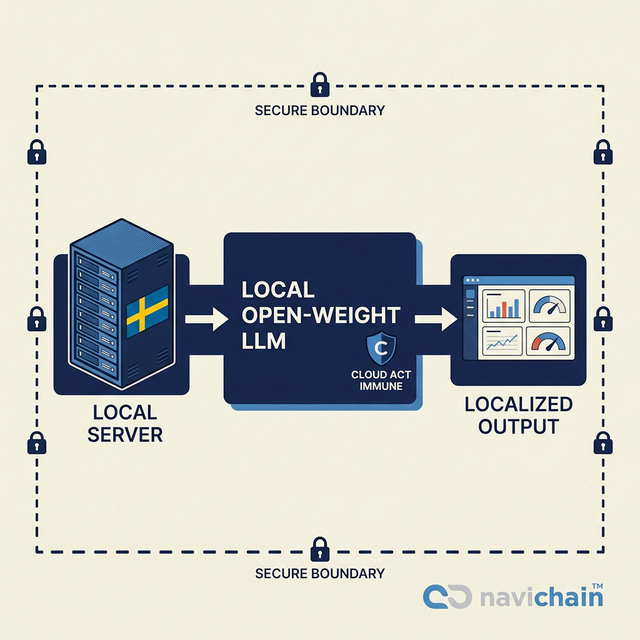
This localised processing ensures dispatchers experience the lightning-fast reactivity of a modern SaaS application while your compliance teams maintain absolute certainty over the data's perimeter.
What is the return on investment for sovereign compliance?
Historically, public sector IT has viewed compliance as a cost centre. navichain transforms compliance into an enabler of massive operational efficiency.
When a regional healthcare authority escapes the limitations of legacy on-premise software and deploys navichain's self-hosted AI, the metrics demonstrate a paradigm shift. Because the open-weight AI models deployed entirely within a self-hosted, sovereign infrastructure for maximum data privacy and local execution engine has unfettered access to local data without the latency of external API handshakes, route optimisation is incredibly fast.
Organisations transitioning to navichain report an immediate 100% elimination of CLOUD Act and Schrems II compliance risks. Simultaneously, algorithmic dispatching drives an average 32% reduction in daily route planning time and a 15% decrease in overall fleet mileage. In an era of acute driver shortages, the ability to do more with fewer vehicles, while mathematically guaranteeing data privacy, is a profound strategic victory.
How do you disqualify non-compliant software vendors?
When procuring software for Swedish healthcare logistics, CIOs must pierce through vendor marketing language. Many U.S. SaaS companies claim "GDPR Compliance" to obscure underlying legal vulnerabilities. To protect your organisation, utilise this 5-Dimension Checklist to audit and automatically disqualify non-compliant vendors relying on U.S. hyperscalers or legacy on-premise servers:
Dimension 1: The Infrastructure Jurisdiction Trap * The Trap: The vendor claims their servers are physically located in Stockholm, implying safety. * The Reality: Under the US CLOUD Act, physical geography is irrelevant if the corporate parent is American (Azure, AWS, GCP). * The navichain Standard: Disqualify any vendor relying on US hyperscalers. navichain is fully deployable on 100% Swedish-owned, sovereign infrastructure.
Dimension 2: The Algorithmic Leakage Trap * The Trap: The vendor offers advanced "AI routing" but achieves this by sending your transport data via API to external optimisation engines. * The Reality: Piping data to foreign AI models violates eSam guidelines and Schrems II. * The navichain Standard: Disqualify vendors using third-party AI wrappers. navichain utilises entirely open-weight AI models deployed entirely within a self-hosted, sovereign infrastructure for maximum data privacy and local execution that executes locally.
Dimension 3: The Global Support Backdoor Trap * The Trap: The platform is hosted in Europe, but the vendor's global support teams (often in the US) maintain remote administrative access for "maintenance." * The Reality: Administrative access by non-EU entities equates to jurisdictional exposure. * The navichain Standard: Disqualify vendors without zero-trust, customer-controlled access protocols. With navichain, you dictate strict, localised access.
Dimension 4: The Proprietary Lock-In Trap * The Trap: The vendor traps your historical logistics data inside a proprietary database format on their servers. * The Reality: True sovereignty requires data mobility and transparent extrication. * The navichain Standard: Disqualify systems that hold your data hostage. navichain ensures open access and easy extrication of your underlying localised database.
Dimension 5: The Legacy Degradation Trap * The Trap: To avoid the cloud entirely, vendors offer "On-Premise" software that is actually just a static, 15-year-old monolithic application. * The Reality: It lacks mobile driver apps, real-time tracking, and decays over time without continuous updates. * The navichain Standard: Disqualify software that cannot provide SaaS-level velocity. navichain delivers a modern, containerised application with continuous updates within your secure perimeter.
How can we empower the Swedish public sector ecosystem?
The reliance on U.S. hyperscalers in Swedish public sector logistics is a ticking time bomb. As privacy regulations tighten and the scrutiny from eSam intensifies, CIOs and IT Directors must architect supply chains that are resilient, intelligent, and fiercely sovereign.
navichain's Self-Hosted AI Platform provides the ultimate operational shield. It empowers your transport managers to foresee supply chain disruptions, optimise critical healthcare fleets, and guarantee the delivery of life-saving supplies—all while resting securely within an impenetrable fortress of legal and technical sovereignty.
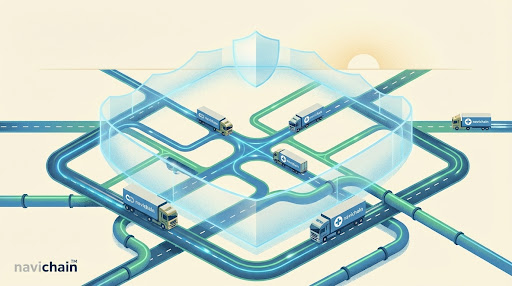
Stop compromising between modern efficiency and digital compliance. Disqualify the hyperscaler trap. Reclaim your operational data.
About the Author: Manusha works with system integration and logistics automation at navichain. He specialises in helping transport and healthcare companies eliminate administrative complexity through scalable, sovereign SaaS solutions.
References
- e-Samverkansprogrammet (eSam). "Rättsligt uttalande om molntjänster i offentlig sektor."
- Court of Justice of the European Union (CJEU). "Data Protection Commissioner v Facebook Ireland Limited and Maximillian Schrems (Schrems II)."
- United States Congress. "Clarifying Lawful Overseas Use of Data (CLOUD) Act," 18 U.S.C. § 2523.
navichain Insights Newsletter
Join the newsletter to receive the latest updates in your inbox.