Predictive Maintenance: Listening to the Engine's Sub-Vocal Signals
Table of Contents
In the high-margin world of 2026 logistics, a breakdown is not just a repair cost; it's a reputation killer. Traditional maintenance is Reactive (wait for the breakdown) or Scheduled (replace parts that are still good). Neither is efficient.
Navichain introduces the Sovereign Predictive Model. By leveraging the deep CAN-bus integration of the Teltonika FMC650, we don't just wait for a "Check Engine" light. We listen to the vehicle's "sub-vocal" health signals—J1939 DM1 & DM2 codes—to identify failing components before they cause a roadside stoppage.
The Data Source: Deep J1939 Integration
The FMC650 is not just a GPS tracker; it is an edge diagnostic computer. It reads the raw J1939 data stream directly from the truck's ECU.
To predict failure, we monitor three critical data points for every fault: 1. SPN (Suspect Parameter Number): What is failing (e.g., Turbo Pressure). 2. FMI (Failure Mode Identifier): How it is failing (e.g., Voltage Below Normal). 3. OC (Occurrence Count): How often it has happened.
High-Value Signals (The "Amber Alerts")
We focus on the "Ghost Faults"—the intermittent issues that drivers ignore but which signal imminent failure.
| SPN | Component | The Predictive Sign |
|---|---|---|
| 110 | Coolant Temp | Spikes $> 100^\circ\text{C}$ for $> 5$ mins under load. |
| 102 | Turbo Boost | Inconsistency between Boost Pressure and Fuel Flow. |
| 4334 | DPF Pressure | High backpressure indicating a clogged filter (Regen needed). |
| 175 | Oil Temp | Sudden rise without a corresponding load increase. |
The Intelligent Diagnostic Engine
Raw codes are noisy. A single loose wire can trigger 50 alerts in a minute. To prevent "Alert Fatigue," we implement a Condition-Based Monitoring (CBM) service on your local secure server.
This service uses smart filtering and historical comparisons to identify real issues.
Instead of alerting on every single signal, the system checks the secure historical database to see if this specific fault has happened before under similar conditions. It looks for patterns—such as a specific warning appearing multiple times in a short period—to distinguish between a momentary glitch and a genuine developing failure.
Only when a confirmed "Ghost Fault" pattern is detected does the system trigger a predictive alert.

The "Smart Maintenance" Workflow
What happens when a predictive alert is triggered? The system creates an automated operational workflow.
- Detection: Truck #42 reports intermittent "Low Coolant Pressure" (SPN 111).
- Validation: The Intelligent Engine confirms this is the 4th occurrence today.
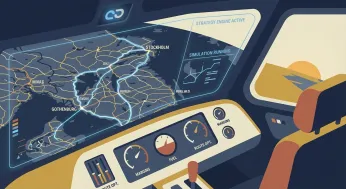
- Simulation (GraphHopper): The system checks the mission route. It finds an authorized Scania workshop 12km ahead.
- Action: The Dispatcher receives a "Mission in Danger" prompt:
- "Critical Warning: Truck #42 has a confirmed coolant leak risk. Reroute to Scania Södertälje (Adds +15 mins)? [Accept/Deny]"
Sovereign Privacy & Security
Manufacturer diagnostic codes are sensitive. Scania and Volvo often use proprietary extensions that reveal detailed performance data. By processing this On-Premise (in your Swedish data center), you ensure that your fleet's mechanical health data is not being mined by third-party cloud providers or insurance adjusters.
Conclusion
A 100 EUR sensor failure should not cause a 20,000 EUR engine rebuild. By shifting to Predictive Maintenance, you essentially employ a master mechanic who rides in the passenger seat of every truck, listening to the engine 24/7. Fix it before it breaks.
Stop paying for roadside repairs.
navichain Insights Newsletter
Join the newsletter to receive the latest updates in your inbox.