Predictive Fleet Health: Moving from 'Fix When Broken' to 'Fix Before Failure'
Table of Contents

Foreknowledge is Profit: Fixing a €200 sensor today saves a €20,000 engine tomorrow.
In the logistics economy of 2026, the difference between profit and loss often sits under the hood. Traditional "Fixed Interval" maintenance (servicing every 50,000km) is obsolete. It is either too early (wasting money) or too late (risking failure).
Navichain introduces Predictive Fleet Health & Lifecycle ROI. By tapping directly into the vehicle's brain (the J1939 CAN-bus) via the FMC650, we transform your maintenance strategy from "Reactive" to "Condition-Based". We don't just tell you a truck is broken; we tell you when it will break.
Take Action
Cut your Total Cost of Ownership (TCO).
- Predict Breakdowns: Analyze 2,000+ engine parameters in real-time.
- Green Premium: Charge more for "Verified Green" transport using ISO 14083 data.
- Surgical Maintenance: Replace parts only when they are actually worn out.
- Maximize Uptime: Schedule repairs during driver rest periods, not delivery windows.
Most SMEs manage fleet health with spreadsheets and guesswork. They wait for a dashboard warning light. By the time that light turns on, the damage is already done.
1.1 The Cost of Reaction
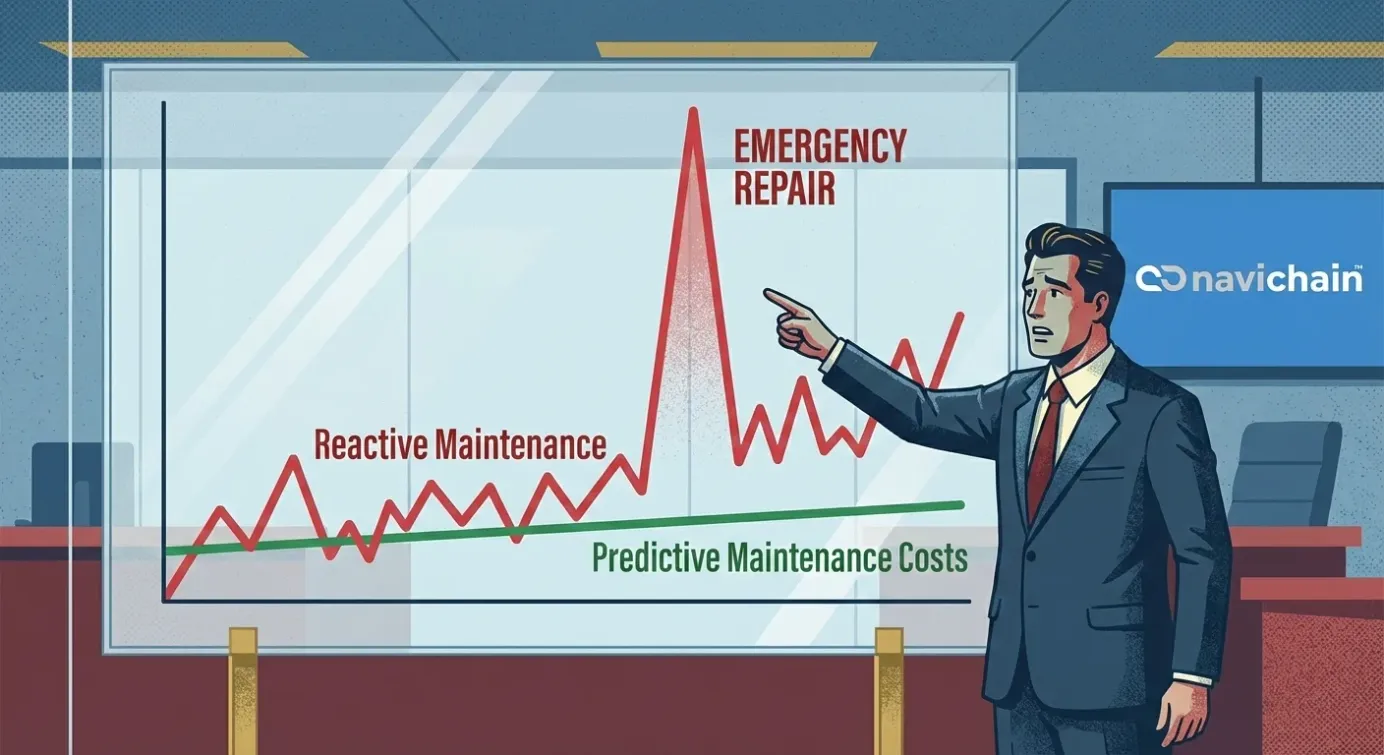
- The Breakdown: A truck stuck on the Autobahn costs €1,500 in towing, €500 in penalties for late delivery, and unknown damage to customer trust.
- The Parts: buying a turbocharger in an emergency situation costs 30% more than a planned purchase.
- The Driver: A stranded driver is an unhappy driver (and probably requires a hotel).

The Reactive Spike: Emergency repairs destroy annual margins in a single day.
Navichain does not just track GPS; it listens to the engine.
2.1 The Digital Stethoscope (FMC650)
The FMC650 connects to the J1939 CAN-bus, the nervous system of the truck. It reads raw SPN (Suspect Parameter Number) and FMI (Failure Mode Identifier) codes that are usually only visible to mechanics with laptops.
2.2 The Prediction Engine
Our .NET backend analyzes this stream of data: * Oil Temperature Trends: Is the engine running 2°C hotter than last week? * Boost Pressure Variance: Is the turbo spooling slower? * Fuel Flow Irregularities: Is an injector starting to clog?
The system detects these micro-patterns 15 days before a catastrophic failure.

Condition-Based Monitoring: Seeing the invisible signs of wear.
Predictive Health is not just about saving money; it is about making money.
3.1 ISO 14083 Carbon Tracking
Because we read the actual fuel flow (milliliter precision) from the engine, our carbon reporting is not an estimate. It is a measurement. * Verified Green: You can prove to clients that your fleet runs efficiently. * The Eco-Premium: Forward-thinking shippers pay extra for "Scope 3" emissions data that is audit-ready.
3.2 The Green Lifecycle
A well-maintained engine burns less fuel. By fixing a clogging air filter instantly (instead of waiting for the 50k service), you reduce fuel consumption by 3-5% across the fleet.
Monetizing Sustainability: Turning carbon data into a competitive advantage.
SMEs often sell trucks too early or keep them too long. Navichain provides the data to make the exact right decision.
4.1 The "Sell or Keep" Algorithm
The system tracks the exact cost-per-kilometer for every vehicle, including fuel, ad-blue, tires, and repairs. * The Tipping Point: The dashboard alerts you when a truck's maintenance cost curve is about to cross its depreciation curve. * Action: "Sell Vehicle X-123 this month to maximize retained value."
In logistics, a parked truck is a money pit. Navichain's Predictive Fleet Health ensures your wheels are always turning, your engines are always efficient, and your profit is always protected.

Navichain: Intelligent Engineering.
References/sources
- SAE International (2024). J1939 Standards Collection. https://www.sae.org/standards/content/j1939_201808/
- ISO (2023). ISO 14083:2023 Greenhouse gases — Quantification and reporting. https://www.iso.org/standard/78881.html
- Deloitte (2025). Predictive Maintenance in Logistics 4.0.
- Scania (2024). Connected Services and Data Driven Repair.
Enabling the Vision: Navichain SaaS Unified Logistics Platform
This white paper has described a maintenance strategy that was previously available only to mega-fleets. Navichain creates it for the SME.
We directly embody the three core principles required for Predictive Health: 1. Unified Operational Fabric: Maintenance is not a silo. When the system predicts a breakdown, it automatically informs the Planning Module to block that truck from long-haul trips. It schedules the repair during planned downtime. 2. Sovereign Data Architecture: Your engine data reveals your route efficiency and driving style. We host this sensitive telemetry in our Sovereign Data Bunker. Use the data to improve, without sharing your operational secrets with truck manufacturers. 3. Embedded Intelligence: The system comes pre-loaded with the "fault signatures" of common engines (Volvo, Scania, Mercedes). It knows what a failing turbo looks like on your specific truck model.
Our mission is to give you the engineering insights of a Formula 1 team, applied to the daily grind of European logistics.
Ready to stop breakdowns before they happen?
navichain Insights Newsletter
Join the newsletter to receive the latest updates in your inbox.