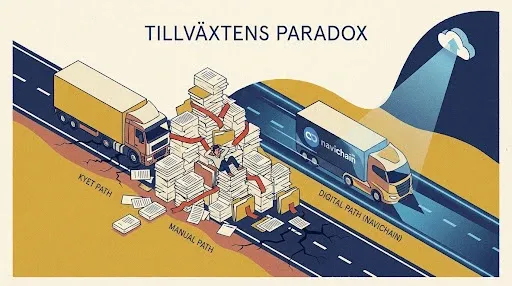
The Growth Paradox in European Haulage: How Digitalisation Breaks the Administrative Cost Curve at Scale
Table of Contents
For European haulage companies, scaling operations often leads to escalating administrative costs. This white paper examines how digitalisation—specifically cloud-based TMS and e-CMR—breaks the administrative cost curve, enabling hauliers to decouple overhead from volume and achieve sustainable, profitable growth while ensuring compliance with upcoming eFTI regulations.
Key Takeaways / Executive Summary: * The Growth Paradox: Manual administrative costs increase linearly with new transport volumes, erasing operational economies of scale. * eFTI Compliance: The 2027 EU regulation mandates digital freight documents, making manual paper processes obsolete. * Digital Decoupling: Integrating a TMS and e-CMR changes administration from a variable to a fixed cost, breaking the cost curve. * The navichain Advantage: An end-to-end SaaS platform built to automate order management, routing, and invoicing for structural profitability.
For European haulage companies, scaling operations often leads to a counterintuitive outcome: escalating administrative costs that erode profitability. This white paper examines how digitalisation, particularly through SaaS platforms like Navichain, can decouple growth from overhead, creating sustainable economies of scale.
The European transport and haulage industry, while crucial to the internal market, faces inherent challenges including fragmentation, thin profit margins (typically 2-5%), and a disproportionate administrative burden. While economies of scale are theoretically achievable in vehicle operations, many companies relying on manual processes encounter a 'growth paradox': operational gains are offset by linearly or exponentially increasing administrative overheads. The EU's eFTI regulation (Regulation EU 2020/1056) mandates the acceptance of digital freight documentation by 2027, necessitating a shift away from paper-based processes costing the industry billions annually. This paper analyses the drawbacks of manual administration, the advantages of digitalisation, and presents a quantified perspective on cost behaviour as transport companies grow. We demonstrate how platforms such as Navichain SaaS are essential for European hauliers to scale profitably and sustainably in the face of increasing regulatory pressures and market competition.
1. What is the European context for the growth paradox?

The European transport and haulage industry forms the backbone of the internal market, facilitating the seamless flow of goods across borders. However, this sector has historically been characterised by extreme fragmentation, intensely competitive pricing pressures leading to compressed profit margins (often hovering around a precarious 2–5 percent), and a disproportionately large administrative burden that weighs heavily on operational efficiency. The theoretical premise of economies of scale, where increased production volume leads to decreased per-unit costs, often fails to materialise in practice for haulage companies clinging to outdated manual processes. Instead, these companies encounter a 'growth paradox'. While operational efficiencies may be gained in the actual transportation of goods, these gains are swiftly negated by the burgeoning administrative overheads that grow linearly – or even exponentially – with increased volume.
From a broader European perspective, the imperative to transition away from this inefficient model is no longer a matter of choice but a regulatory obligation. What is eFTI? The European Union's Regulation on Electronic Freight Transport Information (eFTI – Regulation EU 2020/1056) [https://eur-lex.europa.eu/eli/reg/2020/1056/oj], slated for full implementation by 2027, compels member state authorities to accept digital freight documents. This landmark legislation aims to eliminate the paper-based barriers that currently cost the industry billions of euros annually in wasted time, resources, and administrative inefficiencies. As Gnap et al. (2022) demonstrate in their study on the impact of digitisation, embracing digital solutions is crucial for maintaining competitiveness in the evolving landscape of European road freight transport. The integration of solutions such as Navichain SaaS becomes essential for hauliers aiming to navigate the complexities of eFTI compliance and unlock sustainable growth.
In light of these challenges and regulatory pressures, a comprehensive re-evaluation of administrative processes and a decisive shift towards digitalisation are paramount for European haulage companies to achieve sustainable growth and long-term profitability.
2. How does the manual trap create administrative diseconomies of scale?

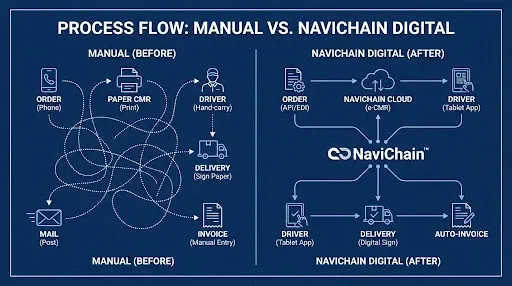
In a traditional, manually operated transport company, administrative overhead is often perceived as an unavoidable variable cost, intrinsically linked to operational activity. Each international shipment necessitates the creation and management of physical freight documents, such as paper-based CMR forms, often in multiple copies. This is compounded by the complexities of manual customs clearance procedures, frequent telephone calls for shipment tracking and confirmation, and the extensive handling of paper-based invoices and proof of delivery documents. The reliance on manual processes introduces significant inefficiencies and vulnerabilities into the system.
As such a company expands its fleet and increases its transport volume, it inevitably encounters administrative diseconomies of scale. The administrative burden increases almost linearly with the number of new assignments. An expansion of the truck fleet invariably necessitates the recruitment of additional transport managers, payroll administrators, and invoicing clerks to handle the increased paperwork and communication overhead. This linear relationship between volume growth and administrative staffing levels directly impacts profitability.
Furthermore, empirical data consistently demonstrates that manual order processing is plagued by protracted lead times. From the initial confirmation of an order to the final confirmation of delivery, the process can span 2–3 days, excluding the time drivers spend physically handling paperwork. This extended lead time not only reduces operational efficiency but also delays revenue recognition and impacts cash flow. Crucially, growth within a manual operational context inevitably leads to a proliferation of human error, including data entry errors, misfiled documents, and communication breakdowns. These errors create hidden costs in the form of customer disputes, delayed payments, and ultimately, reputational damage. The accumulation of these inefficiencies acts as a significant drag on profitability, effectively negating the potential benefits of increased scale. As McKinsey & Company (2024) have highlighted, the persistence of manual processes in logistics significantly impedes operational efficiency and profitability.
For instance, consider a haulage company processing 1,000 shipments per month with a team of 5 administrative staff. If the company aims to double its shipment volume to 2,000 per month using the same manual processes, it would likely need to double its administrative staff to 10 to cope with the increased workload. This direct proportionality between volume and administrative costs exemplifies the manual trap and highlights the urgent need for digitalisation to achieve sustainable growth.
3. How can digital decoupling build structural economies of scale?
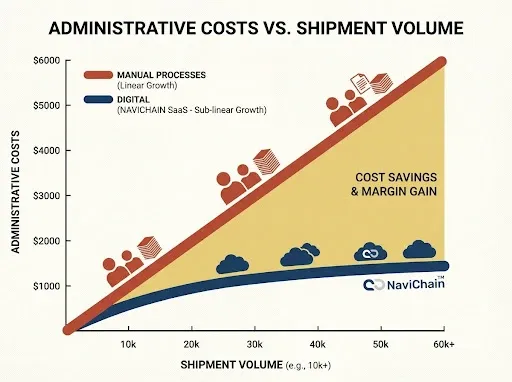
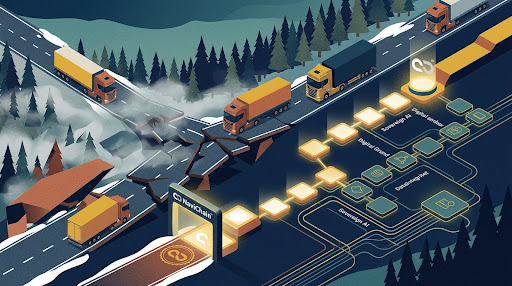
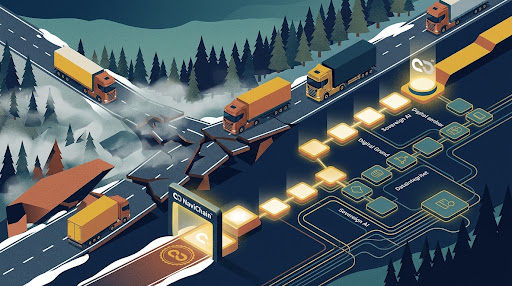
In stark contrast to their manually driven counterparts, companies that strategically invest in comprehensive, end-to-end digitalisation – through cloud-based Transport Management Systems (TMS), What is EDI? Electronic Data Interchange (EDI/API) technologies, and electronic consignment notes (e-CMR) – fundamentally alter their cost structure and unlock substantial operational efficiencies. Digitalisation acts as a decoupling mechanism, effectively severing the previously inextricable link between volume growth and administrative overhead. By ensuring that data is entered only once and automatically validated throughout the entire supply chain, administration is transformed from a variable cost to a fixed (or, more accurately, sub-linear) cost. This fundamental shift in cost structure creates the foundation for genuine economies of scale.
Consider a fully digitalised system managing 1,000 freight documents per month. With the implementation of automated workflows, electronic data exchange, and streamlined communication channels, this system can seamlessly scale to handle 10,000 documents without requiring a commensurate increase in administrative staff. The marginal cost of administration per new order consequently approaches zero, allowing the company's growth to directly contribute to an increase in profit margin. This decoupling effect is the key to breaking the administrative cost curve and achieving sustainable profitability at scale.
The integration of platforms such as Navichain SaaS further accelerates this decoupling process by providing a centralised, cloud-based solution that streamlines all aspects of transport management, from order booking and dispatch to real-time tracking and automated invoicing. Navichain SaaS leverages APIs to integrate seamlessly with existing systems, eliminating the need for manual data entry and reducing the risk of human error. Furthermore, by supporting e-CMR and other digital freight documents, Navichain SaaS facilitates compliance with eFTI regulations and unlocks further efficiencies in cross-border transport. As HOPI Logistics (2024) have reported, embracing document digitalisation can yield substantial savings in overall documentation costs, significantly boosting profitability and operational agility. The strategic implementation of such systems is therefore paramount for European hauliers seeking to thrive in an increasingly competitive and regulated market environment.
4. What are the quantified assumptions for sustainable growth?
Based on the synthesis of contemporary research and European industry data, we can establish quantifiable assumptions regarding cost behaviour as a transport company grows, for example, by adding 10,000 new freight assignments per year. These assumptions highlight the significant financial and operational advantages of digitalisation and underscore the importance of embracing technologies like Navichain SaaS to achieve sustainable growth.
Assumption 1: Reduced Time Expenditure and Direct Costs
Quantification: According to European pilot studies and industry analyses (including Trans.INFO, 2025 [https://trans.info/en/the-real-numbers-behind-ecmr-70-cost-reduction-60-time-savings-255228]), the transition from paper-based CMR to e-CMR results in a reduction of administrative time expenditure by up to 60% per shipment and lowers direct document handling costs by nearly 70%. Logistics experts (HOPI Logistics) estimate that companies save between 20–50% of their total documentation costs by transitioning away from paper-based systems. With a growth of 10,000 assignments, this translates into radical savings in pure wage costs and materials for the digital company, while the manual company has to hire more administrators and still faces paper costs.
For instance, consider a company that spends an average of 30 minutes per shipment on manual administrative tasks, including data entry, document preparation, and communication with customers and partners. By implementing e-CMR and automating these tasks, the company can reduce this time to just 12 minutes per shipment, saving 18 minutes per shipment. Over 10,000 shipments, this equates to a total saving of 3,000 hours, which translates into significant cost savings in terms of reduced labour costs.
Assumption 2: Cash Flow and Financing of Growth (Working Capital)
Quantification: Manual processes require physical papers (Proof of Delivery) to be sent back before invoicing can take place. A scientific study published in MDPI (Gnap et al., 2022 [https://www.mdpi.com/2076-3417/12/19/9920]) investigated the effect of e-CMR and found that digitalisation shortens the average invoicing delay by as much as 11.5 days. This immediately releases approximately 7% of the tied-up working capital. A fast-growing digital company can use these funds to finance its own expansion interest-free (e.g. leasing of new cars), while the manual company risks acute liquidity shortages and is forced to utilise expensive overdraft facilities.
For example, if a company has a monthly revenue of €1,000,000 and an average invoicing delay of 30 days, it has €1,000,000 of working capital tied up in outstanding invoices. By reducing the invoicing delay by 11.5 days through digitalisation, the company can free up approximately €383,333 of working capital, which can then be reinvested in the business. This provides a significant competitive advantage over companies that continue to rely on manual processes and face liquidity constraints.
Assumption 3: Operational Efficiency and Error Rate
Quantification: According to McKinsey & Company (2024), automation in the logistics sector can lower total operational costs by 10 to 15% and shorten the total order processing time from days to 1–2 hours. Automated data validation eliminates the input errors that, in a manual environment, increase proportionally with growth and cause expensive rework.
Consider a company that experiences an error rate of 5% in its manual order processing, resulting in costly rework, customer disputes, and delayed payments. By implementing automated data validation and electronic workflows, the company can reduce its error rate to less than 1%, saving significant time and resources on error correction and improving customer satisfaction. This improved operational efficiency directly translates into increased profitability and a stronger competitive position in the market.
In conclusion, a transport company cannot simply 'hire its way out' of its growth challenges. Companies that continue to operate manually build expensive, variable overhead costs that threaten to erase the profit from new volumes. Those who digitalise build a platform where each new transport assignment is performed with an administrative marginal cost that is close to zero, which is an absolute prerequisite for survival in the future European logistics apparatus. The adoption of solutions like Navichain SaaS is no longer a luxury but a necessity for European hauliers seeking to achieve sustainable growth and thrive in an increasingly digital and competitive market.
**
Ready to break the administrative cost curve and decouple your growth from overhead costs? Navichain SaaS provides the platform for the future of digital logistics without the need for heavy IT integrations.**
5. How does digitalisation impact work processes in logistics?
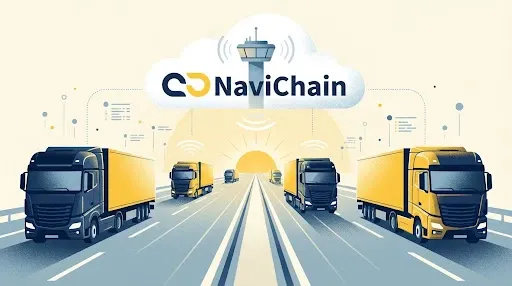
The implementation of Navichain SaaS and digital solutions in logistics fundamentally affects traditional work processes, leading to a more streamlined and efficient operation. This transformation encompasses several key areas:
Order Management: In a manual environment, order management often involves paper-based documents, phone communication, and manual data entry across multiple systems. This is a time-consuming and error-prone process. With Navichain SaaS, order management is automated, reducing the need for manual input and communication. Customers can place orders online, and the information is automatically transferred to the transport planning system. This reduces the risk of errors and accelerates the order process.
Transport Planning: Traditional transport planning is often done manually, using maps, tables, and experience. This is a complex and time-consuming task, particularly for companies with a large fleet and many destinations. Navichain SaaS offers advanced transport planning features that optimize routes, minimize fuel consumption, and improve delivery precision. The system takes into account factors such as traffic conditions, weather conditions, and load capacity to create the most efficient routes.
Tracking and Monitoring: In a manual environment, tracking shipments and getting an overview of the entire supply chain is difficult. This can lead to delays, lost shipments, and reduced customer satisfaction. Navichain SaaS offers real-time shipment tracking, allowing customers to follow their goods from sender to receiver. The system generates automatic notifications of delays or deviations, enabling the company to proactively manage issues and inform customers.
Invoicing and Payment: Manual invoicing is a time-consuming and error-prone process. Invoices must be created manually, sent by mail, and followed up for payment. Navichain SaaS automates the invoicing process, from creating invoices to payment reminders. The platform integrates with existing accounting systems and enables automatic reconciliation of payments. This reduces the administrative workload and improves cash flow.
Reporting and Analysis: In a manual environment, collecting and analyzing data on transport processes is challenging. This prevents the company from identifying areas for improvement and optimizing its processes. Navichain SaaS offers comprehensive reporting and analysis tools that provide the company with insights into its transport processes. The system generates reports on key performance indicators (KPIs), such as delivery precision, fuel consumption, and customer satisfaction. These reports can be used to identify inefficiencies and optimize processes.
About the Author: Manusha works with system integration and logistics automation at navichain. He specialises in helping transport and healthcare companies eliminate administrative complexity through scalable, sovereign SaaS solutions.
6. What are the scientific sources and references?
Gnap, J., Senko, Š., Kostrzewski, M., & Brída, P. (2022). The Impact of Digitization Transport Documents on the Competitiveness of Road Freight Transport Companies. MDPI. European Union (2020). Regulation (EU) 2020/1056 of the European Parliament and of the Council on electronic freight transport information (eFTI). Trans.INFO (2025). "The real numbers behind eCMR: 70% cost reduction, 60% time savings". Zyllem / McKinsey & Company Analytics (2024). "Manual vs. Digital: Transforming Transport Management and Distribution Logistics". HOPI Logistics / EU Council Analytics (2024). "Document Digitalization in Freight Transport".
Further reading: * Deloitte. (2023). Digital Transformation in Logistics: Opportunities and Challenges. * PwC. (2024). The Future of Logistics: A Data-Driven Perspective. * Accenture. (2025). Logistics 4.0: Revolutionizing the Supply Chain. * Gartner. (2026). The Top 10 Strategic Technology Trends Impacting Supply Chain in 2026.
navichain Insights Newsletter
Join the newsletter to receive the latest updates in your inbox.