Fleet Emissions Reporting & Compliance: From Guesswork to ISO 14083
Table of Contents
Navichain Sovereign Emissions: Precision reporting for the green transition.
Executive Summary
The era of "estimated emissions" is over. With the 2026 CSRD (Corporate Sustainability Reporting Directive) requirements now fully active, large logistics buyers are demanding primary data, not averages. Standard telematics solutions often rely on GPS distance x Average Liters/100km, a method that is no longer audit-proof.
Navichain introduces the Sovereign Emissions Model. By leveraging the Teltonika FMC650 to extract real-time fuel injection data via CAN-bus (FMS) and processing it through a locally hosted .NET engine, we provide precise, ISO 14083 compliant reports. This ensures your fleet isn't just "greenwashing"—it's audit-ready.
The Problem: The "Average" Trap
Most fleet management systems calculate CO2 based on assumed consumption. * The Flaw: They take "Distance Traveled" (e.g., 100km) and multiply it by a static "Average Consumption" (e.g., 28L/100km). * The Reality: A fully loaded truck driving uphill in winter burns 45L/100km. An empty truck coasting downhill burns 12L/100km. * The Risk: When a CSRD auditor asks for your source data, "averages" can lead to accusations of false reporting.
The Solution: Primary Data Calculation
Navichain bypasses estimates by reading the Total Fuel Used (AVL ID 115) directly from the engine's ECU.
1. The Sovereign Emissions Engine (C#)
Our logic runs securely, converting raw liters into $CO_2e$ (Carbon Dioxide Equivalent) using localized emission factors (WTW).
public EmissionResult Calculate(double fuelConsumedLitres, string fuelType, double payloadTons, double distanceKm)
{
    // 2026 Standard Emission Factors (Well-to-Wheel / WTW)
    private readonly Dictionary<string, double> _fuelFactors = new() {
        { "Diesel_B7", 3.15 }, // kg CO2e per Litre (Standard)
        { "HVO100", 0.65 },    // kg CO2e per Litre (Bio-diesel)
        { "CNG", 2.65 }        // kg CO2e per kg
    };

    // ISO 14083 Primary Calculation
    double totalEmissionsKg = fuelConsumedLitres * _fuelFactors[fuelType];

    // Intensity Metric (CSRD Requirement)
    double intensity = totalEmissionsKg / (payloadTons * distanceKm);

    return new EmissionResult { TotalCo2Kg = totalEmissionsKg, IntensityMetric = intensity };
}
- Audit Confidence: You are reporting the exact chemical reaction that occurred in the engine, not a statistical guess.
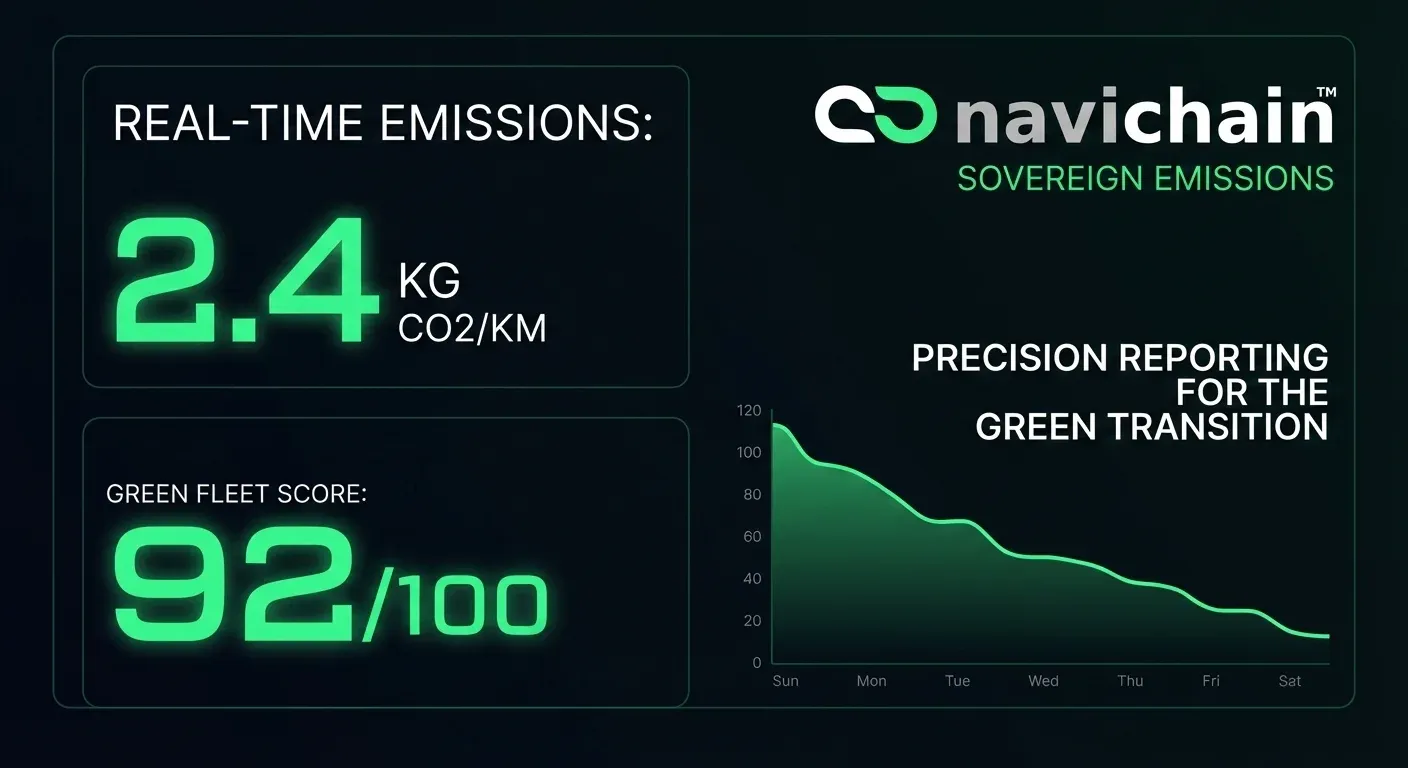
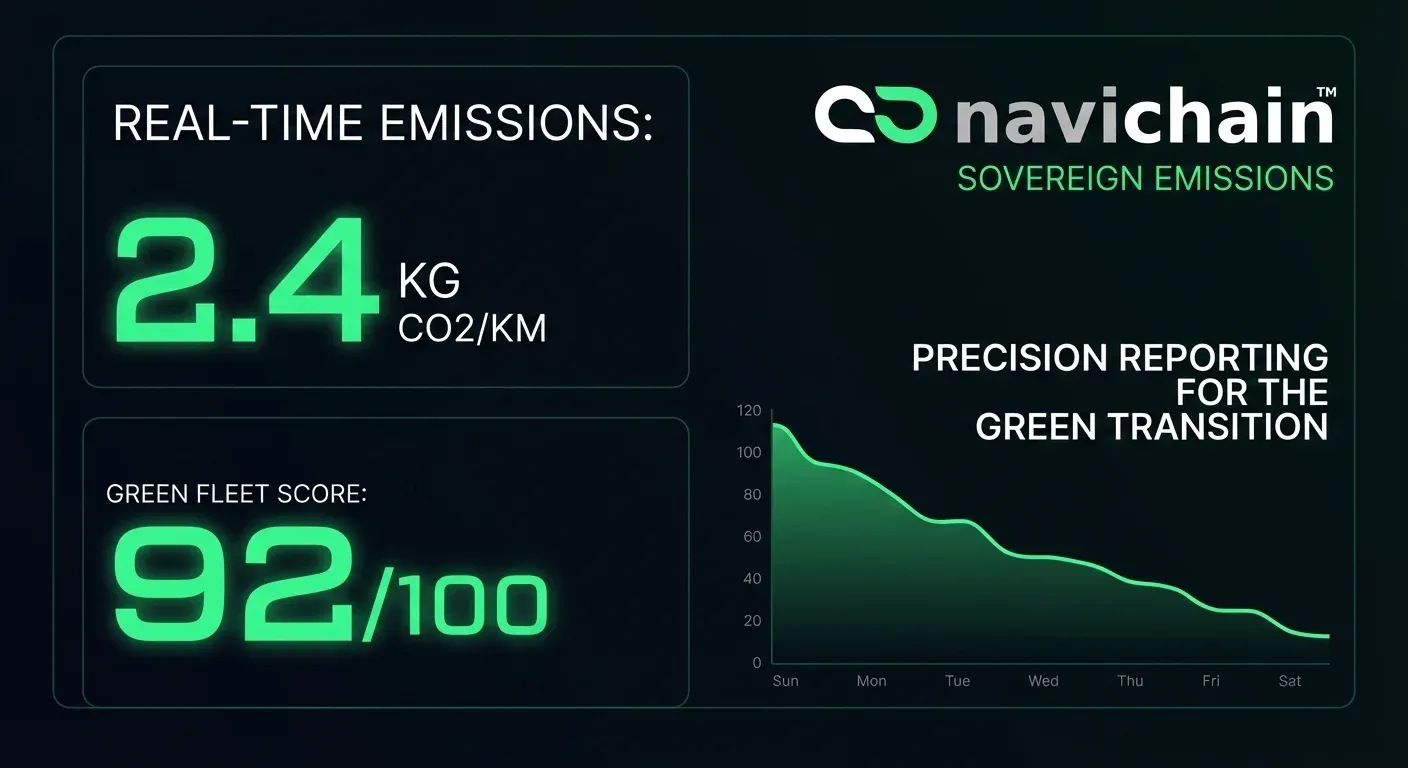
Precision matters: Actual FMS data reveals the true carbon cost of every kilometer.
2. ISO 14083 Compliance Checklist
To ensure your reports pass the scrutiny of the BAG (Germany) or Transportstyrelsen (Sweden), Navichain enforces three critical pillars:
- Well-to-Wheel (WTW): We calculate the full lifecycle emissions, including the production of the fuel, which is mandatory for Scope 3 reporting.
- Empty Running Detection: Using GraphHopper and load status, the system identifies "Empty Legs." This allows you to accurately report (and improve) your Emissions Intensity ($g CO_2e / tkm$).
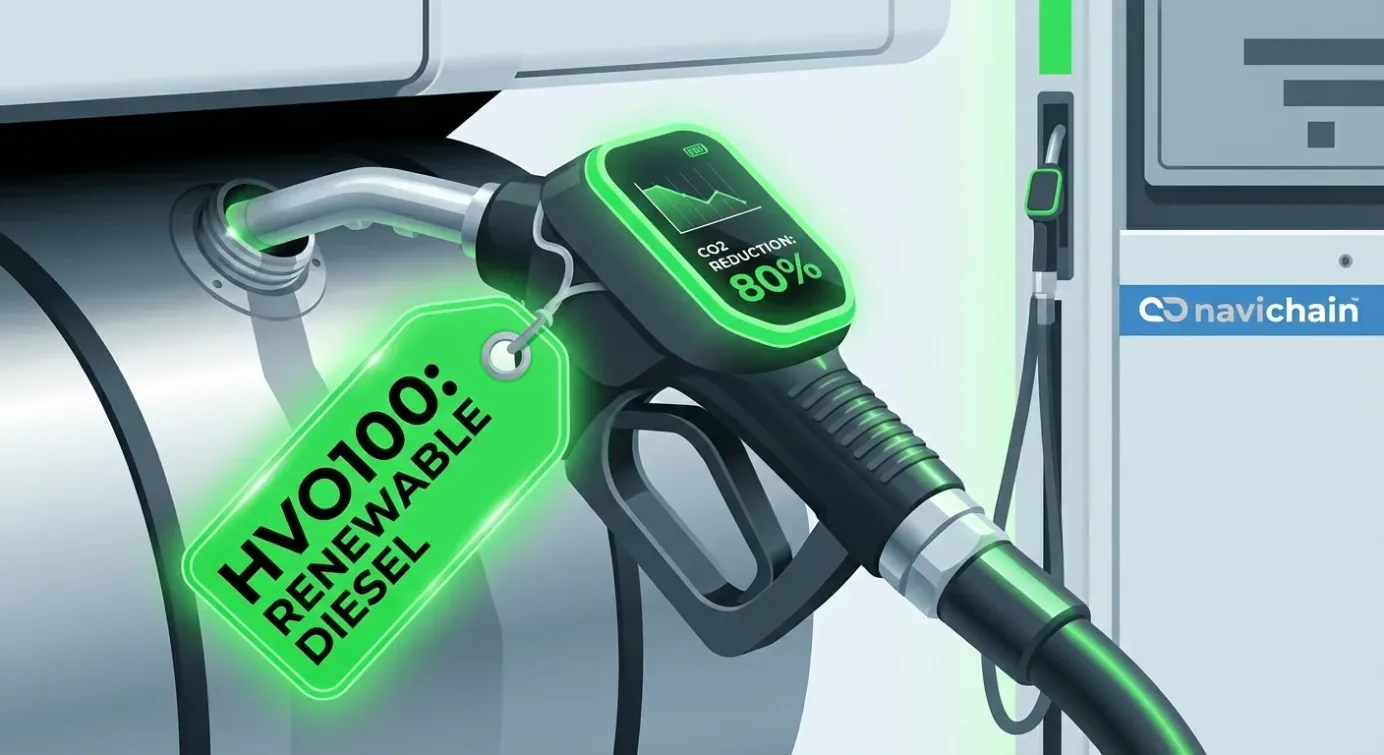
- HVO100 Tagging: If you fill up with Renewable Diesel (HVO100), the system allows you to "tag" that refueling event. This instantly lowers the specific emissions for that trip by ~80%, providing concrete ROI for your sustainable fuel investments.
3. The "Fleet Health" Dashboard
Data is useless if it doesn't drive decisions. The Carbon Ledger provides executive visibility:
- Real-Time Ticker: "Fleet has saved 4.2 Tons of CO2 today vs. 2025 baseline."
- Efficiency Leaderboard: Identifies which drivers achieve the lowest emissions per ton-km, rewarding Eco-Driving habits (coasting, low RPMs) monitored by the FMC650.

The Carbon Ledger: Visualizing the ROI of your green initiatives.
Infrastructure Readiness (RavenDB)
Sustainability data is legal data. In navichain SaaS, we store these high-resolution emission records for up to 10 years. This guarantees that when a client audits your 2026 supply chain in 2030, you can produce the original, immutable telemetry proofs.
Conclusion
Sustainability is no longer a marketing buzzword; it is a license to operate. Navichain's Fleet Emissions module empowers you to move from defensive estimation to offensive precision. Provide your clients with the gold standard of carbon reporting and secure your place in the sustainable supply chains of the future.
Navichain: Validated sustainability, sovereignly hosted.
References
- ISO 14083:2023. Greenhouse gases — Quantification and reporting of greenhouse gas emissions arising from transport chain operations.
- European Union (2025). Corporate Sustainability Reporting Directive (CSRD) Implementation Guide.
- Teltonika Telematics (2025). FMS Data Standards and Fuel Can-Bus accuracy.
- Global Logistics Emissions Council (GLEC). Framework for Logistics Emissions Methodologies.
Ready for the 2026 CSRD Audit?
navichain Insights Newsletter
Join the newsletter to receive the latest updates in your inbox.