Dispatcher Brain Drain: When Experience Retires
Table of Contents
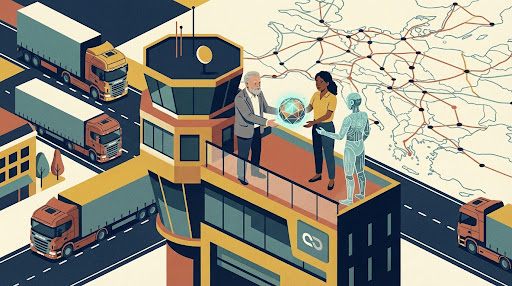
The transport industry is facing a demographic cliff edge. We call it the "Silver Tsunami." Across Europe and North America, a staggering 30% of the logistics workforce is expected to retire by 2030. These aren't just employees; they are the "Tribal Elders" of the supply chain. They hold the unwritten codes, the personal relationships, and the intuitive problem-solving skills that keep goods moving. When they leave, they take the company's brain with them.
Executive Summary
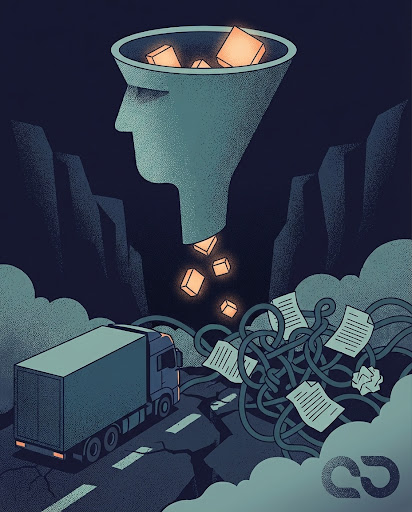
While trucking companies obsess over the driver shortage, a more subtle but equally dangerous shortage is brewing in the office: The Dispatcher Brain Drain. The role of the dispatcher has historically relied on "Tacit Knowledge"—information that isn't written down in any manual but exists solely in the heads of experienced staff.
Replacing a 60-year-old veteran with a 22-year-old graduate is not a 1:1 swap. The newcomer lacks the experience, and often, the patience for legacy IT systems.
This white paper proposes a dual strategy for survival: 1. Digitize the Wisdom: Using AI to capture "Tribal Knowledge" before it walks out the door. 2. Modernize the Tools: Creating a gamified, app-based environment that attracts and retains Gen Z talent.
Part 1: The Silver Tsunami & Tribal Knowledge
The Demographic Mathematics
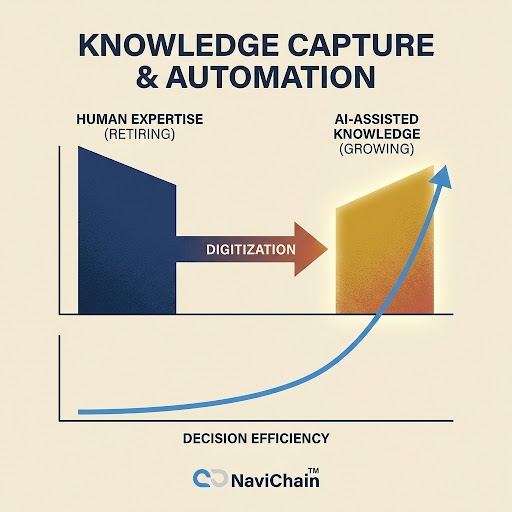
The numbers are unforgiving. The average age of a transport planner in Germany is 54. in the UK, it's 57. * The Exit Rate: Over the next 5 years, the industry will lose its most experienced layer of management. * The Experience Gap: It takes roughly 7-10 years to train a "Master Dispatcher." We do not have 10 years to train the replacements.
The Problem of "Berra" (Tribal Knowledge)
Every haulage company has a "Berra." Berra has worked there for 35 years. * The Black Box: Berra knows that "Customer X always says they close at 17:00, but the gatekeeper stays until 17:30 if you bring him a coffee." This rule is not in the system. It is in Berra's head. * The Chaos: When Berra goes on holiday, efficiency drops by 15%. When Berra retires, the route planning collapses. * The Risk: relying on individual heroism rather than systemic process is a business continuity risk that investors and large clients are increasingly flagging.
Part 2: AI as the Digital Apprentice
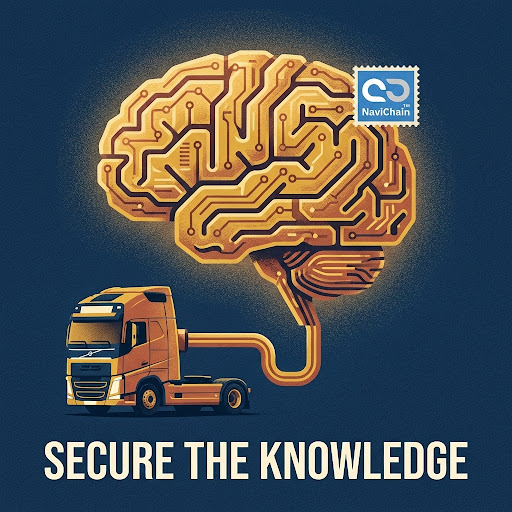
Digitize the brain before it leaves the building.
We cannot clone Berra. But we can clone his decisions.
"Shadow Mode" Learning
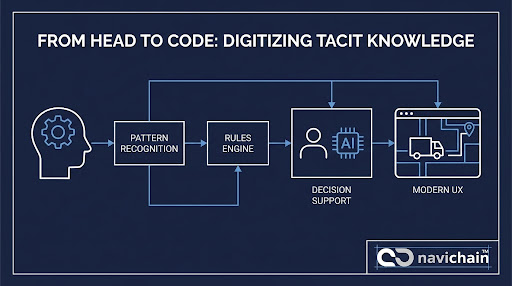
Navichain's AI doesn't just calculate; it observes. * Observation: The system watches how experienced dispatchers handle exceptions. "Why did Berra override the algorithm and send Truck A instead of Truck B?" * Pattern Recognition: The AI correlates this decision with external factors (e.g., "Truck B driver hates waiting"). * Codification: The AI suggests a new rule: "Avoid assigning Driver B to high-wait customers." * Result: The tacit knowledge is extracted and turned into code.
The Corporate Memory
Navichain becomes the central repository for operational wisdom. * Wiki-on-Rails: Instead of a dusty Word document manual, the knowledge is embedded in the workflow. When a new dispatcher tries to book Customer X, a pop-up appears: "Tip: Gatekeeper stays late for coffee." * Continuity: The system ensures that the company's IQ doesn't drop when an individual leaves.
Part 3: The Gen Z Factor - Gamification & UX
You cannot attract a digital native to work on a green-screen AS/400 terminal. To them, that looks like archaeology, not technology.
The "Fortnite" Interface
Navichain is designed like a modern consumer app, not enterprise bloatware. * Visual Dispatching: Drag-and-drop interfaces, map-based planning, and instant chat. * Gamification: We introduce elements of game design. "Efficiency Streaks," "CO2 Savings Badges," and "On-Time Leaderboards." This taps into the competitive nature of younger workers and provides instant dopamine feedback loops similar to social media.
Lowering the Barrier to Entry
By automating the complex compliance rules (Driving & Resting times), we lower the skill floor required to start. * From 3 Years to 3 Months: A junior dispatcher can be productive in weeks because the system acts as guardrails, preventing them from making illegal or expensive mistakes.
Part 4: The Hybrid Team of the Future
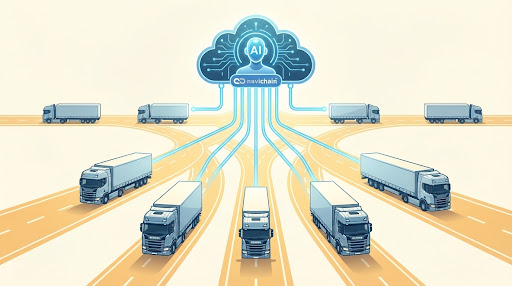
The goal is not a "human-less" dispatch room, but a "super-human" one.
The Mentor Role
The role of the senior dispatcher shifts from "doing everything" to "tuning the machine." * Algorithm Tuning: The veterans spend their final years helping to configure the AI logic, ensuring their legacy lives on in the software parameters. * Exception Management: The AI handles 90% of the standard flow, leaving the humans to deal with the 10% of complex, messy reality that requires empathy and creativity.
Scalability without Scale
With AI handling the routine, you can grow your fleet without linearly growing your office staff. One dispatcher can manage 50 trucks instead of 20, with higher job satisfaction and less burnout.
Conclusion
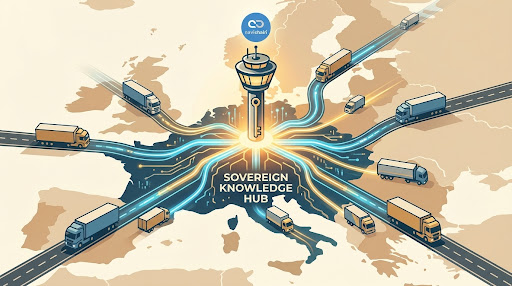
The Silver Tsunami is inevitable, but the Brain Drain is optional.
If you ignore this shift, you will wake up in 2030 with a parking lot full of trucks and an office full of empty chairs. But if you act now—by using AI to capture wisdom and modern UX to attract youth—you can build a resilient, future-proof organization.
Don't let your competitive advantage walk out the door into retirement. Capture it in the code.
Secure Your Knowledge.
See how Navichain combines AI learning with modern design.
navichain Insights Newsletter
Join the newsletter to receive the latest updates in your inbox.