Data Sovereignty: Why Your Logistics Data Must Stay in Europe
Table of Contents
Executive Summary: The New Data Cold War
The digitalization of the logistics industry has delivered efficiency gains we could only dream of a decade ago. Real-time tracking, AI-optimized routes, and automated invoicing are now standard. But this digital revolution has carried a Trojan horse: the reliance on foreign cloud infrastructure.
For European companies using US cloud services (such as AWS, Azure, or Google Cloud), there is an uncomfortable truth hidden in the user agreements: the US Cloud Act. This law gives US authorities the legal right to demand your data, regardless of whether the servers are located in Frankfurt, Dublin, or Luleå.
This white paper is a wake-up call and a roadmap. We dive deep into what Data Sovereignty actually means, analyze the legal conflict between GDPR and American surveillance, and present why a Swedish-owned, Swedish-operated Sovereign Cloud is the only sustainable strategy for logistics companies that value their secrets.
Section 1: The Invisible Threat – When Your Data Is No Longer Yours
Many business leaders live under the delusion that "data residency" (where data is geographically stored) is the same as "data sovereignty" (who has legal control over the data). They assume that if their data is stored in a data center on European soil, it is automatically protected by European laws. This is a dangerous, and potentially illegal, misconception.
What is the US Cloud Act?
The Clarifying Lawful Overseas Use of Data Act (CLOUD Act), enacted in 2018, changed the playing field for global data management. The law was designed to give US law enforcement agencies (such as the FBI and NSA) the ability to compel US technology companies to hand over data they "own, control, or possess," regardless of where in the world this data is physically located.
In practice, this means that US legislation extends beyond US borders. If you use a US cloud provider – even via their European subsidiaries – your data falls under American jurisdiction. A US court can issue an order for your data to be handed over, and your cloud provider often has no legal ability to refuse, or even inform you that it has happened (so-called "gag orders").

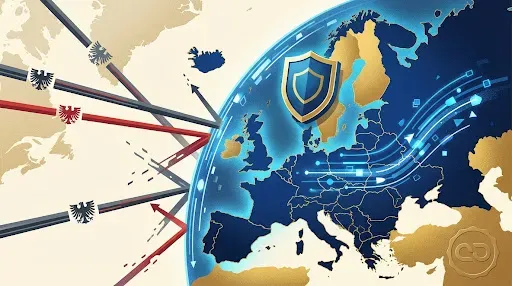
Caption: The legal collision. The US Cloud Act tears apart the safety net that GDPR attempts to build around European data.
Why is this a risk for logistics companies?
For a logistics company or carrier, data is hard currency. It's not just about GDPR and personal data regarding drivers and customers. It's about business-critical information:
- Supply Chains: Who delivers to whom? What volumes?
- Pricing: What margins do you have with key clients?
- Routes and Goods: Where is valuable or sensitive cargo located right now?
In a world characterized by geopolitical unrest and trade wars, this information is strategically vital. Imagine a foreign authority, under the pretext of an investigation, gaining access to your entire customer database. Or industrial espionage being enabled through backdoors in cloud infrastructure. The risk exposure is not theoretical; it is built into the system.
Section 2: GDPR and Schrems II – A Legal Dead End
To understand the severity, we must look at the EU's attempts to protect us. GDPR (General Data Protection Regulation) is the world's strictest data protection law. It is built on the principle that European citizens' personal data must be protected, regardless of where it is sent.
Twice, the Court of Justice of the European Union has invalidated data transfer agreements between the EU and the US (Safe Harbor and Privacy Shield). The latest ruling, known as Schrems II, established that US surveillance laws (such as FISA 702 and the Cloud Act) lack the safeguards and proportionality that GDPR requires. The court starkly concluded that American companies cannot guarantee the protection of European data, as they are obliged to cooperate with US intelligence services.
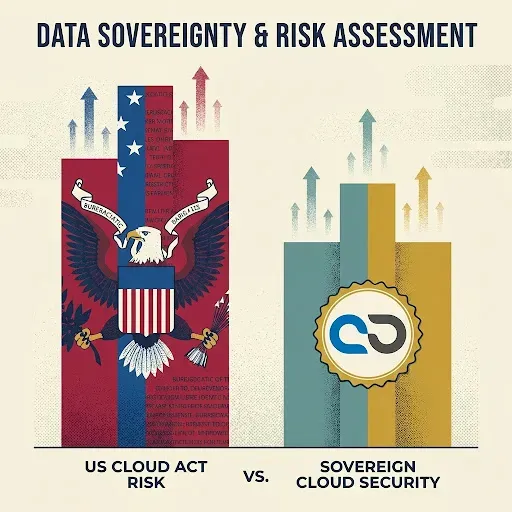
Caption: Statistics on data requests. The chart illustrates the explosive increase in government requests to US cloud giants in recent years.
The Consequence for You
This creates a legal minefield. If you use US cloud services to store personal data (e.g., in your TMS or ERP system), you risk violating GDPR, even if the data never leaves Sweden. The Swedish Authority for Privacy Protection (IMY) has begun to act and issue fines against organizations using, for example, Google Analytics illegally. It is only a matter of time before scrutiny reaches the logistics sector, which handles enormous amounts of personal and location data.
Section 3: The Solution – What is a Sovereign Cloud?
The answer to this dilemma is not to go back to pen and paper, or to run servers in the basement. The answer is Data Sovereignty.
A Sovereign Cloud is a cloud service where all data, all metadata, and all operations remain under the laws of a specific jurisdiction – in this case, Swedish and European law. It is about total control.
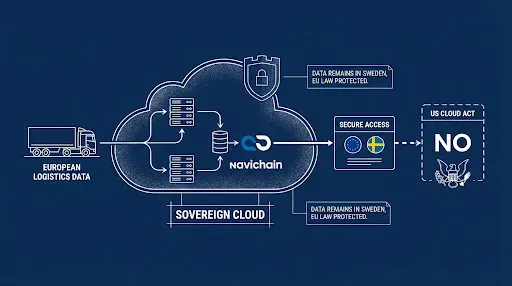
Caption: How Sovereign Cloud works. A closed ecosystem where data flows securely within Sweden's borders, protected from foreign access.
Three Pillars of Sovereignty with Navichain:
- Legal Sovereignty: Data is stored and processed by a legal entity (Navichain AB) registered in Sweden and not owned by foreign interests. We answer solely to Swedish courts.
- Operational Sovereignty: No foreign support staff have access to the systems. Operations, maintenance, and administration are handled by staff based in Sweden.
- Technical Sovereignty: We own our code and control our infrastructure. We are independent of black-box solutions from "Big Tech."
This means that when a US court demands data, we can – unlike Microsoft or Amazon – legally say: "No. We correspond to Swedish law."
Section 4: Navichain Advantage – Technology Without Compromise
Many believe that choosing a local, sovereign alternative means sacrificing performance or functionality. Navichain proves the opposite. We have built a platform that combines the innovative power of Silicon Valley with Swedish engineering and privacy mindset.
Proprietary AI on Swedish Soil
Most "AI solutions" in the logistics industry are actually just shells sending your data to OpenAI or Google for processing. This means your sensitive data trains their models. Navichain runs proprietary AI models for route optimization and invoice interpretation locally in our own cloud. Your data never leaves our secure environment. It trains your business, not others.
Hardware and Infrastructure
We do not rely on virtual machines somewhere in a nebulous cloud. We use "Bare Metal" servers in Swedish security-classified data centers.
- Physical Security: Perimeter protection on par with bank vaults.
- Redundancy: Data is mirrored between geographically separated Swedish halls for maximum uptime.
- Encryption: All data is encrypted both in transit and at rest, with keys controlled by us and you – never a third-party provider.
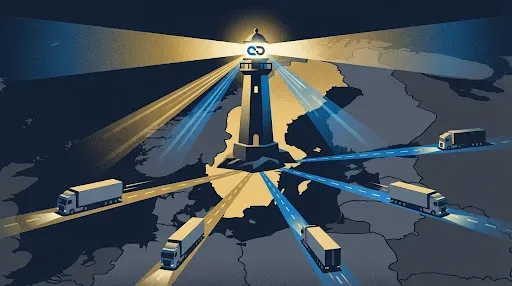
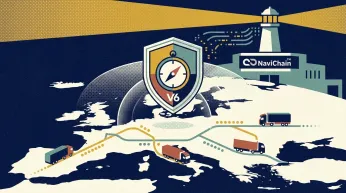
Caption: Navichain's architecture. A central beacon guiding logistics flows with precision, driven by local, sovereign intelligence.
Section 5: Business Value – Resilience as a Competitive Advantage
Data sovereignty is not just a matter of compliance. In today's market, it is a strategic asset that builds trust and resilience.
1. Security for Your Customers
By choosing Navichain, you can guarantee your clients – whether the Armed Forces, pharmaceutical companies, or retail – that their delivery data is handled with the highest security classification. This becomes a crucial differentiator in procurements where security carries heavy weight.
2. Protection Against Geopolitical Uncertainty
The global situation changes rapidly. Trade wars or political conflicts can suddenly stifle access to foreign cloud services or change the conditions for data export. With a Swedish, sovereign solution, your business is insulated from these global disruptions. You have "data independence."
3. Future-Proofed Compliance
GDPR is just the beginning. New EU regulations such as the Data Governance Act and Cyber Resilience Act place ever-increasing demands on digital sovereignty. Navichain is built to meet not only today's but also tomorrow's legal requirements.
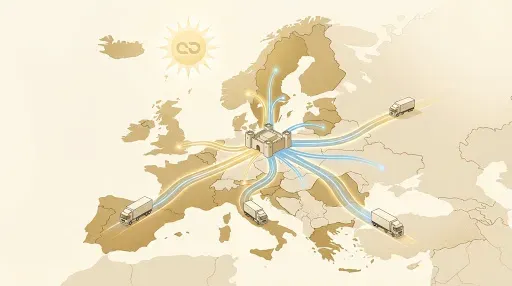
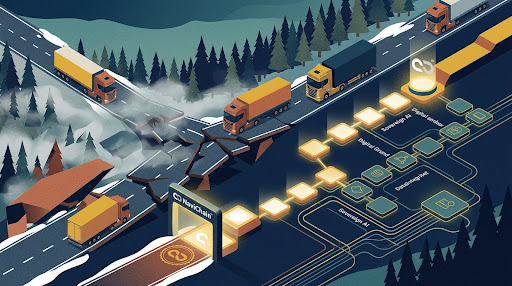
Caption: The result. An optimized, secure, and legal logistics network where you retain full control over your most valuable asset: your data.
The Future: Sovereignty as an Enabler of Innovation
Data sovereignty is not a barrier to innovation; it is a prerequisite for it. As we look ahead to the next generation of logistics systems, the need for secure data management will only increase.
IoT and Real-Time Data
Modern trucks and containers are packed with sensors generating terabytes of data daily. Sending this data across the Atlantic for analysis is not only insecure, it is inefficient (latency). With Navichain's sovereign cloud, data is processed close to the source (Edge Computing principles), providing faster decisions and lower bandwidth costs.
Blockchain and Traceability
For blockchain to work in logistics, trust is required. If the nodes in the network are controlled by foreign actors, the entire idea of a decentralized, secure ledger falls apart. A sovereign cloud is the natural home for private blockchains where shipping documents and ownership are handled immutably.
AI-Driven Predictive Analytics
The logistics of the future is not about fighting fires, but predicting them. Our AI can forecast supply chain disruptions, optimize inventory, and automate pricing. But for AI to be effective, massive amounts of historical data are required. Companies that dare to feed this data into our models know it stays there. This gives them the confidence to fully digitize.
Checklist for Decision Makers
Before you renew your contract with a US cloud provider, ask yourself the following questions:
- Legal Jurisdiction: Under which law's jurisdiction does my data fall in practice, not just according to the contract?
- Access Control: Can the provider's support staff in third countries (e.g., the US or India) technically access my data?
- Metadata: Even if the content is encrypted, who has access to my metadata (who I communicate with, when, and how often)?
- Lock-in Effect: How difficult and expensive is it to move my data if the legal situation changes (e.g., with a new "Schrems" ruling)?
If the answers to these questions make you unsure, it is time to evaluate a sovereign alternative.
Conclusion: A Strategic Crossroads
We stand at a crossroads. One path leads to increased dependence on global giants, where your data becomes a commodity in a jurisdiction you cannot influence. The other path – Navichain's path – leads to independence, security, and control.
For the European logistics industry, the choice should be simple. We have a proud tradition of independence and quality. Let us apply that to our digital infrastructure as well.
Choose not just a system to move goods. Choose a system to protect your future.
References and Further Reading
Is your data secure?
Don't take risks with your business-critical information. Book a review with our experts on how Navichain Sovereign Cloud protects your business.
Swedish Data. Swedish Law. Your Security.
navichain Insights Newsletter
Join the newsletter to receive the latest updates in your inbox.