App Fatigue in the Cab: Why Your Drivers Hate Their Work Phone
Table of Contents
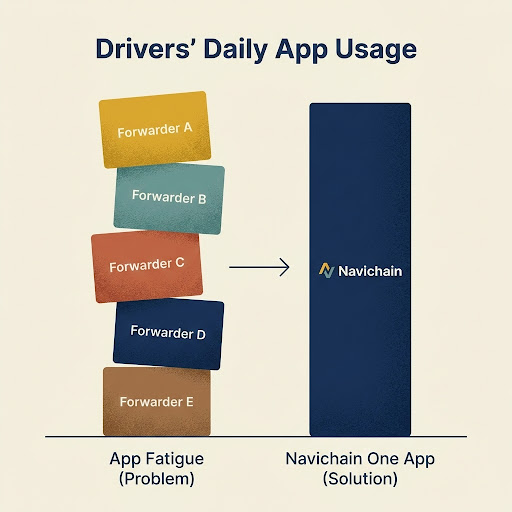
Digitalization was supposed to make life easier. But for many drivers, it has been the opposite. Instead of stacks of paper, they now have a phone filled with 5-6 different apps from the major forwarders – all requiring login, updates, and different procedures. This "App Fatigue" is not just annoying; it is a safety hazard and a primary driver of staff turnover. It is time to clear the dashboard.
Executive Summary
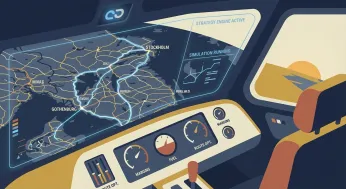
The modern truck cab has transformed into a mobile command center. But while the vehicle technology has become streamlined and ergonomic, the software layer has become a chaotic patchwork. A typical subcontractor driving for multiple major forwarders (e.g., DHL, DSV, Schenker, Kuehne+Nagel) is often contractually obligated to use each client's specific mobile application for proof-of-delivery (POD), status updates, and deviation reporting.
The result is App Fatigue: a state of cognitive exhaustion caused by the constant switching of contexts, interfaces, and logical flows.
This white paper argues that this fragmented ecosystem is unsustainable. It leads to: 1. Safety Risks: Increased cognitive load while driving. 2. Data degradation: Drivers skipping reporting steps to save time. 3. Retention Crisis: A younger generation of drivers (Gen Z) rejecting archaic and clumsy enterprise software.
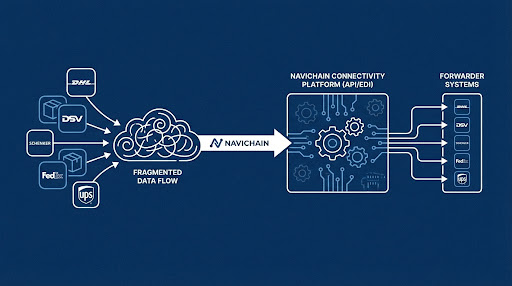
Navichain proposes a radical simplification: The Universal Adapter Model. One single, high-UX app for the driver, with a backend that intelligently routes data to the correct forwarder's API.
Part 1: The Challenge - Chaos in Pocket Format
The Fragmented Workday
Imagine you are an office worker. To send an email to Client A, you must use Outlook on a laptop. To email Client B, you must use Gmail on a tablet. To email Client C, you must use a proprietary terminal from 1998 that only works when plugged into a specific wall socket.
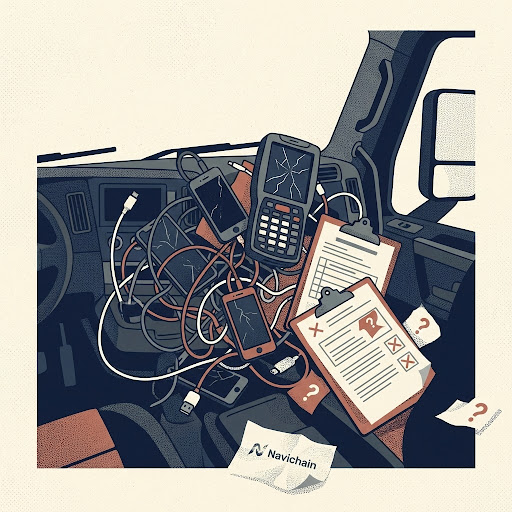
This absurdity is the daily reality for a transport subcontractor. * Login Chaos: "What was my password for the Schenker portal again?" Forgotten credentials causing 15-minute delays at the gate. * Inconsistency: In App A, you swipe right to confirm delivery. In App B, swiping right deletes the order. This lack of standardization increases the error rate significantly. * Hardware Hassle: Some forwarders still demand proprietary handheld computers (PDAs), leading to cabs cluttered with multiple charging cradles and devices.
The "Switching Tax" on the Brain
Psychological research on Cognitive Load shows that every "context switch" carries a mental tax. Ideally, a driver's mental resources should be 90% focused on safe driving and 10% on logistics administration. * The Reality: With app fatigue, the administrative load spikes. Drivers are interacting with devices for up to 4.5 hours a day, mostly while the vehicle is in operation or during short stops. * The Safety Hazzard: Conflicting notifications from three different apps (e.g., a route update, a pickup alert, and a message from dispatch) create a "cocktail party effect" of distractions. Research indicates that interacting with complex apps can increase crash risk by diverting attention from the road for extended periods.
Part 2: The Retention Crisis & The "Gen Z" Filter
The logistics industry is facing a severe driver shortage. As the "Baby Boomer" generation retires, they must be replaced by younger drivers. This new cohort—Gen Z and Millennials—has zero tolerance for bad technology.
The "TikTok Standard"
Younger drivers grew up with Instagram, Spotify, and Uber. They expect apps to be: * Instant: No loading screens. * Intuitive: No user manuals. * Beautiful: Dark mode, clean typography, smooth animations.
When you hand a 25-year-old driver a ruggedized PDA running a Windows CE emulator from 2005, you are signaling: "We do not care about your experience."
Why They Quit
"Digital Friction" is cited as a top frustration in exit interviews. Drivers want to drive, not fight with IT support. * Shadow IT: To bypass bad apps, drivers create their own workflows. They start WhatsApp groups to share load details because the official app is too slow. This creates Shadow IT risks where sensitive data (gate codes, customer lists) leaves the secure corporate environment.
Part 3: Navichain's Solution - The Universal Adapter

From chaos to control.
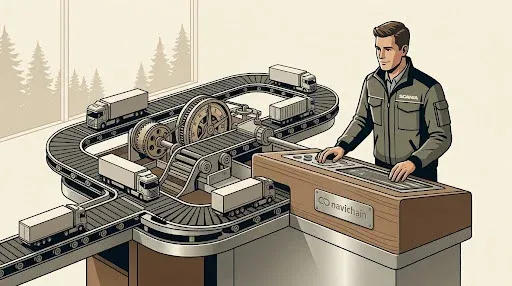
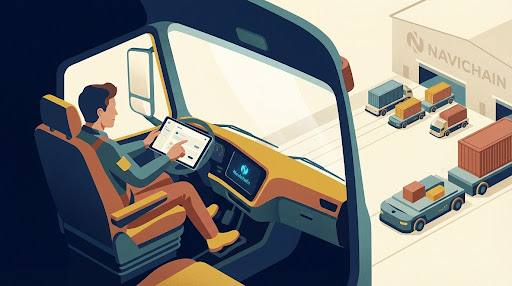
Navichain flips the model. Instead of the driver adapting to the forwarders' systems, the technology adapts to the driver.
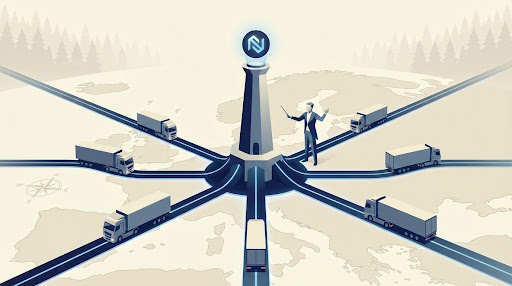
One App to Rule Them All
We provide a single, unified interface for the driver. * Unified Flow: A "Pickup" looks the same in Navichain, whether the client is DHL or a local bakery. The driver learns one process. * The "Universal Adapter": In the background, Navichain acts as a translation layer. * Input: Driver clicks "Delivered" and signs on screen. * Processing: Navichain checks the order source. * If source == DHL: Convert to FORTRAS status message -> Send to DHL API. * If source == DSV: Convert to EDIFACT status -> Send to DSV EDI gateway. * If source == Small Client: Generate PDF proof-of-delivery -> Email to client. * The Result: The forwarder gets exactly the data they need, in the format they demand, without ever touching the driver's phone.
Reducing Cognitive Load
By stripping away the complexity of multiple apps, we lower the cognitive load. * Focus Mode: The app interface changes based on vehicle state. When moving, it shows only critical navigation info. When stopped, it unlocks administrative features. * Aggregated Routing: Instead of checking three apps to plan the day, Navichain interleaves orders from multiple clients into a single, optimized route list.
Part 4: The Economics of UX
Investing in Driver UX is not just about being nice; it is about hard ROI.
The Cost of "Fumbling"
Let's do the math on bad UX. * The Scenario: A driver does 20 stops a day. * The Friction: A clunky app takes 2 minutes extra per stop to load, navigate, and crash. * The Loss: 40 minutes per day per driver. * The Annual Cost: For a fleet of 50 trucks, that is 16,000 lost hours per year. That is equivalent to 8 full-time drivers doing nothing but staring at loading screens.
Data Quality ROI
When an app is hard to use, drivers take shortcuts. They mark goods as "undamaged" even if there is a scratch, just to avoid a 5-page damage report form. * With Navichain: Reporting a deviation is a 3-tap process. Photo -> Tag -> Send. * The Effect: deviation reporting goes up, but claims and disputes go down because you have the evidence documented instantly.
Part 5: Technical Enabler - Offline First & Sync
To truly solve app fatigue, the app must work where drivers work: in basements, in forests, and in concrete warehouses.
The "Offline First" Architecture
Many forwarder apps are just web wrappers that crash without 5G. Navichain is built differently. 1. Local Database: All data is stored on the device first. 2. Optimistic UI: The app confirms actions instantly ("Done!"), even if the server hasn't received the data yet. The driver never waits for a spinner. 3. Background Sync: As soon as connectivity is restored, the "Universal Adapter" synchronizes the data to all relevant parties.
Conclusion
App fatigue is an unnecessary suffering imposed by an industry that has historically prioritized enterprise contracts over user experience. But the tide is turning. The fleets that will win the talent war in 2026 are those that treat their drivers' attention as a scarce resource.
By consolidating your digital tools into a single, modern platform, you do more than just clean up the dashboard. You restore dignity to the profession, improve road safety, and unlock thousands of hours of hidden productivity.
Let technology adapt to the human, not the other way around.
Simplify Your Drivers' Everyday Life.
See how navichain replaces 5 apps with 1 and makes life in the cab smoother.
navichain Insights Newsletter
Join the newsletter to receive the latest updates in your inbox.