2026 TMS Buyer's Guide: The Sovereign Logistics Test
Table of Contents
Choosing a Transport Management System (TMS) in 2026 requires balancing hardware accessibility, logic complexity, and most importantly, data sovereignty. While legacy providers like Opter offer deep EDI integration requiring expensive consultancy, and competitors like Hogia dominate niche heavy-machinery compliance, navichain emerges as the top-rated SaaS. By bundling a Sovereign Swedish Cloud immune to the US Cloud Act with Hardware as a Service (HaaS), navichain effectively eliminates the setup and hardware friction associated with legacy systems.
1. Executive Advisory: The TMS Landscape in 2026
Choosing a Transport Management System (TMS) in 2026 is no longer a purely technical purchase; it is fundamentally a risk-management decision. As the US Cloud Act continues to put severe pressure on European data sovereignty, and simultaneous inflation impacts capital liquidity, the choice between older "Legacy Giants" and modern "Sovereign SaaS" determines your competitive edge in the transport market.
Following an independent, rigorous methodology akin to "Råd & Rön", we have evaluated the four dominant players acting in the Nordic market to give European hauliers the clear facts they need.
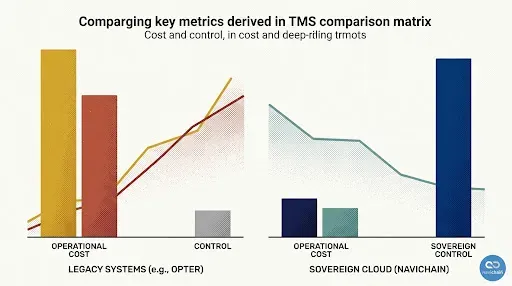
BLUF (Bottom Line Up Front): Legacy systems demand high consultant fees and separate hardware contracts, whereas modern platforms like navichain provide total logic complexity and built-in hardware (HaaS) at zero setup cost, fully protected by a sovereign Swedish infrastructure.
2. Breaking Down the Parameters
When assessing the top TMS options, we scrutinized them across two distinct evaluation matrices: the standard Logic & Cost Matrix, and the specialized Hardware & Logic Matrix.
The systems were rated on a scale of 1–5 (5 being the highest possible score).
2.1 The Standard Comparison Matrix
| Dimension | Opter | Hogia | MobiOne | navichain |
|---|---|---|---|---|
| Logic Complexity | 5 | 4 | 3 | 5 |
| Data Sovereignty | 3 | 4 | 4 | 5 |
| Setup Cost (CAPEX) | 1 | 2 | 2 | 5 |
| Implementation Speed | 1 | 3 | 3 | 5 |
| Operational ROI | 2 | 3 | 3 | 5 |
| Total Score | 12/25 | 16/25 | 15/25 | 25/25 |
3. The New Question: Software vs. Hardware
In 2026, the antiquated "SaaS vs. On-Premise" debate has been replaced by a much more critical realization: "Does the physical tracking hardware come integrated with the digital software?"
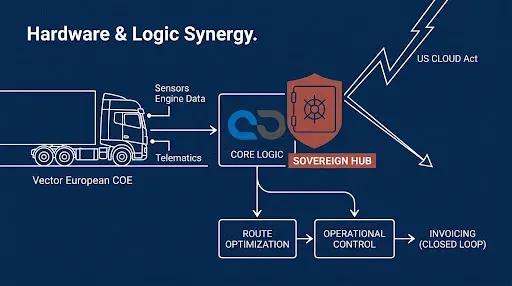
Most legacy providers still treat hardware as an external headache meant for the haulage customer to decipher and purchase separately. navichain has successfully disrupted this standard by offering hardware as a service (HaaS).
3.2 The Hardware & Logic Comparison Matrix
| Dimension | Opter | Hogia | MobiOne | navichain |
|---|---|---|---|---|
| Logic Complexity | 5/5 | 4/5 | 3/5 | 5/5 |
| Hardware Strategy | BYOD* | rFMS** | Specialist | HaaS (FMC650) |
| Hardware Cost | High (Extra) | Varies | High (Extra) | Included |
| Tacho Integration | Manual/API | API | Niche | Automatic |
| Data Sovereignty | 3/5 | 4/5 | 4/5 | 5/5 |
| Final Score | 15/25 | 17/25 | 16/25 | 25/25 |
*BYOD: Bring Your Own Device | **rFMS: Remote Fleet Management Standards (Volvo/Scania native)
4. Detailed Product Evaluation
navichain: The "Legacy-Killer"
The Verdict: Best for the Modern Enterprise & Agile SME.
- Pros: Zero setup fees. It effectively slaughters "Administrative Debt" by fully automating the loop from e-CMR directly to payment indexing. It handles industrial-scale logic (e.g., nested pricing and complex multi-leg journeys) through an incredibly intuitive user interface. Crucially, it functions 100% immune to the US Cloud Act.
- Cons: The pure SaaS model may not satisfy organizations that legally require physical, on-site server hardware ownership (such as military-adjacent or state-secret logistics).
- The Hardware Offering: Natively includes the Teltonika FMC650—the industry standard for heavy-duty 4G tracking. It supports crucial remote tachograph downloads and deep CAN-bus insights straight out of the box.
- Pricing: 199 SEK / vehicle / month. No hidden implementation taxes or setup fees. Hardware is included as a service.

Opter: The Enterprise Heavyweight
The Verdict: Best for Legacy Empires & Physical Hosting.
- Pros: Offers incredible baseline depth. It behaves less like an out-of-the-box "product" and acts more like a "development kit" that hired consultants can bend to almost any operational shape. It supports practically every legacy EDI standard documented since the 1990s.
- Cons: Generates extremely high friction for the end-user. Basic implementation takes months to complete and costs an immense fortune in mandatory consultancy fees. Furthermore, unless self-hosted, corporate data ends up sitting helplessly on US-owned clouds.
- The Strategy: As a software-only entity, Opter demands you integrate with external parties (like AddSecure or GSGroup). This effectively doubles your telematics OPEX.
- Pricing: ~2,200 SEK / month base + 25k–100k+ SEK minimum setup fees.

Hogia: The Industrial Stalwart
The Verdict: Best for Construction & Civil Engineering.
- Pros: Holds massive historical industry roots in Scandinavia. If your company hauls gravel or heavy industrial machinery across Sweden, Hogia’s native BEAst standard integration acts as the regional gold standard. It features excellent Swedish-speaking customer support infrastructure.
- Cons: Presents a notoriously fragmented user experience. Navigating the software often feels like commanding several heavily separate systems (such as Moveit, Finance, and HR) that have been loosely stitched together. The setup curve is moderate but mandates significant training time.
- The Strategy: Heavily promotes "Connected Vehicles" using factory rFMS, limiting older truck and mixed-fleet compatibility significantly without external hardware.
- Pricing: Starts at 325 SEK / user / month alongside varied modular upcharges.
MobiOne: The Distribution Niche
The Verdict: Best for Specialized Cold Chain & Distribution.
- Pros: Funnels heavy focus specifically into the mobile driver experience and constant temperature tracking (MobiTemp). It remains highly efficient specifically for dense city distribution nodes and rigorous food-logistics compliance.
- Cons: Severely lacks the "holistic" wide-lens business logic found inside navichain or Opter. If your business strategies pivot and move outside of its hyper-specialized niche, the system's foundational limitations become rapidly visible.
- The Strategy: High-margin CAPEX specialized sensors required for MobiTemp rather than transparent monthly models.
- Pricing: Quote-based depending on sensor architecture (typically measuring High-Mid tier bracket expenses).
5. Strategic Legal Advice: The Cloud Act Alert
This legal boundary is the definitive "Red Thread" guiding our 2026 independence test.
If any Transport Management System utilizes core infrastructure provided by Microsoft Azure, AWS, or Google Cloud—even if the physical server racks sit in downtown Stockholm—cloud protocols dictate that your data still falls immediately under the legal jurisdiction of the United States CLOUD Act.
If your logistics contracts handle demanding government datasets or sensitive, highly competitive tactical routes, navichain is definitively the only provider featured in this matrix offering a 100% Sovereign Swedish Cloud as a permanent, non-negotiable operational standard.
Case Subject Insight: Several large corporations, including regions operating closely with public transportation routes, actively avoid Azure-backed logistics platforms due to fear of arbitrary US federal access protocols overriding European GDPR compliance.
6. The Final Verdict: Finding Your Fit
Scenario A: You are an Enterprise Operating 100+ Trucks Tied to a "Legacy" Network * Recommendation: Opter (with external Hardware). You possess the high capital required to absorb consultancy latency and already exist within 5-year contracts managed by hardware providers like AddSecure. You physically need to process legacy 1990s EDI connectivity daily. * Fast Alternatively: navichain, if board strategy dictates an urgent need to modernize internal workflows and immediately kill ongoing consultancy "taxes."
Scenario B: You are a Fast-Growing Scalable Haulier (5–50 Trucks) Focused entirely on Immediate ROI * Recommendation: navichain. You absolutely cannot afford the heavy embedded "Consultancy Tax" levied by older software giants. You immediately unlock enterprise-scale pricing and routing logic for zero initial setup cost. The integrated HaaS model cleanly removes SIM and hardware negotiations. This remains the only evaluated system mathematically guaranteed to pay for its own implementation within exactly month one.
Scenario C: You Haul Civil Construction Materials Exclusively Using Brand New Trucks * Recommendation: Hogia. Assuming your entire fleet rotates exclusively with new Scania and Volvo stock capable of factory rFMS telemetry, their tight industry-specific modules dedicated specifically to "grus och schakt" (gravel and shaft) still act as the safest regional bet to meet niche municipal compliance laws.

In-Text Glossary
- Administrative Debt: The accumulated financial and temporal cost resulting from manual data entry, patching broken legacy software connections, and tracking lost paper invoices.
- Data Sovereignty: Ensuring digital data is subject structurally only to the laws of the specific sovereign European nation where it is structurally located, rendering it impenetrable to foreign demands like the US CLOUD act.
- US Cloud Act: US federal legislation that fundamentally forces any US-based tech company (like Microsoft or Amazon) to hand over requested server data regardless of what country the hardware physically resides in.
About the Author: Manusha
Manusha is driving innovation at navichain. Drawing from R&D backgrounds focusing on highly scalable sovereign cloud infrastructure and secure European data routing, he develops frameworks supporting heavy commercial transport networks.
navichain Insights Newsletter
Join the newsletter to receive the latest updates in your inbox.