The Last-Mile Lag: Why the 'POD-to-Cash' Gap is the New Profit Bottleneck for European SMEs
Table of Contents
The Last-Mile Lag: Why the "POD-to-Cash" Gap is the New Profit Bottleneck for European SMEs
European logistics SMEs face a relentless margin squeeze, with driver shortages exceeding 426,000 (IRU, 2025) and costs rising. The conventional response is to hunt for on-road efficiencies. But what if the biggest profit drain isn't fuel? The 'POD-to-Cash' gap—the administrative lag between a completed delivery and a paid invoice—is a critical, unaddressed bottleneck. This delay, often accepted as 'the cost of business,' is a symptom of a deeper strategic failure: a fragmented, non-sovereign approach to digitalization. This white paper presents a 3-principle framework for solving this lag, arguing that the solution is a unified, sovereign-by-design architecture that secures cash flow and shields data from foreign legal overreach.
The margin squeeze is real, but we're looking in the wrong place
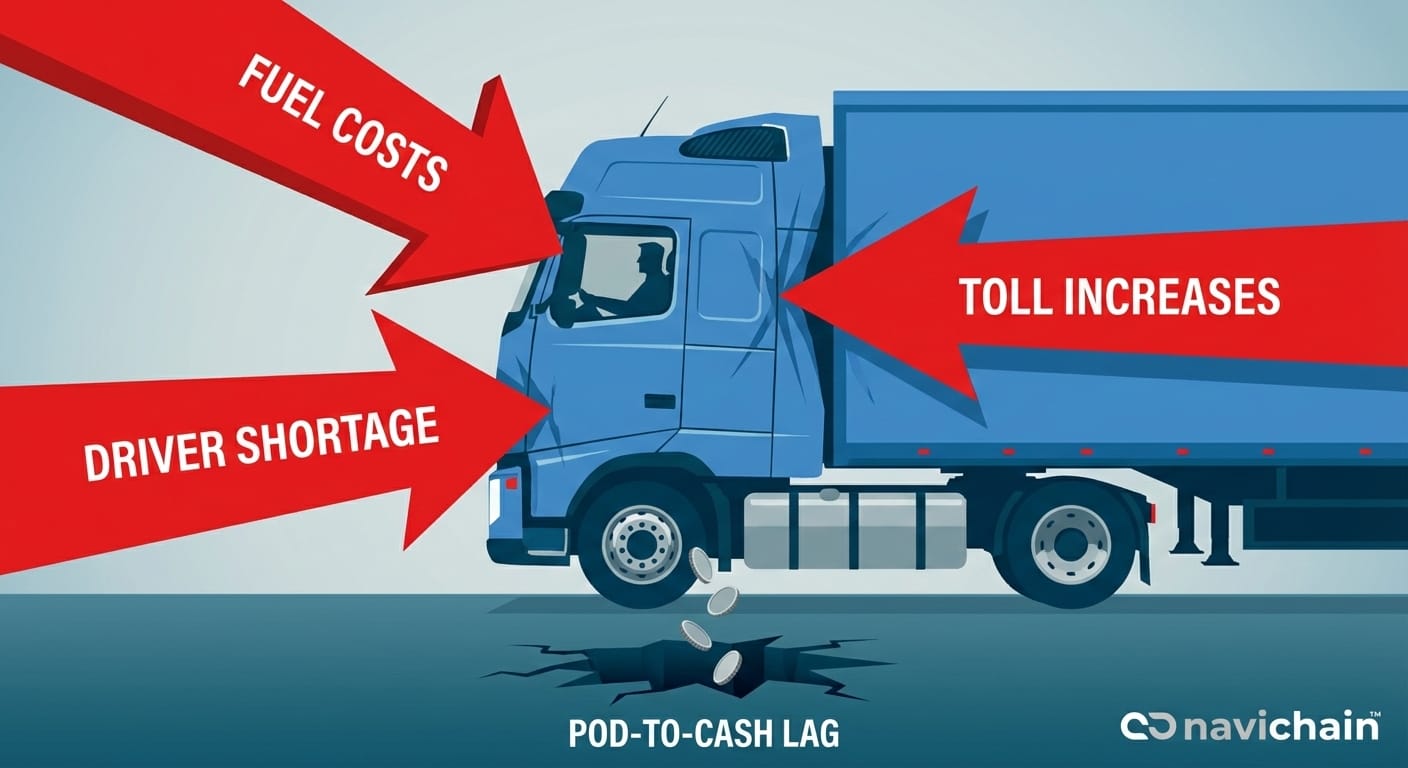
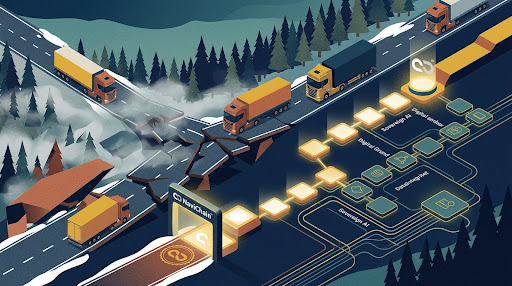
Increased operational complexity and rising costs put immense pressure on European logistics SMEs, highlighting the urgent need for innovative solutions.
For leaders in Europe's SME logistics sector, the pressure is relentless. The operating environment in 2025 remains a complex puzzle of persistent driver shortages, which the IRU estimates to be over 426,000 positions across Europe, coupled with volatile fuel prices and a patchwork of new national toll increases. This unrelenting cost pressure has, quite rationally, forced a management obsession with on-road efficiency: optimizing routes, minimizing fuel consumption, and maximizing asset utilization. These are worthy pursuits. But they are no longer enough.
While managers are scrutinizing fuel reports, a far greater—and more controllable—source of profit erosion is hiding in plain sight. It is not happening on the road, but in the office. It is the administrative lag between a driver confirming a delivery and the finance department collecting payment.
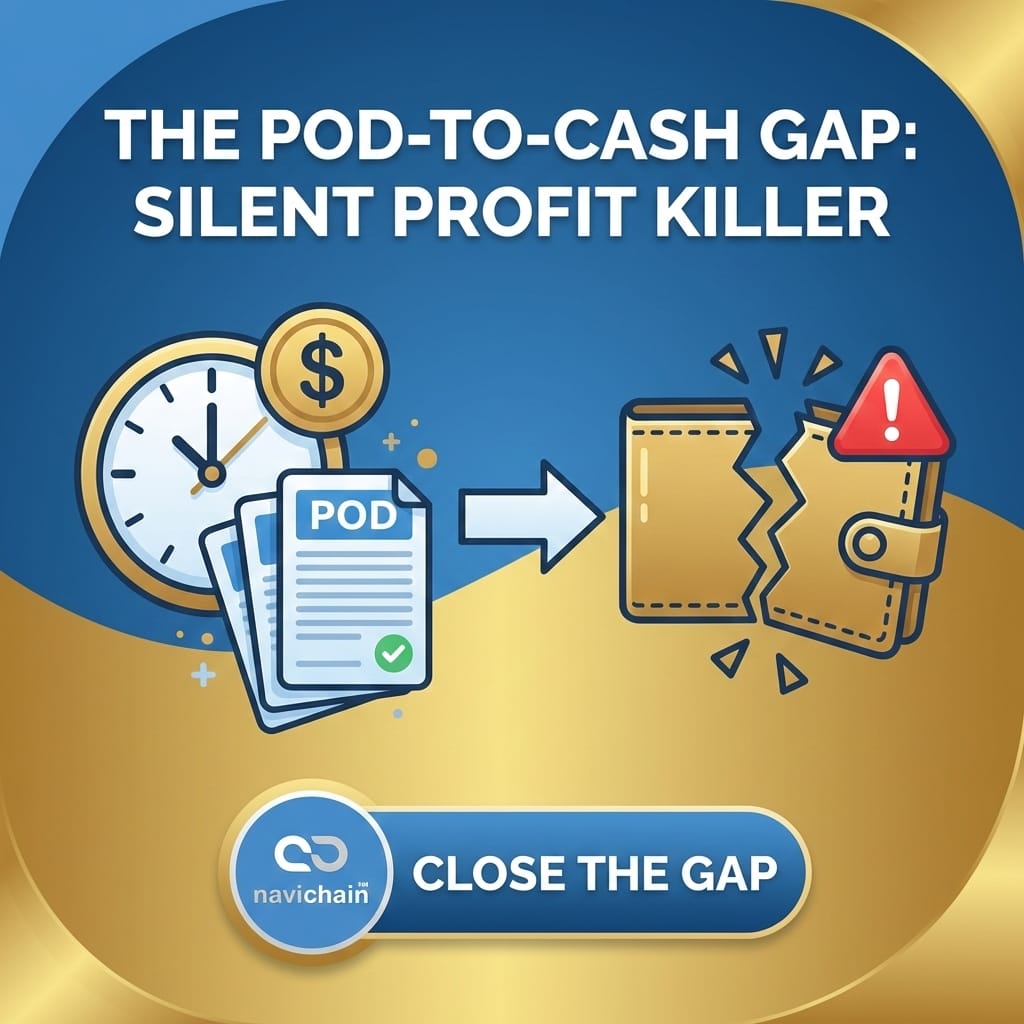
This is the "POD-to-Cash" gap. It is the black hole where your working capital disappears.
We argue that for the modern European SME, this critical data gap is no longer on the road but in the cloud. The delay between a digital Proof of Delivery and its conversion to cash is a symptom of a deeper, systemic failure—a fragmented operational architecture that is both cripplingly inefficient and dangerously non-sovereign.
The anatomy of a data silo: Deconstructing the "pod-to-cash" gap
Fig 2: Research on B2B cash flow consistently identifies invoice discrepancies as a "frequent culprit" for delayed payments (ArcherPoint, 2025).
Let's follow the journey of a single Proof of Delivery (POD) in a typical, partially-digitized SME haulage company.
- The Driver: The driver completes a delivery. If they are using a paper system, the POD is a physical document that must be physically returned to the office, a process that can take days, or even weeks. If they are using a standalone e-POD mobile app, they capture a signature or photo. This "solves" the paper problem, but the data now sits in the proprietary cloud of that app provider.
- The Dispatcher: The dispatcher, working in the Transportation Management System (TMS), needs to see that the job is complete. If the e-POD app isn't integrated with the TMS, they must wait for the driver to call it in, or manually cross-reference the e-POD system. The job remains "in-progress" in the TMS long after it's physically complete.
- The Warehouse: The Warehouse Management System (WMS) needs confirmation that the goods have been delivered to finalize inventory records. This system, too, is often separate from the TMS and the e-POD app.
- The Finance Department: This is the critical failure point. The billing department, working in a separate accounting or ERP system, cannot issue an accurate invoice without a clean, verifiable POD. They must manually pull the POD data from the driver's app, cross-reference it with the order details in the TMS, and then re-key all the information into the billing system.
This manual, multi-system reconciliation is a recipe for errors, disputes, and, most importantly, delay. Research on B2B cash flow consistently identifies invoice discrepancies as a "frequent culprit" for delayed payments (ArcherPoint, 2025). Every day the POD is lost in transit or trapped in a data silo is another day added to your Days Sales Outstanding (DSO). For an SME operating on thin margins, this self-inflicted cash flow crisis is a direct threat to operational viability.
The paradox of piecemeal digitalization
Fig 3: The irony is that this problem has been worsened by the very trend that was supposed to solve it: digital transformation.
The irony is that this problem has been worsened by the very trend that was supposed to solve it: digital transformation.
Confronted with the high cost and complexity of enterprise-grade software, SMEs have naturally turned to a "best-of-breed" or piecemeal approach. They subscribe to a standalone e-POD app, a separate cloud-based TMS, and a generic cloud accounting platform.
This strategy creates a paradox of piecemeal digitalization: each individual tool may be efficient at its single task, but the system as a whole becomes more fragmented. You have simply replaced paper silos with digital silos.
This digital fragmentation is the primary reason for the vast "digitalization gap" in Europe. While 91% of large EU enterprises have at least a basic level of digital intensity, that number plummets to just 58% for SMEs. More tellingly, only 4% of SMEs have achieved a high level of digital intensity, compared to 26% of large firms (Eurostat, 2024). SMEs in Scandinavia, while leading adoption, still face this integration hurdle.
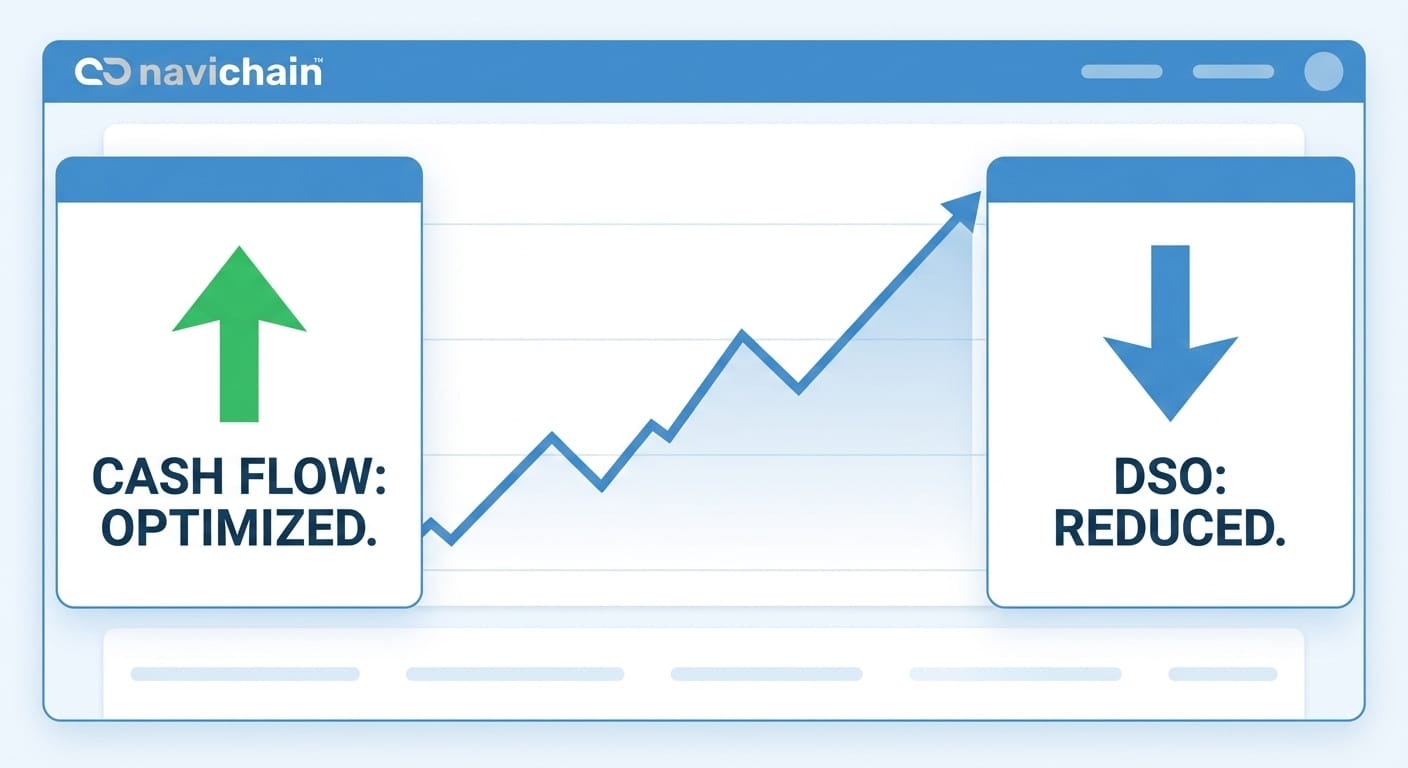
Chart illustrating the "digitalization gap" between large enterprises and SMEs in Europe, highlighting the lower levels of digital intensity among smaller businesses.
The cost of this fragmentation is not just in subscription fees. The true cost is the massive, hidden overhead of managing integrations, the perpetual IT headache of systems that "stop talking" after an update, and the strategic inability to get a single, real-time view of the entire operation. You have more data than ever, but less clarity.
The hidden liability: Data fragmentation as a compliance time bomb
The problem, however, goes much deeper than inefficiency. It touches on a critical, C-suite-level risk: data sovereignty.
Where does all your fragmented operational data live? Your e-POD app is likely hosted on Amazon Web Services (AWS). Your cloud TMS runs on Microsoft Azure. Your customer list is in a CRM hosted by a US-based provider. Even if these providers guarantee your data is stored on a server in Frankfurt, Stockholm, or Dublin, you are exposed to a profound legal conflict.
This conflict is between the EU's General Data Protection Regulation (GDPR) and the US CLOUD Act.
Here is the simple, unavoidable truth: The CLOUD Act grants US law enforcement the authority to compel US-based technology companies (like AWS, Google, and Microsoft) to provide data they control, regardless of where that data is stored.
As legal analysts at Wire (2025) have pointed out, "under the CLOUD Act, location is irrelevant. Jurisdiction follows ownership."
For a European SME, this means your most sensitive commercial data—your customer lists, your delivery routes, your pricing, your supplier contracts—is not truly sovereign. It is subject to the jurisdiction of a foreign government, creating a direct conflict with your GDPR obligations to protect that data. This isn't a theoretical risk; it's a fundamental flaw in any strategy that relies on non-sovereign infrastructure. The European Commission is actively developing frameworks to counter this, but for now, the liability rests with you, the data controller.
From diagnosis to design: The blueprint for a resilient logistics operating system
Fig 2: A fast, unified system that exposes your data to the CLOUD Act is a liability.
This analysis reveals a dual challenge: the operational challenge of fragmentation and the strategic challenge of non-sovereign data. Solving one without the other is a failed strategy. A fast, unified system that exposes your data to the CLOUD Act is a liability. A sovereign system that is clunky and siloed is inefficient.
The path forward requires a new blueprint. The strategic objective is not just to "digitize" but to unify and secure. Any modern logistics platform for SMEs must be built on three core principles.
Principle 1: Unified operational fabric
The problem of data silos must be solved at the architectural level. A "unified operational fabric" means a single, integrated system where Transportation Management (TMS), Warehouse Management (WMS), Billing Management, and Order Management are not separate applications, but native modules of one platform.
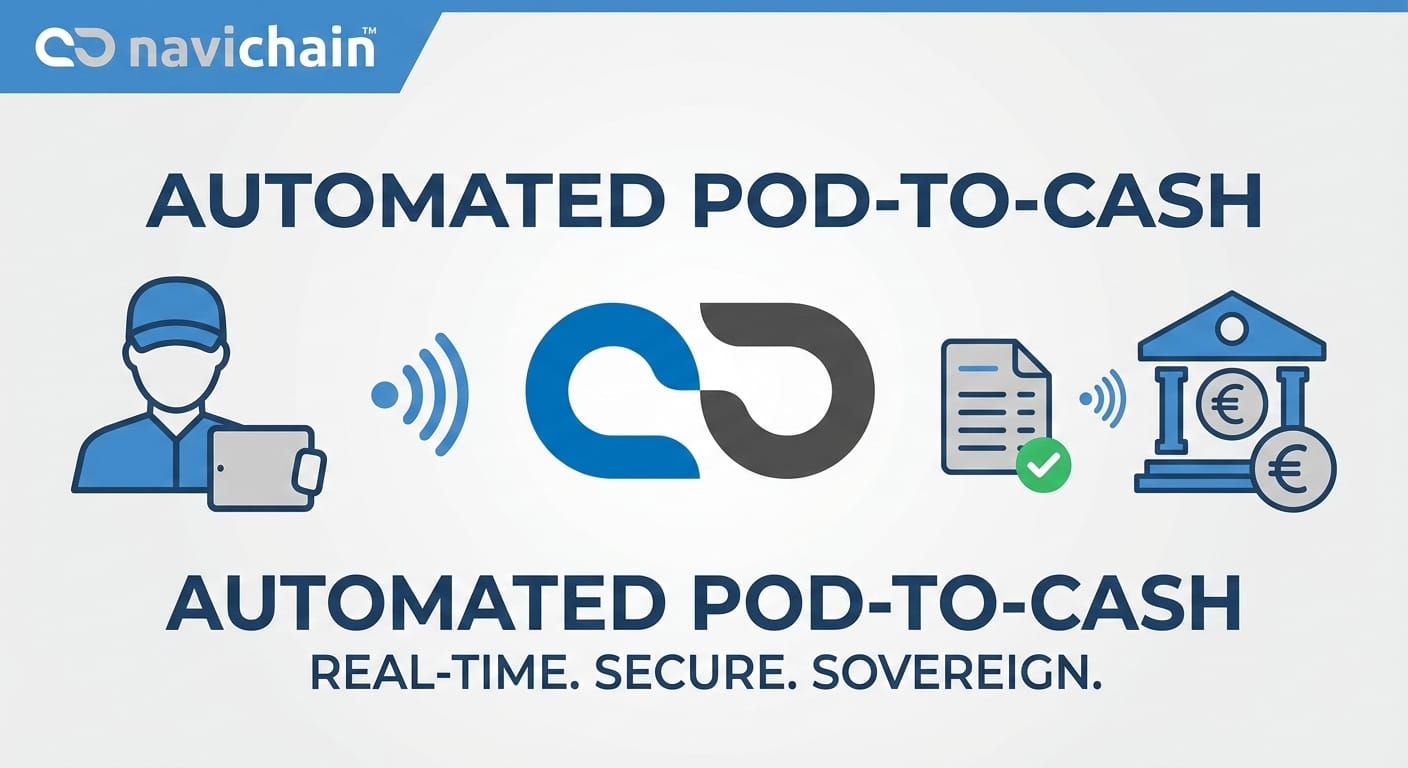
This is the 'central nervous system' for the logistics operation. When a driver marks a delivery as "complete" on their device, the system instantly and automatically updates the job status in the TMS, confirms inventory exit in the WMS, and—most critically—triggers the finance module to generate a correct, verified invoice complete with the POD. This act alone eliminates the POD-to-Cash gap, turning a multi-day administrative process into an real-time, automated event.
Principle 2: Sovereign data architecture
This principle is non-negotiable for European enterprises. True operational resilience requires data sovereignty. This is not a marketing term; it is a legal and technical reality.
To be truly compliant and secure, the platform's entire infrastructure—from the application servers to the database backups—must be hosted and managed by a European entity, within a European jurisdiction (like Sweden), and under the exclusive protection of European law. This Self-Hosted approach is the only architecture that is fully compliant with GDPR and, crucially, is shielded from the extraterritorial reach of foreign legislation like the US CLOUD Act. This is the foundation of trust and modern risk management.
Principle 3: Embedded analytic intelligence
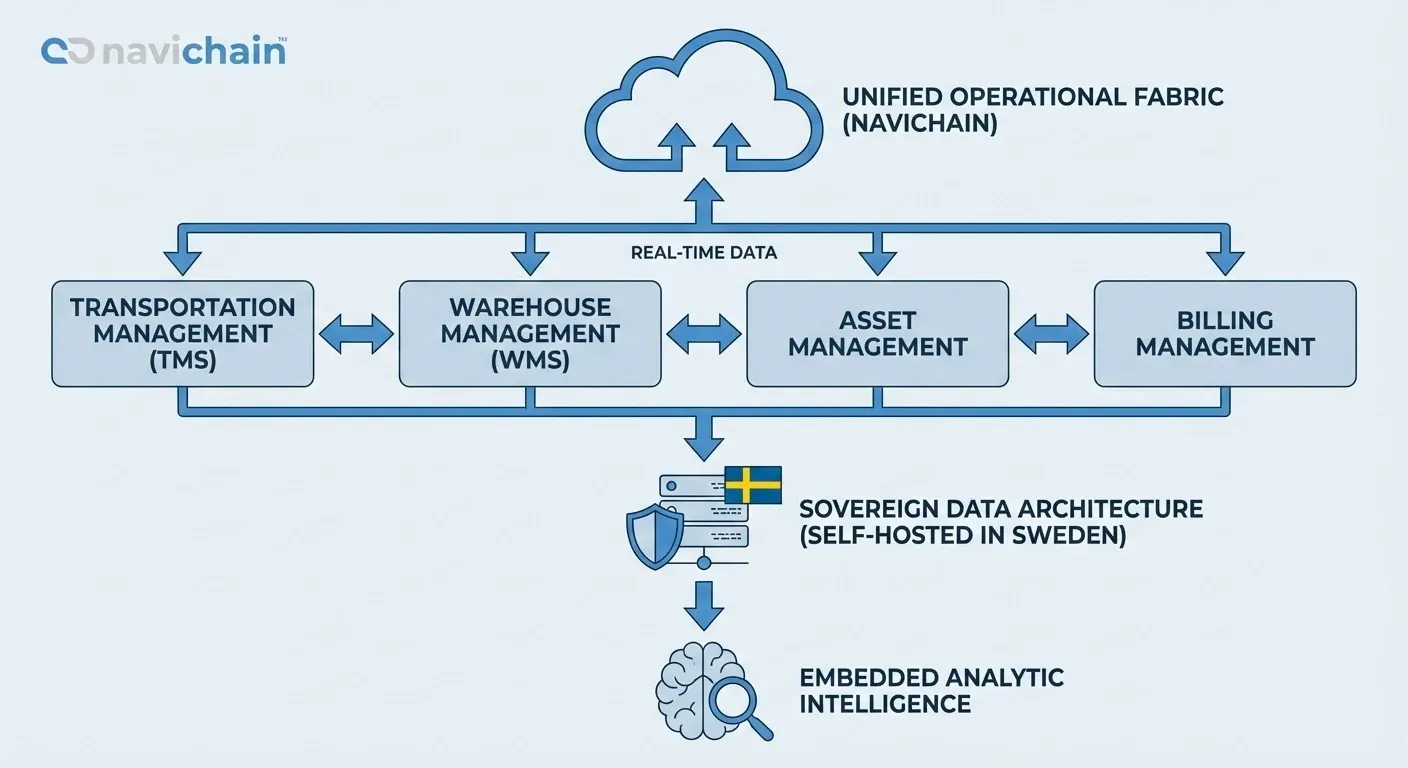
Schematic illustrating the interconnected data flow within a unified operational fabric, highlighting real-time updates and automated processes.
For years, data-driven decision-making has been a hollow promise for SMEs. Why? Because their data is scattered across a dozen fragmented, non-sovereign systems. Meaningful analysis is impossible.
However, once your operations run on a Unified Operational Fabric (Principle 1) within a Sovereign Data Architecture (Principle 2), you suddenly have a complete, secure, and unified dataset. This is the prerequisite for powerful, embedded intelligence. A integrated AI layer running within this same secure environment can analyze cross-functional data—connecting transport costs to warehousing patterns to billing cycles—to uncover efficiencies you could never see before. It allows you to leverage the power of AI without the risk of exporting your most sensitive data to a third-party, non-sovereign AI tool.
Fig 3: For years, data-driven decision-making has been a hollow promise for SMEs.
References/sources
- IRU (International Road Transport Union). (2025). European Road Freight Rate Benchmark & Driver Shortage Report. https://www.iru.org/news-resources/newsroom
- Eurostat. (2024). Digital intensity of businesses. https://ec.europa.eu/eurostat/statistics-explained/index.php?title=Digital_intensity_of_businesses
- ArcherPoint. (2025). Staying on Top of Outstanding Invoices is Critical for 3PL Cash Flow. https://archerpoint.com/blog/
- Wire. (2025). What the CLOUD Act Really Means for EU Data Sovereignty. https://wire.com/en/blog/cloud-act-eu-data-sovereignty
- Ti Insight. (2025). European Road Freight Transport Market Forecasts. https://ti-insight.com/
Fig 4: This analysis reveals a dual challenge: the operational challenge of fragmentation and the strategic challenge of non-sovereign data.
Enabling the blueprint: The navichain SaaS unified logistics platform
Fig 4: It is the exact blueprint we used to build the navichain SaaS platform.
The strategic blueprint outlined above—a Unified Operational Fabric, Sovereign Data Architecture, and Embedded Analytic Intelligence—is not a theoretical exercise. It is the exact blueprint we used to build the navichain SaaS platform.
We are a Swedish company on a mission to democratize logistics technology for the SMEs that form the backbone of the European economy. We designed our platform from the ground up to embody these three core principles.
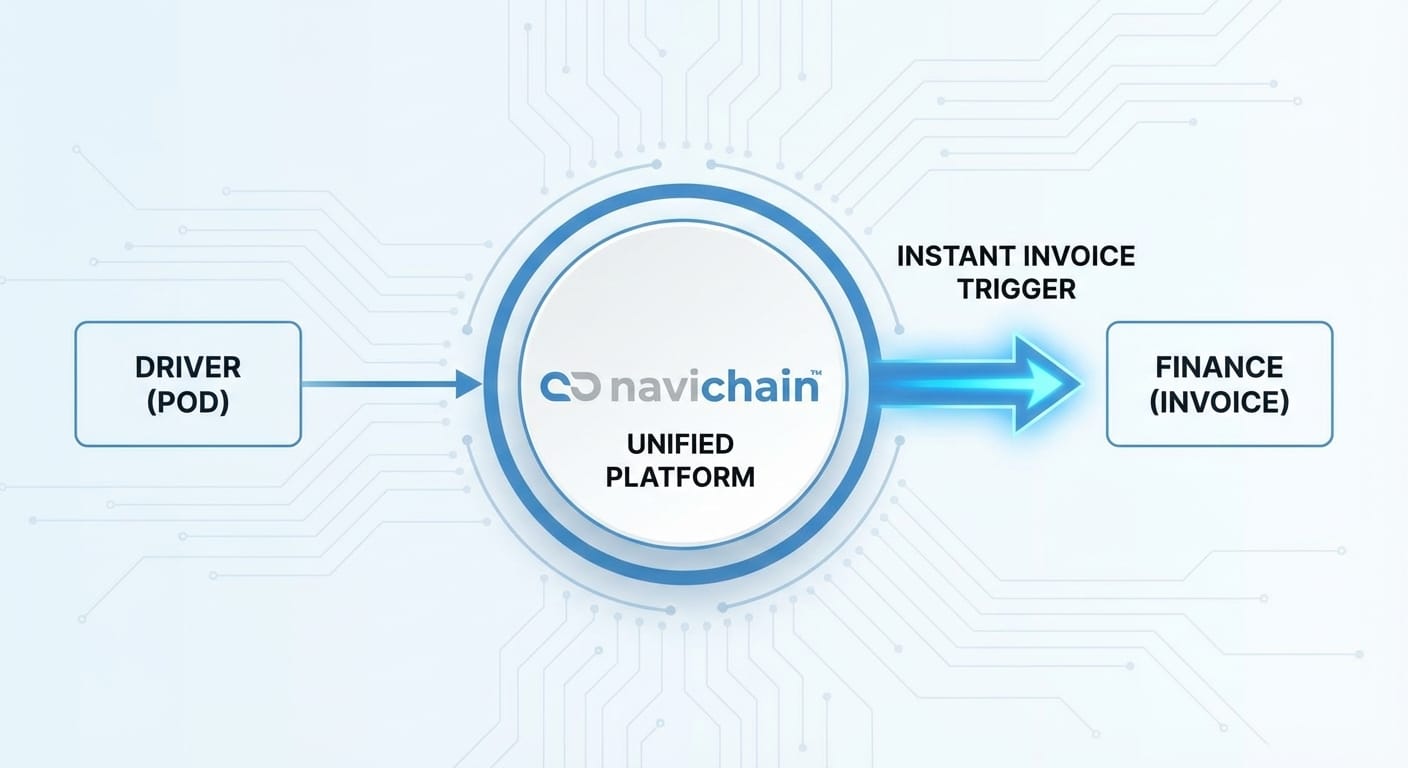
This outcome image visualizes the unified, sovereign, and intelligent logistics environment enabled by the navichain SaaS platform.
- For 'Unified Operational Fabric': navichain SaaS is a single, integrated logistics operating system. It is not a collection of separate apps. Our platform seamlessly unifies Transportation Management (TMS), Warehouse Management (WMS), Asset Management, Billing Management, and Order Management into one cohesive solution, creating the single source of truth required to eliminate the POD-to-Cash gap.
- For 'Sovereign Data Architecture': This is our core promise. The entire navichain SaaS platform is hosted on our own proprietary infrastructure in Sweden (Self-Hosted). Your data—and your clients' data—never leaves Sweden. It remains exclusively under Swedish and EU jurisdiction, ensuring full GDPR compliance and complete, categorical immunity from foreign legislation like the US CLOUD Act.
- For 'Embedded Analytic Intelligence': Our platform is enhanced by a integrated AI that runs on the same secure Swedish infrastructure. This allows our clients to perform deep, secure data analysis on their unified operational data, unlocking unique efficiencies without ever compromising on data sovereignty.
We believe that SMEs should not have to choose between powerful technology and data security. Our mission is to provide an integrated, powerful, and affordable platform that empowers you to increase efficiency, reduce costs, and deliver exceptional service, all from a single, sovereign source of truth.
Navichain's unified platform integrates TMS, WMS, asset management, and more into a single, secure operating system hosted in Sweden.
Navichain's platform provides a unified view of TMS, WMS, and asset management, all securely hosted in Sweden to ensure data sovereignty and GDPR compliance.
Ready to optimise your supply chain?
navichain Insights Newsletter
Join the newsletter to receive the latest updates in your inbox.