The Integration Paradox: How Client IT Demands Can Become Your Most Profitable Service
Table of Contents
The Integration Paradox: How Client IT Demands Can Become Your Most Profitable
The service is no longer enough
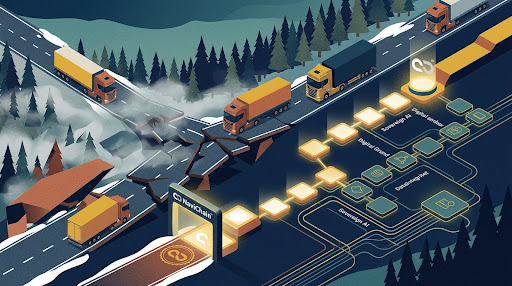
Fig 1: The European logistics sector is at an inflection point. The European logistics sector is at an inflection point. For decades, the value proposition for a small to medium-sized (SME) haulier was simple: move goods from Point A to Point B, on time, and at a competitive price. Reliability was the brand. Today, reliability is table stakes. The 'Amazon effect' has fundamentally rewired B2B customer expectations. A recent Salesforce report found that 84% of B2B buyers now rate the 'experience' of a transaction as highly as the service or product itself. In logistics, this 'experience' has a clear definition: effortless communication, 100% real-time visibility, predictive ETAs, and self-service access to documentation. For the pragmatic Logistics Manager or Owner of an SME haulage firm, this presents a crisis. Your largest clients are no longer just asking for this experience; they are demanding it in the form of complex IT integrations (API/EDI), real-time data feeds, and instant electronic Proof of Delivery (e-POD). Most SMEs view these demands as a costly, complex burden—a technological hoop to jump through to keep a low-margin contract. This paper argues that this perspective is strategically dangerous. The integration demand isn't the problem; it's the symptom. The real threat is service commoditization. The Integration Paradox is this: the very IT demands you view as a cost center are, in fact, a blueprint for your most valuable, high-margin, and loyalty-building new service offering. This white paper presents a strategic framework for SME hauliers to stop reacting to IT demands and start productizing their digital experience. We will explore how to transform your operations from a simple transport service into a premium, data-driven experience that builds loyalty and defends margins.
Deconstructing the 'experience gap'
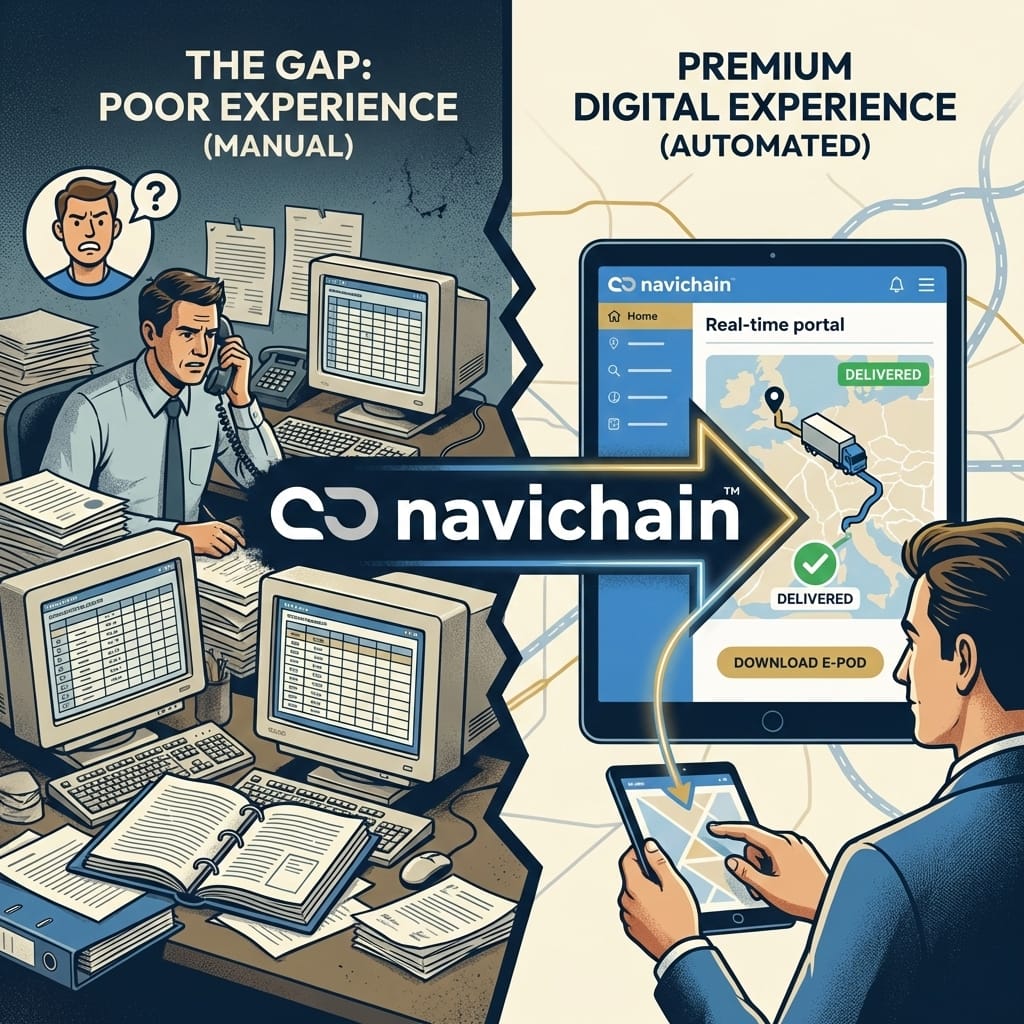
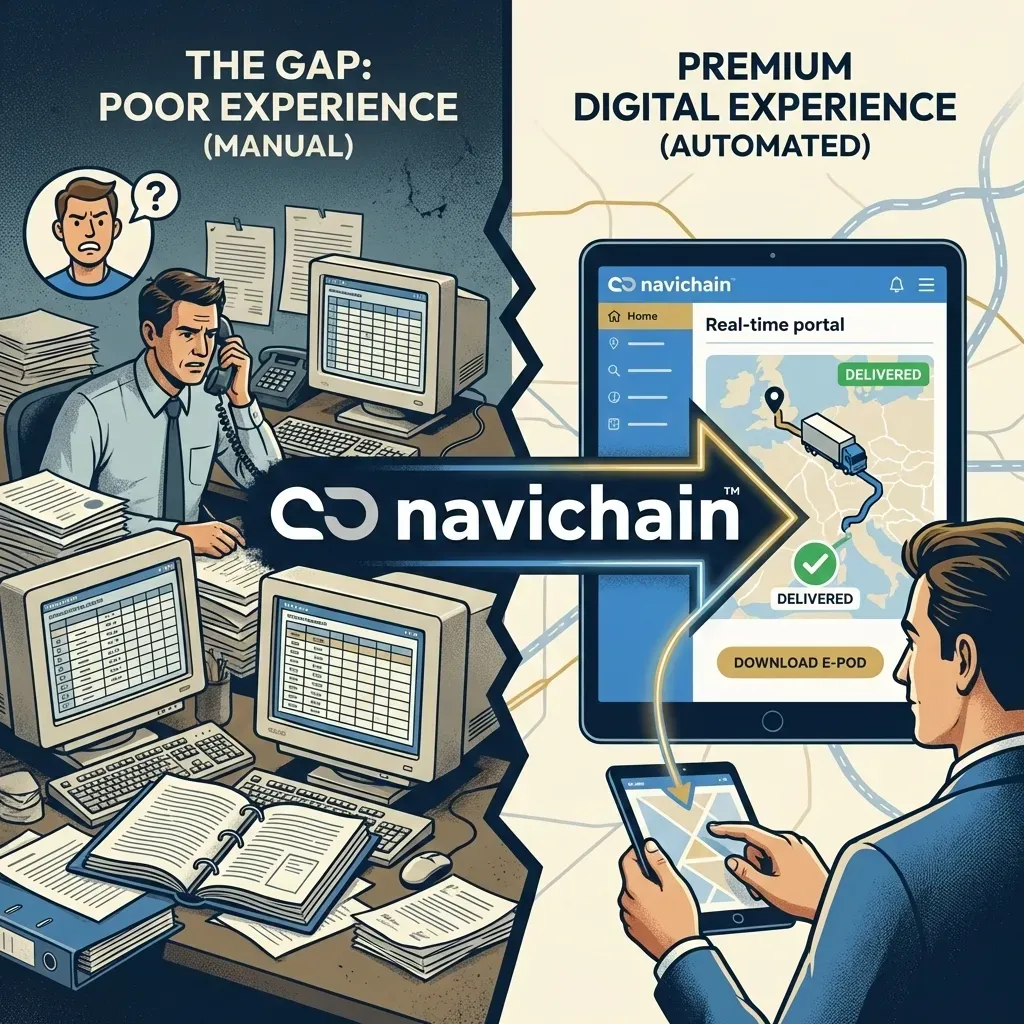
Fig 2: This gap creates three critical business risks: 1. The primary challenge for SME hauliers is not the rising cost of fuel or the shortage of drivers; it is the widening 'Experience Gap.' This is the delta between the seamless, digital-first experience your customers receive in their consumer lives and the fragmented, manual experience they often endure in their professional lives.
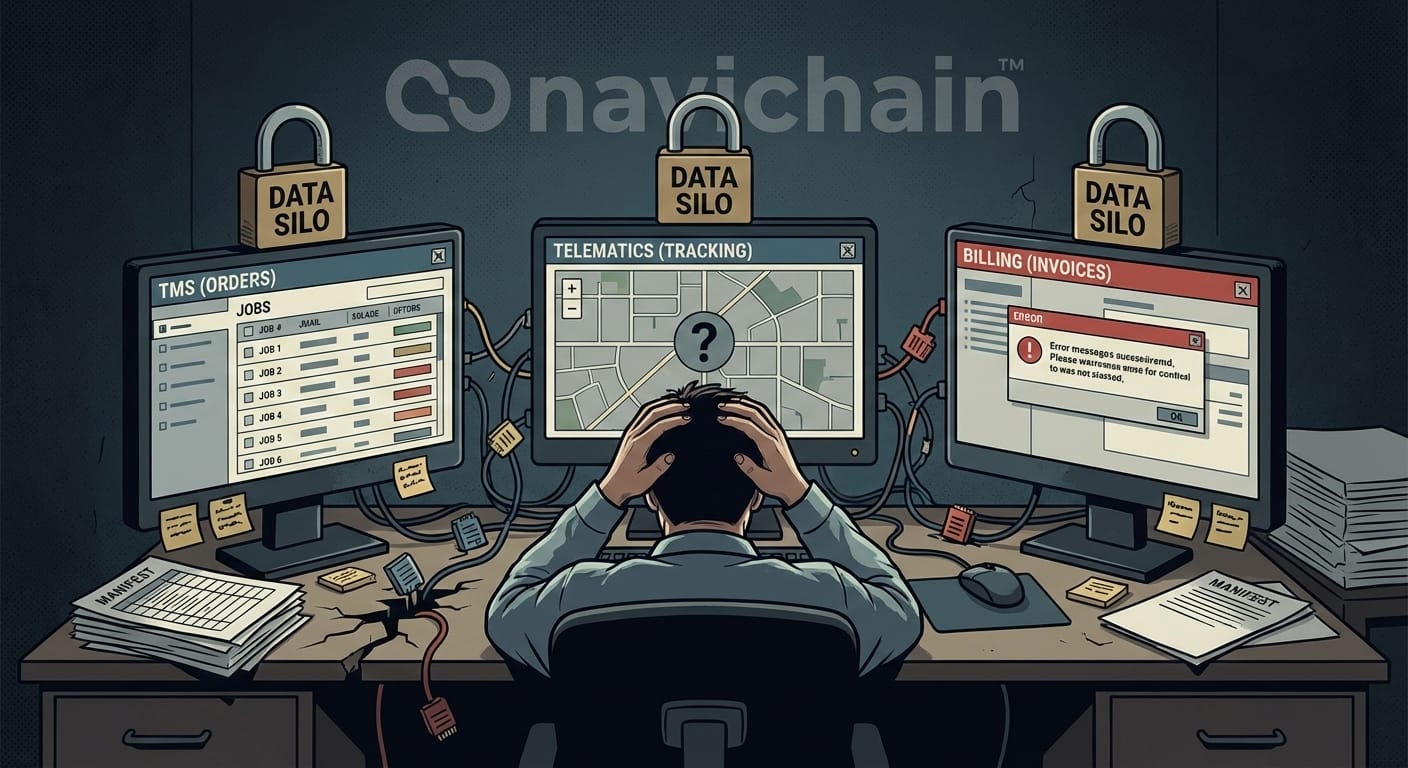
Disconnected systems and manual processes contribute to a fragmented and frustrating customer experience, widening the 'Experience Gap'.
The anatomy of a poor customer experience
For many SMEs, the operational workflow is a patchwork of disconnected systems—a TMS for orders, a separate telematics system for tracking, spreadsheets for resource planning, and an accounting program for billing. This fragmentation creates a poor external and internal experience: * External Friction (The Customer): The customer's primary question is 'Where is my stuff?' To answer it, they must call or email your dispatcher. They receive PDF invoices that must be manually entered into their system. They wait for a scanned POD days after delivery. This is a high-friction, high-anxiety process that erodes trust.
- Internal Friction (The Team): Your dispatcher spends their day not optimizing routes, but acting as a human API—fielding calls, manually cross-referencing data from two different screens, and chasing drivers for updates. Your billing department wastes time reconciling orders against PODs. This is inefficient and demoralizing.
The strategic risk of 'good enough'
Many leaders believe this is simply 'the cost of doing business.' They are wrong. This Experience Gap is where loyalty dies. When a customer has to work hard to get information, they perceive your service as unreliable, even if the truck is perfectly on time. This gap creates three critical business risks: 1. Commoditization and Churn: When all competitors offer a poor experience, the only differentiator is price. The moment a competitor offers a self-service portal or proactive alerts, they are no longer just selling transport; they are selling peace of mind. This is a superior product, and it wins the contract. 2. Inability to Scale: You cannot grow your business if you must hire a new dispatcher for every 10 new trucks. Manual processes are a direct cap on scalability. 3. Data Security Exposure: This fragmented, often US-cloud-based, software stack creates a massive, unseen risk. Your customer's sensitive shipping data is scattered across multiple platforms, often hosted outside the EU. This exposes you and your client to significant GDPR compliance risks and the jurisdictional overreach of foreign laws like the US CLOUD Act. Viewing client IT demands as a 'cost' misses the point. The client is telling you exactly what they value: a frictionless, data-rich experience. The challenge is to build a system that delivers this experience not just for one large client, but for all clients, profitably and at scale.
The path forward: Productizing the haulage experience
Fig 3: To close the Experience Gap, SME hauliers must undergo a mental shift: You are no longer just a transport company; you are a technology-enabled service company. To close the Experience Gap, SME hauliers must undergo a mental shift: You are no longer just a transport company; you are a technology-enabled service company. Your product is not 'trucking.' Your product is 'reliable, visible, and predictive logistics.' This requires a strategic framework built on three pillars.
Pillar 1: From reactive communication to proactive visibility
The lowest-value work in any transport office is the 'where is my order?' phone call. The highest-value work is managing exceptions before they become problems. The first step is to build a system that makes data available to everyone, instantly. This means unifying your core operations—orders (TMS), assets (telematics), and documentation (e-PODs)—into a single platform. When a driver marks a job as 'started' on their mobile app, the system should automatically update the order status, the customer portal, and the internal dashboard. This single source of truth moves your team from 'reactive' to 'proactive.' Instead of answering a phone, your dispatcher is looking at a dashboard that flags a truck running 15 minutes late and can proactively alert the customer. This single act transforms a service failure into a moment of trust-building.
Pillar 2: From manual processes to customer self-service
The next step is to securely expose this unified data to your customer. A customer portal is no longer a 'nice to have'; it is a core feature of your service product. This portal should allow customers to: * Place and track new orders without sending an email.
- See the real-time location and status of all current shipments.
- Instantly download all relevant documentation (e-PODs, invoices) 24/7. A self-service portal fundamentally changes your value proposition. You are saving your customer their most valuable asset: time. You are removing friction and anxiety from their workday. This is a sticky, high-value service that builds deep, structural loyalty far beyond what a friendly dispatcher (who goes home at 5 PM) can provide.
Pillar 3: From data silos to embedded intelligence
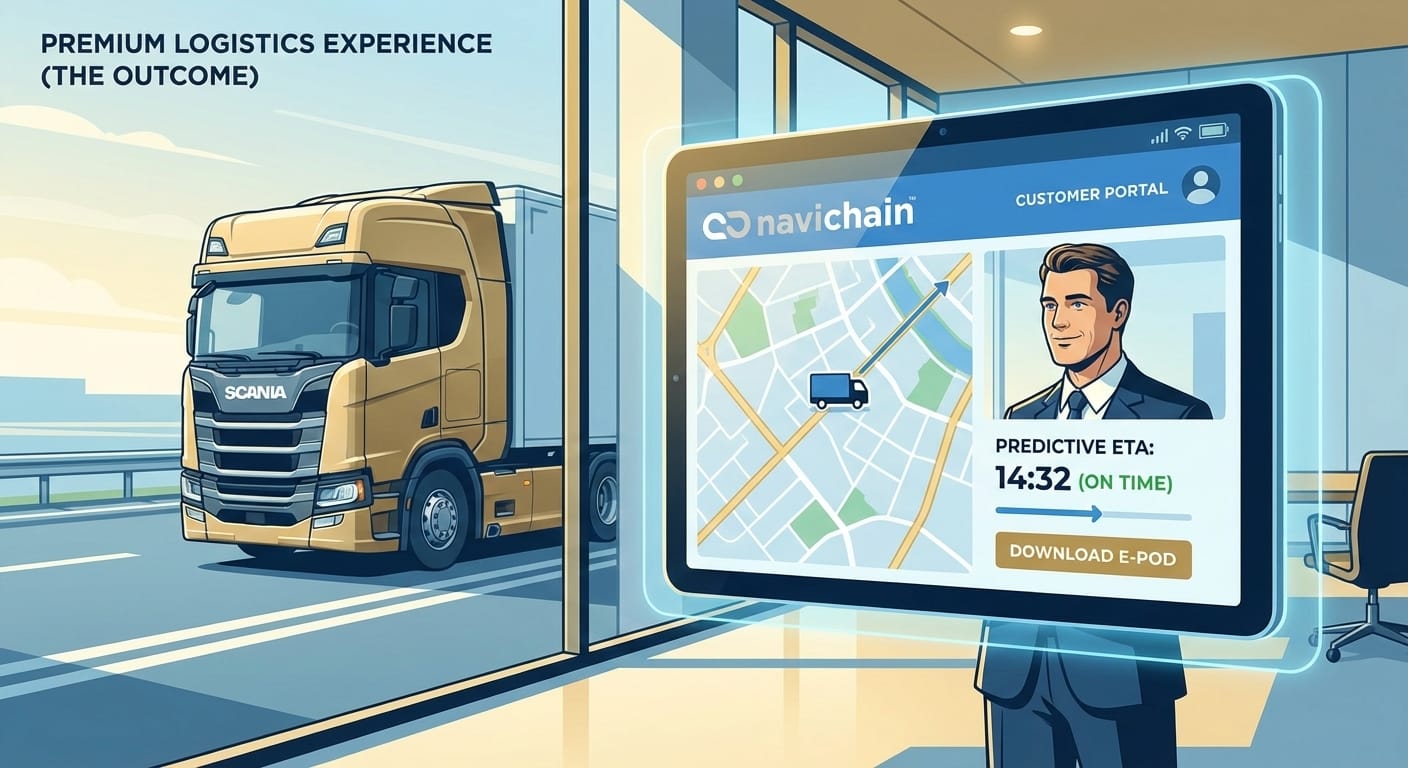
Fig 1: Once your data is unified (Pillar 1) and accessible (Pillar 2), the final step is to make it smart.
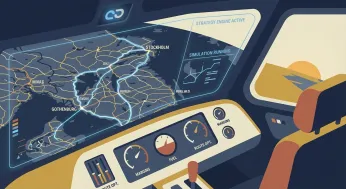
Once your data is unified (Pillar 1) and accessible (Pillar 2), the final step is to make it smart. In a fragmented system, your data is 'dead'—it only tells you what has happened. In a unified system, your data is 'alive'—it can tell you what will happen. This is the power of an embedded, integrated AI layer. By running secure analysis on your own unified operational data (orders, routes, driver hours, real-time traffic), a modern logistics platform can: * Generate truly optimized routes that account for all constraints.
- Provide predictive ETAs that learn from past performance.
- Identify your most (and least) profitable routes and customers. This intelligence becomes part of the product. You are no longer just telling your customer, 'Your delivery is on truck 42.' You are telling them, 'Your delivery is on truck 42 and, based on current conditions and our historic data, will arrive at 14:32, three minutes ahead of schedule.' This is the pinnacle of the premium logistics experience.
From diagnosis to design: The blueprint for a resilient logistics operating system
Fig 2: To execute this strategy, a logistics platform must be built on three foundational design principles.
This framework—moving from reactive to proactive, from manual to self-service, and from siloed to intelligent—is the strategic 'what.' But the 'how' is equally critical. To execute this strategy, a logistics platform must be built on three foundational design principles.
Principle 1: Unified operational fabric
You cannot present a unified view to your customer if you do not have a unified view internally. A modern logistics operating system must, by design, be a single, integrated platform. This means Transportation Management (TMS), Warehouse Management (WMS), Order Management, Asset Management, and Billing Management are not separate modules, but a single 'operational fabric.' Data is entered once and flows seamlessly across all functions, creating a single, indisputable source of truth. This is the 'central nervous system' that eliminates data silos and enables the entire experience.
Principle 2: Sovereign data architecture
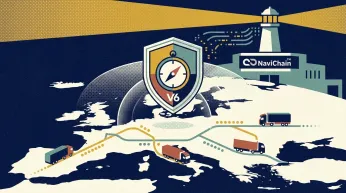
For a European SME, trust is a non-negotiable asset. Your customer's data—their shipping manifests, their client lists, their pricing—is incredibly sensitive. Entrusting this data to a platform hosted by a US-based hyperscaler (like AWS, Azure, or Google Cloud) creates a profound, often misunderstood, strategic risk. Regardless of where the server is located, data held by a US company is subject to the US CLOUD Act, which can compel the provider to turn over your data to US authorities without your consent or knowledge. True operational resilience, therefore, requires 'data sovereignty.' The only way to guarantee this is with a platform that is not just 'GDPR-compliant,' but is structurally sovereign. This means the software provider is European, and your data is hosted on self-hosted infrastructure within your own legal jurisdiction (e.g., Sweden/EU), forever shielded from extraterritorial laws. This is a powerful component of your service product: 'Work with us, and your data is legally and physically secure.'
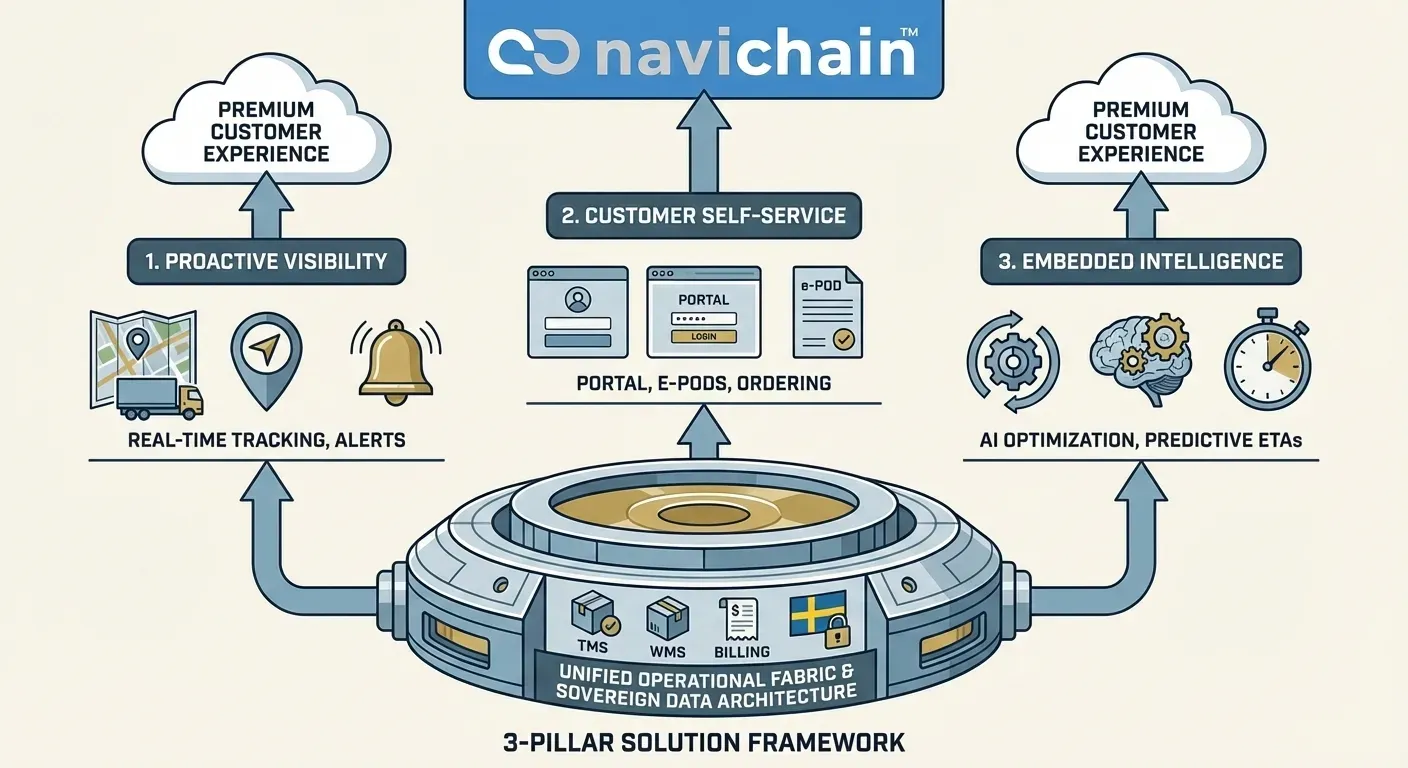
Schematic illustrating the unified operational fabric, where data flows seamlessly across TMS, WMS, Order Management, Asset Management, and Billing Management.
Principle 3: Embedded analytic intelligence
Finally, the platform's intelligence layer must not be a bolt-on. A integrated AI that runs within the secure, sovereign environment (Principle 2) and acts directly upon the data from the unified fabric (Principle 1) is essential. This embedded intelligence ensures that your most sensitive operational analysis—your margins, your customer behaviors, your route efficiencies—is never exposed to third-party models or external data brokers. The insights belong to you, and they are used to enhance your operation, not train a global competitor's algorithm.
Fig 3: Finally, the platform's intelligence layer must not be a bolt-on.
References/sources
- Salesforce Research. (2024). 'State of the Connected Customer' Report. Provides key statistics on B2B buyer expectations for customer experience.
- Source
- McKinsey & Company. (2023). 'The B2B Digital Tipping Point: Customer Experience Comes First'. Analysis of the shift in B2B purchasing drivers toward digital experience.
- Source
- International Road Transport Union (IRU). (2024). 'Road Freight Market Outlook 2024'. Data on cost pressures and digitalization trends in the European haulage sector.
- Source
- Transport Intelligence (Ti Insight). (2024). 'European Road Freight Market Report'. Provides analysis on the adoption of digital solutions and telematics by SMEs.
- Source
- European Commission. (2023). 'General Data Protection Regulation (GDPR) and its Impact on SMEs'. Guidelines on data handling and the importance of compliance.
- Source
Fig 4: This framework—moving from reactive to proactive, from manual to self-service, and from siloed to intelligent—is the strategic 'what.' But the 'how' is equal...
Enabling the blueprint: The navichain SaaS unified logistics platform
Fig 4: The navichain SaaS platform was designed from the ground up to be the engine for this transformation, directly embodying the three core principles.
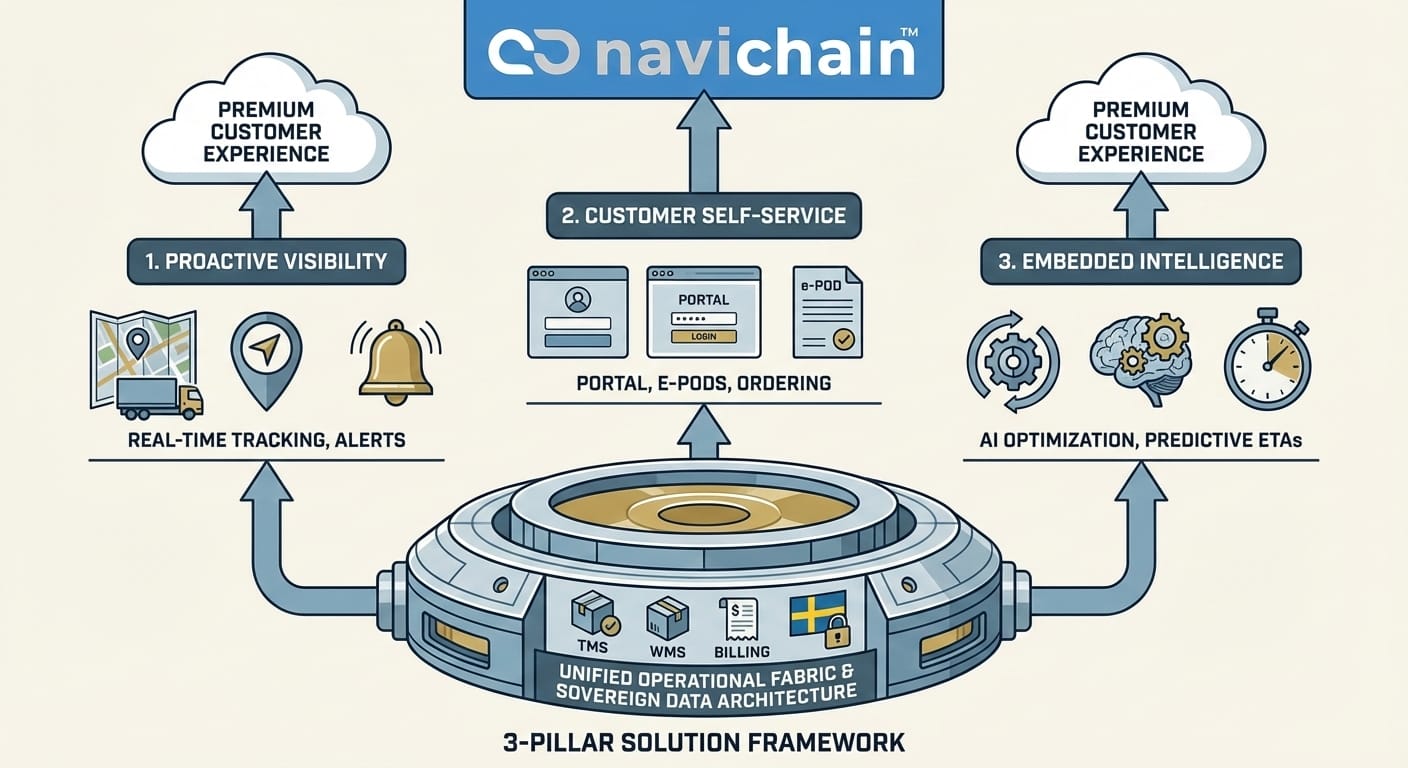
This illustration depicts the desired outcome: a loyalty-driven digital experience achieved through a unified logistics platform that prioritizes data sovereignty and GDPR compliance.
This white paper has laid out a strategic blueprint for transforming SME haulage operations from a commoditized service into a premium, loyalty-driven digital experience. The navichain SaaS platform was designed from the ground up to be the engine for this transformation, directly embodying the three core principles. 1. Unified Operational Fabric: navichain SaaS is not a collection of modules; it is a single, unified logistics operating system. Our platform seamlessly integrates Transportation Management (TMS), Warehouse Management (WMS), Order Management, Asset Management, and Customer Billing. This 'single source of truth' eliminates data silos and powers the effortless, visible customer experience described in this paper. 2. Sovereign Data Architecture: Our key differentiator is our unwavering commitment to your data sovereignty. navichain SaaS is a Swedish company, and our entire platform is hosted on our own self-hosted infrastructure in Sweden. This means your data—and your customers' data—stays in Sweden, under Swedish and EU jurisdiction. It is fully GDPR-compliant and structurally shielded from the reach of foreign legislation like the US CLOUD Act. This is the foundation of digital trust. 3. Embedded Analytic Intelligence: Our platform is enhanced by a integrated AI that runs securely on our own Swedish infrastructure. This embedded intelligence analyzes your unified operational data to unlock unique efficiencies, optimize routes, and provide predictive insights—all without ever exposing your sensitive business logic to third-party data models. Our mission is to democratize this powerful logistics technology, making it accessible and affordable for the SMEs that form the backbone of the European economy. We provide the tools to not just meet complex IT demands, but to productize them, turning your operations into your greatest competitive advantage.
The navichain SaaS platform integrates TMS, WMS, order management, asset management, and billing into a unified logistics operating system, underpinned by sovereign data architecture and embedded analytic intelligence.
navichain SaaS provides a unified logistics operating system, integrating key functionalities under a sovereign data architecture hosted entirely in Sweden.
Ready to optimise your supply chain?
navichain Insights Newsletter
Join the newsletter to receive the latest updates in your inbox.