The Haulage Partnership Paradox: How Data Friction Erodes Margins in SME Collaborations
Table of Contents
Scandinavian SME hauliers are increasingly collaborating to win bigger contracts, but are these partnerships actually delivering the anticipated efficiencies? Discover how fragmented systems and manual data sharing are creating a "Partnership Paradox", eroding margins and hindering growth.
The Haulage Partnership Paradox: How Data Friction Erodes Margins in SME Collaborations
Scandinavian SME hauliers increasingly collaborate to compete for larger contracts, yet recent industry reports show administrative overhead remains stubbornly high, squeezing already-thin margins. This is the 'Partnership Paradox': attempting to gain scale by partnering often results in more manual work, data re-entry, and compliance gaps as teams struggle to manage information across disparate TMS systems via email and spreadsheets. This paper outlines a data-driven framework for building a secure, integrated digital ecosystem. It details how to move beyond ad-hoc data exchange to a scalable, API-first integration strategy, enabling true collaboration, profitability, and complete data control.
The collaboration imperative: Why SME hauliers can't go it alone
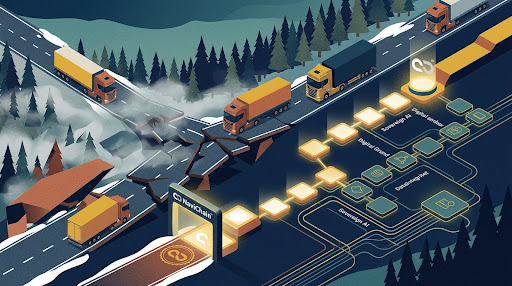
Fig 1: For Small to Medium-sized Enterprises (SMEs) in the Scandinavian and European haulage sector, the operating environment is one of relentless pressure. For Small to Medium-sized Enterprises (SMEs) in the Scandinavian and European haulage sector, the operating environment is one of relentless pressure. Fuel costs, fierce competition from continental giants, complex toll systems, and razor-thin margins are table stakes. Customers, conditioned by e-commerce, demand unprecedented real-time visibility and flexibility. In this environment, isolation is a failing strategy. The logistical demands of modern contracts often exceed the capacity of a single SME fleet. To bid on and win larger, more profitable contracts, collaboration is no longer optional—it's essential. Partnering with other trusted hauliers to subcontract loads, cover specific routes, or manage overflow seems like the obvious strategic move. In theory, this creates a flexible, scalable network that allows a group of SMEs to punch above their weight, mimicking the scale of logistics behemoths like DSV or Maersk. In practice, however, it often creates an operational nightmare. This disconnect between strategic intent and operational reality is what we call the 'Haulage Partnership Paradox.'
Deconstructing the partnership paradox: The high cost of data friction
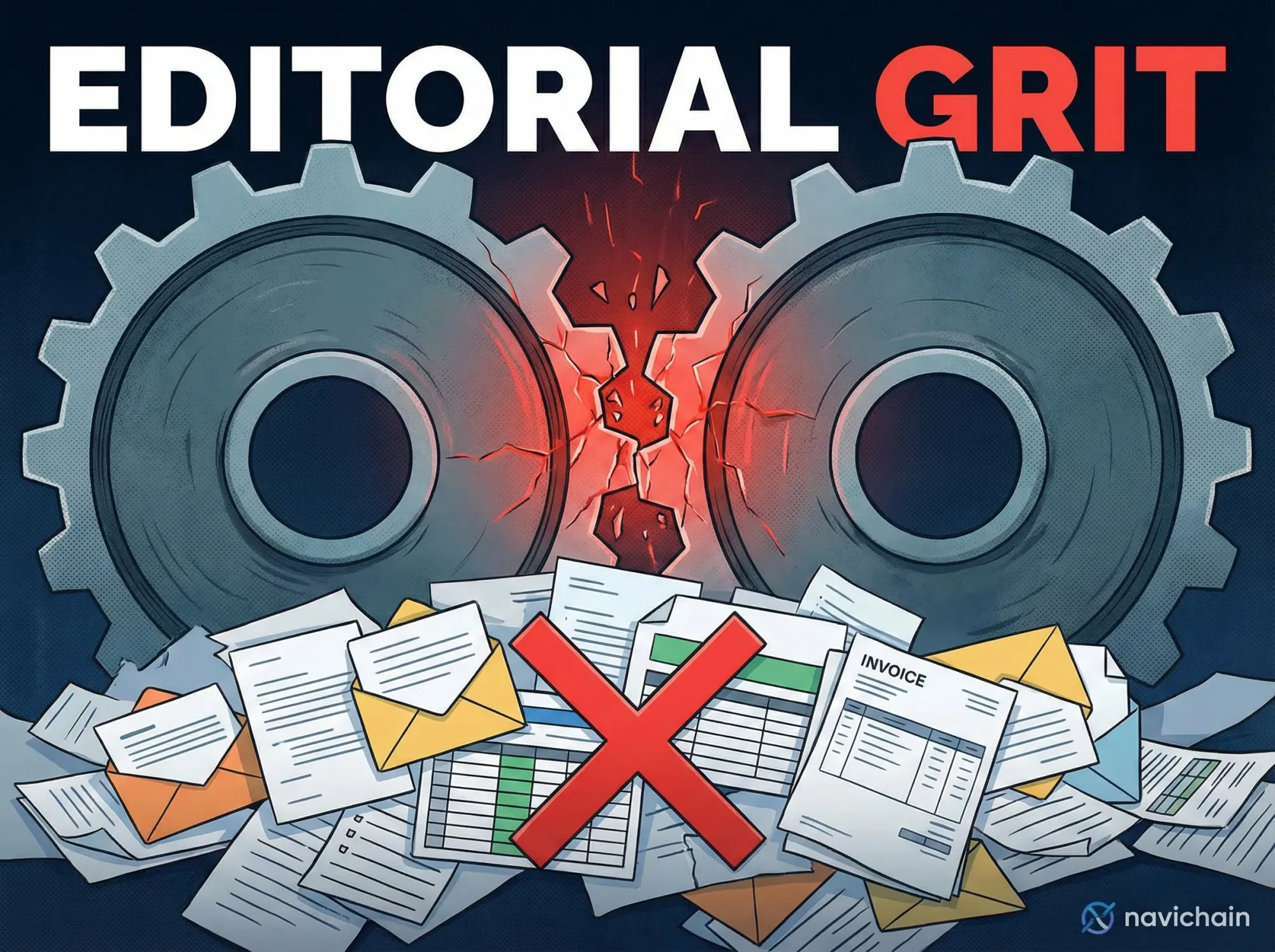
Operational friction and administrative burden stifle SME haulage collaborations.
Why? Because the collaboration is almost always managed through a patchwork of emails, phone calls, spreadsheets, and PDF invoices. Each partner operates within their own isolated Transportation Management System (TMS), creating digital islands. When a load is subcontracted, a damaging and costly process begins.
The "data re-entry" drain
Consider the workflow. Your primary partner emails you the details for a subcontracted load. Your dispatcher must then manually read that email and re-key every piece of information—addresses, reference numbers, cargo details, contact info—into your own TMS. This process is repeated for status updates, proof of delivery, and finally, invoicing. Industry analysis from bodies like the International Road Transport Union (IRU) consistently points to administrative overhead as a significant drain on SME profitability. This manual data re-entry is a primary component of that overhead. It's not just a time sink; it's a direct source of errors. A single mistyped postal code or reference number can lead to a failed delivery, a customer dispute, and a lost invoice—all eroding the slim margin on the original contract.
The visibility black hole
Your customer, who expects end-to-end tracking, calls you asking for a status update. But the load is with your partner. Your TMS is blind. You are forced to reply, "Let me check and get back to you." You then call or email your partner, wait for a response, and relay the information. This "visibility black hole" instantly degrades your service level, making your operation appear amateurish and fragmented. You cannot manage what you cannot see, and you have effectively abdicated control of your customer experience to your partner's manual reporting process.
The compliance and security blind spot
This is the most critical, yet most overlooked, risk. That email containing shipment details? It likely contains Personally Identifiable Information (PII) of the sender and receiver. That PDF invoice? It contains transactional data. Under the General Data Protection Regulation (GDPR), your company is the data controller. When you forward this data to a partner via insecure email, you have minimal control over how they store, process, or secure it. Are their systems compliant? Is their email server secure? If they suffer a data breach, you are exposed. This ad-hoc, email-driven "integration" is a massive, unmanaged compliance liability. Relying on informal agreements for data processing with partners is a risk few SMEs can afford to take.
The path forward: The 'digital haulier network' framework
Fig 3: The solution is not to stop collaborating. The solution is not to stop collaborating. The solution is to industrialize the process of collaboration. SME hauliers must evolve from ad-hoc, manual transactions to building a secure, scalable 'Digital Haulier Network.' This strategic framework is built on three pillars, moving from a foundation of internal strength to a scalable ecosystem of external partners. It directly answers the question, "How can we integrate?"
Pillar 1: Forge a unified internal core
Before you can effectively integrate with external partners, your internal operations must be unified. You cannot create a network hub if your own systems are a collection of data silos. It is impossible to have a single source of truth for your partners if you don't have one for yourself. This requires a modern, unified logistics operating system where your Transportation Management (TMS), Warehouse Management (WMS), Billing, and Order Management all function as one. When an order is created, it should flow seamlessly to the warehouse for picking, to the TMS for planning, and to billing for invoicing without a single manual re-entry. This unified core becomes the "control tower" from which you will manage your entire network, including partners.
Pillar 2: Adopt an api-first integration strategy
With a unified core in place, you can now connect to your partners. The "old way" of integration was Electronic Data Interchange (EDI)—a rigid, expensive, and slow standard that is ill-suited for the dynamic needs of SME partnerships. The modern, flexible, and cost-effective solution is an API-first strategy. An Application Programming Interface (API) is a secure, documented "door" that allows two different software systems (like your TMS and your partner's TMS) to talk to each other directly, in real-time, without manual intervention. A well-designed API can: * Receive Orders: Your partner's system can "push" a new order directly into your TMS, creating the shipment record instantly and accurately.
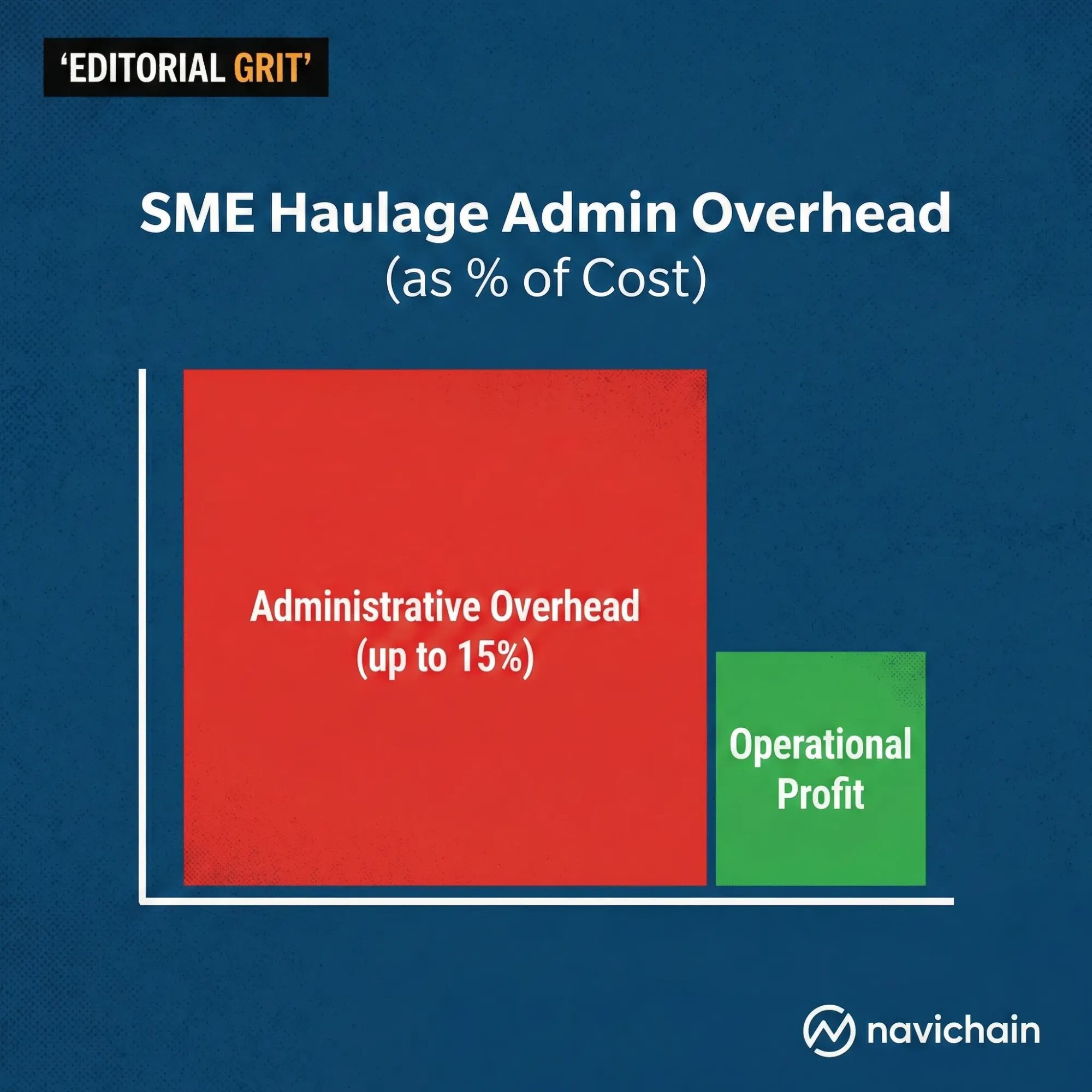
Data silos within an organization prevent seamless information flow, hindering effective collaboration with external partners.
- Share Status: Your TMS can automatically send status updates (e.g., "En Route," "Delivered") back to your partner's system.
- Exchange Documents: Securely transmit Proofs of Delivery (PODs) or invoices system-to-system. This API-driven approach eliminates manual re-entry, closes the visibility black hole, and creates a secure, auditable trail of data exchange, dramatically improving GDPR compliance.
Pillar 3: Build on a foundation of data sovereignty
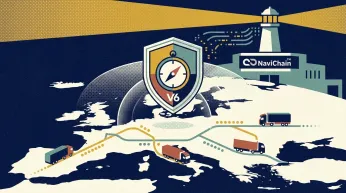
Connecting systems creates new attack surfaces. As you begin to exchange data with partners, the security and location of that data become paramount. This is where a non-negotiable principle must be established: data sovereignty. For any European SME, especially in Scandinavia, the strategic high ground is to ensure your core operational data—and the data of your partners that you process—never leaves your legal jurisdiction. Relying on platforms hosted on non-EU infrastructure creates complex legal entanglements regarding data transfers and exposes you to foreign surveillance laws. Your integration strategy must be built on a platform that guarantees data sovereignty—one that is hosted on secure infrastructure within your own country or, at minimum, the EU. This simplifies GDPR compliance, builds trust with partners, and ensures that you, not a third-party hyperscaler, are in ultimate control of your business-critical information.
From diagnosis to design: The blueprint for a resilient logistics operating system
Fig 2: It dictates a specific technological blueprint.
This framework—moving from an internal core to an external network—is not just a theory. It dictates a specific technological blueprint. To execute this strategy, an SME logistics platform must embody three core principles.
Principle 1: Unified operational fabric
The platform must act as a 'central nervous system' for the entire business. It cannot be a standalone TMS or WMS. It must be a single, integrated fabric that inherently combines transportation, warehousing, asset management, billing, and order management. This creates the single source of truth necessary to manage complex internal operations and provides the stable "hub" required for all external partner integrations.
Principle 2: Secure data architecture and control
This is the non-negotiable foundation. For European SMEs, true operational resilience requires complete control over their data environment. This means the platform's architecture must be built for security and sovereignty. Ideally, this involves data stored and processed under the clear legal jurisdiction of the EU/Sweden on secure, Self-Hosted infrastructure. This design isn't just a feature; it's a strategic imperative that ensures straightforward GDPR compliance and minimizes exposure to the complexities and risks of international data transfers.
Principle 3: Embedded analytic intelligence
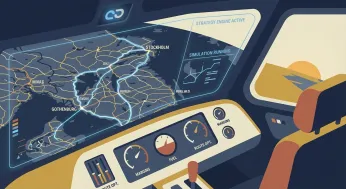
Once you have unified your internal data (Principle 1) and integrated your partner data (via APIs, on the secure foundation of Principle 2), you have a new, incredibly valuable asset: a complete network dataset. The platform must therefore include an embedded intelligence or Integrated AI layer. This AI must run within the same secure environment, allowing it to analyze this unified data to unlock deep insights. Which partners are the most reliable? Where are the most profitable routes in your combined network? How can you optimize cross-company workflows? This intelligence is what turns a simple collaboration into a true strategic advantage.
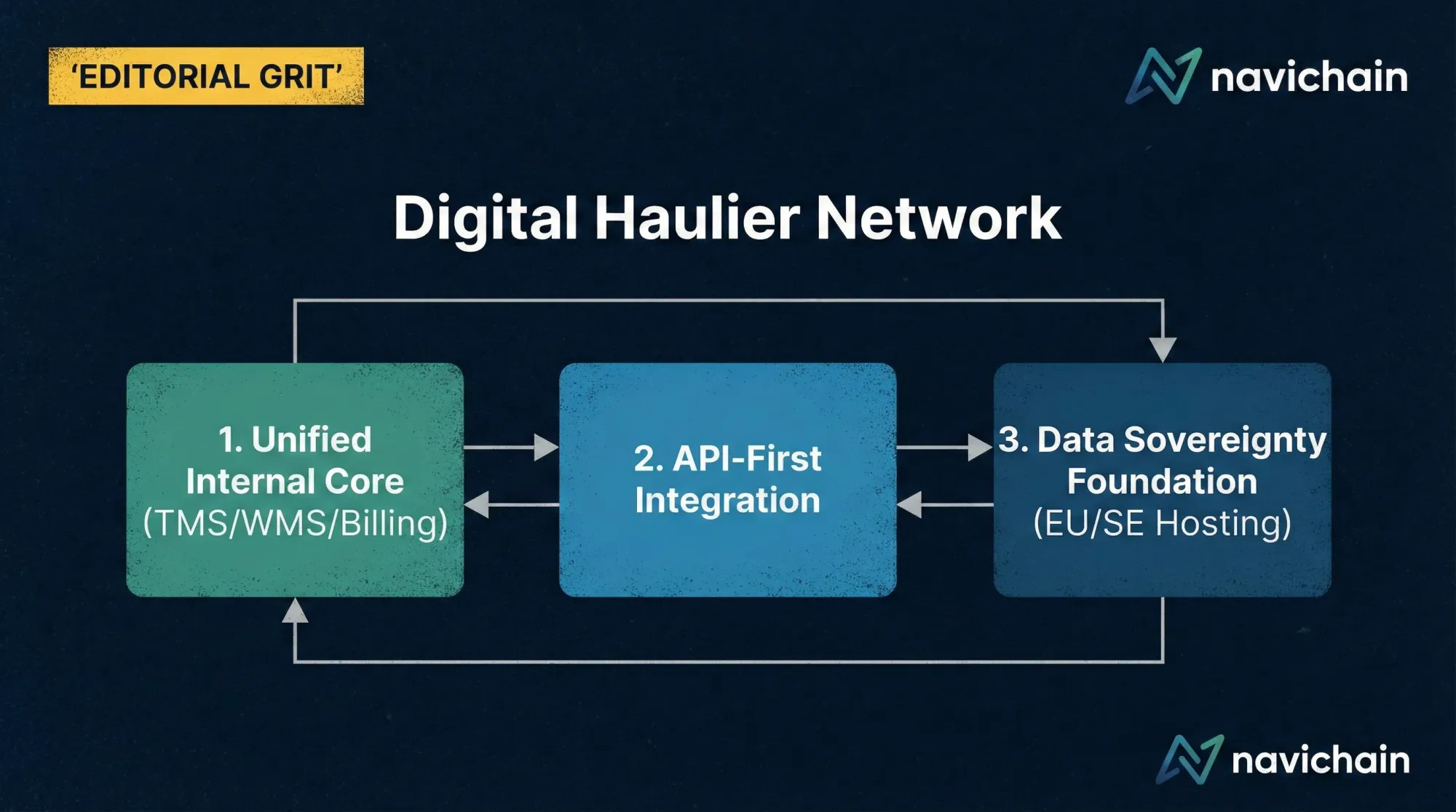
A schematic illustrating the unified operational fabric and secure data flow necessary for embedded analytic intelligence in collaborative SME logistics.
Fig 3: Where are the most profitable routes in your combined network?
References/sources
- International Road Transport Union (IRU). (2025). "Digitalization in European Road Freight: Challenges and Opportunities." https://www.iru.org/resources/publications
- Transport & Environment. (2024). "Efficiency Gaps and Decarbonization in European Logistics." https://www.transportenvironment.org/publications
- Eurostat. (2025). "Freight transport statistics - modal split and administrative burdens." https://ec.europa.eu/eurostat/web/transport/data/database
- Ti Insight. (2024). "European Road Freight Transport 2024: SME Challenges." https://ti-insight.com/reports
- EU Commission. (n.d.). "General Data Protection Regulation (GDPR) - Official Text." https://gdpr-info.eu/
Fig 4: This framework—moving from an internal core to an external network—is not just a theory.
Enabling the blueprint: The navichain SaaS unified logistics platform
Fig 4: The navichain SaaS platform was designed from the ground up to embody these three core principles. 1.
- Unified Operational Fabric: Navichain is not a collection of separate modules. It is a single, unified logistics operating system where Transportation Management (TMS), Warehouse Management (WMS), Billing Management, Asset Management, and Order Management work as one. This creates the 'central nervous system' (Principle 1) that SMEs need to manage their operations and serve as a stable hub for partner integration.
- Secure Data Architecture and Control: To solve the challenge of data sovereignty (Principle 2), our entire platform is hosted on our own secure, Self-Hosted infrastructure in Sweden. This is our key differentiator. By keeping all client data strictly within Swedish/EU jurisdiction, we ensure our clients maintain full control over their operational information, guaranteeing straightforward GDPR compliance and eliminating the risks of international data transfers. This is especially critical when integrating and processing partner data.
- Embedded Analytic Intelligence: Navichain is enhanced by a integrated AI that runs on our same secure Swedish infrastructure (Principle 3). This allows our clients to perform deep, secure data analysis on their unified operational data—including data from integrated partners—to unlock unique efficiencies and optimize their entire network. To directly answer the question of integration, the navichain SaaS platform features a robust and well-documented set of APIs and pre-built connectors. These tools are designed specifically to bridge the gap between disparate systems, making partner TMS integration a scalable strategy, not a technical bottleneck. Our mission is to democratize this level of logistics technology, offering a seamless, powerful, and affordable solution that empowers SMEs to thrive.

The Navichain platform's unified design, secure infrastructure, and embedded AI work together to create a powerful and accessible logistics solution for SMEs.
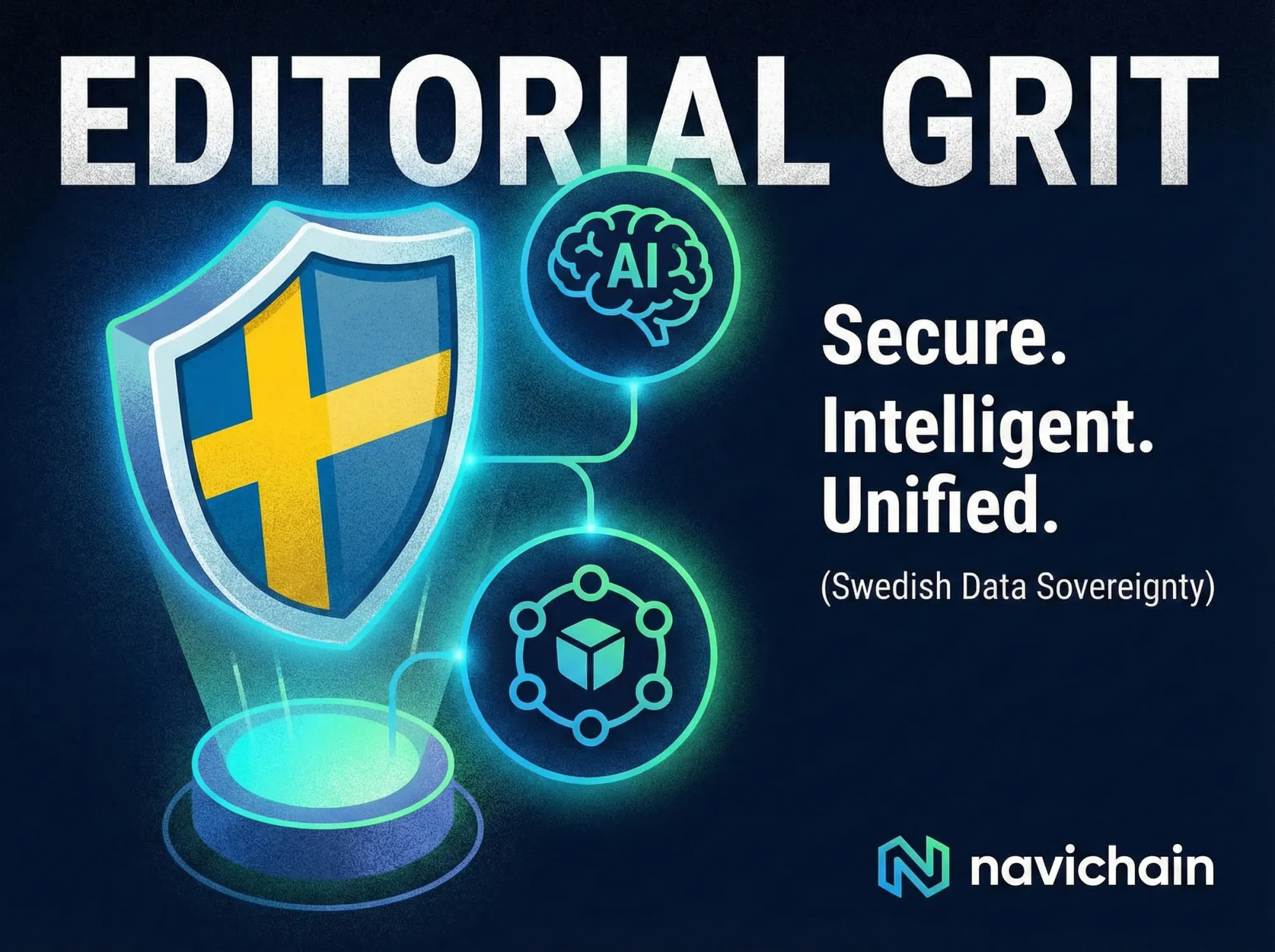
Navichain's API-driven architecture facilitates seamless integration with existing TMS and other partner systems, enabling data sharing and collaborative workflows.
Ready to optimise your supply chain?
navichain Insights Newsletter
Join the newsletter to receive the latest updates in your inbox.