CSRD & Scope 3: Transport Buyer Panic is Your Opportunity
Table of Contents
The era of "Greenwashing" is officially over. The EU's Corporate Sustainability Reporting Directive (CSRD) has fundamentally changed the landscape of European business. For your customers—major retailers, manufacturers, and industrial giants—this is a moment of acute anxiety. They are no longer asked to simply estimate their climate impact; they are legally required to account for it with the same rigor as their financial balance sheet. And the biggest black hole in their ledger? Scope 3: Transport.
Executive Summary

For decades, sustainability reporting in logistics was a game of "guestimation." Companies used generic spending data to approximate their carbon footprint. But under CSRD, which fully impacts large companies in 2026 (reporting on 2025 data), this is no longer acceptable. Companies must report on their entire value chain (Scope 3), and they are under immense pressure to move from Secondary Data (industry averages) to Primary Data (actual fuel consumption and distance).
This shift represents a terrifying liability for transport buyers, but a massive strategic opportunity for hauliers. The market is splitting into two: 1. The Commodity Haulier: Who sells space on a truck. 2. The Data Partner: Who sells space on a truck plus the auditable climate data attached to it.
This white paper explores how the ISO 14083 standard facilitates this transition and how Navichain automates the creation of "Carbon Currency" for your clients.
Part 1: The "Data Cascade" - Why They Are Calling You
The Regulatory Hammer
The CSRD is not a suggestion. It applies to over 50,000 companies in the EU. * The Scope: Companies must report on "upstream and downstream transportation and distribution." * The Audit: Sustainability reports must now be assured by a third-party auditor (just like financial reports). If an auditor sees a carbon calculation based on a 10-year-old spreadsheet, they will flag it as a risk.
The "Cascade Effect"
Because the liability sits with the big buyers (e.g., IKEA, Volkswagen, Siemens), they are pushing the requirement down the chain. 1. The Giant: "We need primary data for every shipment." 2. The Tier 1 Forwarder: "We can't calculate this manually. We need our subcontractors to provide it." 3. The Subcontractor (You): "If you can't give us the numbers, we can't give you the load."
The Death of "Spend-Based" Accounting
Historically, companies calculated emissions by taking their transport spend (€10,000) and multiplying it by an industry average factor (0.5 kg CO2e per €). * The Flaw: This penalizes efficiency. If fuel prices go up, your calculated emissions go up, even if you drove the same distance. * The Pivot: CSRD demands Activity-Based calculation. Distance × Weight × Fuel Factor. This requires real operational data that only you possess.
Part 2: ISO 14083 - The New Gold Standard
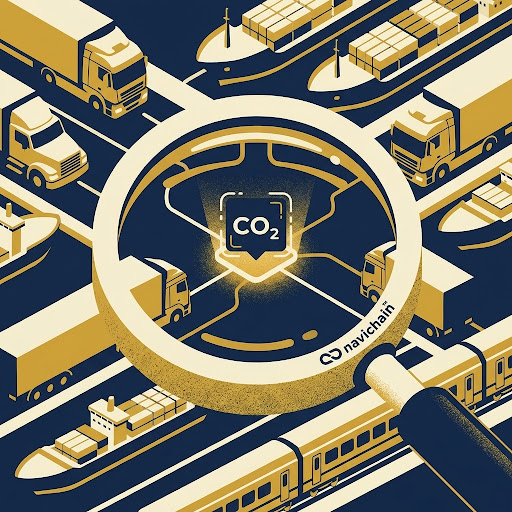
Transparency is no longer a choice, it's a requirement.
To bring order to the chaos of calculation methodologies (GLEC, EN 16258, GHG Protocol), the world has converged on a single standard: ISO 14083:2023.
Why ISO 14083 Matters to You
Your customers don't just want a number; they want a number calculated correctly. ISO 14083 defines exactly how to: * Allocate Emissions: How to split the CO2 of a truck shared by three customers. * Handle Empty Runs: How to account for the repositioning mileage. * Well-to-Wheel (WTW): How to include the emissions from the production of the fuel (upstream), not just the burning of it (tailpipe).
If your current Transport Management System (TMS) isn't ISO 14083 compliant, the data it produces is essentially worthless to a CSRD-audited client.
Part 3: Navichain's Angle - Automation is the Only Way
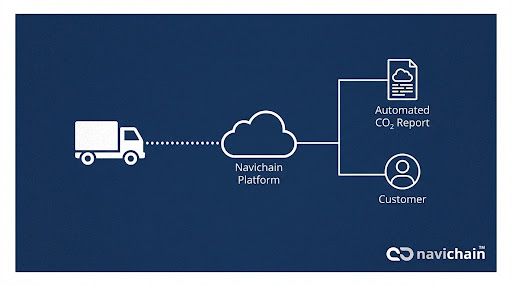
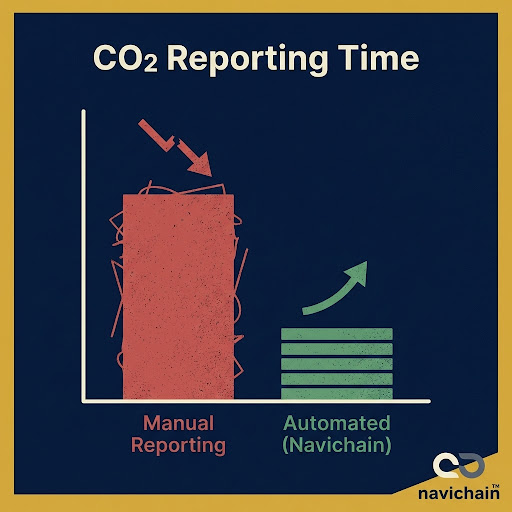
The problem isn't the math; it's the volume. Calculating ISO 14083 emissions for 5,000 shipments a month manually is a full-time job for two people.
Reporting as a Byproduct
In Navichain, carbon accounting is invisible. It is a byproduct of operational planning. 1. Input: Dispatcher assigns a 24-ton load to a Scania R450 aiming for Berlin. 2. Process: Navichain looks up the vehicle's engine class (Euro 6), the fuel type (HVO100), the exact route distance (including topography), and the cargo weight. 3. Calculation: The system runs the ISO 14083 algorithm in real-time. 4. Output: The CO2e (Carbon Dioxide Equivalent) is stamped onto the digital waybill before the truck even leaves the yard.
Data Granularity vs. Privacy
A common fear is giving away too much data. "If I tell them exactly how much fuel I use, they will squeeze my margins." * The Solution: Navichain allows for "Black Box" reporting. You share the verified emission output (kg CO2e) without necessarily sharing the raw fuel input or cost structure. You satisfy the CSRD requirement without exposing your P&L.
Part 4: Winning the Tender - Your Competitive Edge

In 2026, the cheapest price won't always win. The "Most Compliant Price" will.
The New RFP (Request for Proposal)
We are seeing a surge in tender documents with "Sustainability Gates." * Pass/Fail: "Can you provide API-based Scope 3 data per shipment?" If the answer is No, you are disqualified before they even look at your price per kilometer. * The Premium: Buyers are willing to pay a premium for Primary Data. Why? Because using actual data (e.g., "We used HVO100 for this leg") allows them to report a lower carbon footprint than using the generic industry average (which assumes standard diesel). * Your Value Proposition: "By hiring us, you lower your reported corporate emissions immediately, and we have the data to prove it."
Branding: The Transparent Partner
In an industry rife with opacity, transparency is a differentiator. * Proactive Dashboards: Instead of waiting for a monthly Excel request, give your clients access to a Navichain portal where they can download their specific sustainability report. * Accredited Trust: Being able to say "Our reporting is ISO 14083 compliant" carries the same weight today as saying "We are ISO 9001 certified" did twenty years ago.
Part 5: Beyond CO2 - The ESG Landscape
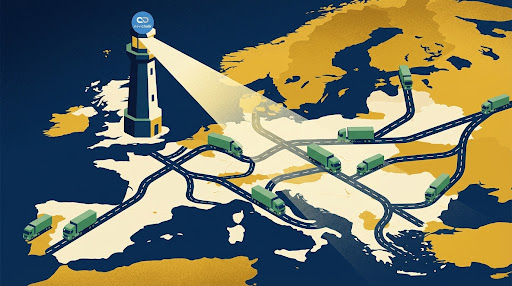
Carbon is just the beginning. CSRD also covers "S" (Social) and "G" (Governance). * Social Compliance: Are your drivers paid correctly? Do they follow driving and resting times? * Navichain's Role: Because our platform handles driver management and tachograph data, you can bundle "Social Compliance Reports" with your Environmental reports. You become the "Safe Choice" in a risk-averse market.
Conclusion
The CSRD is not a bureaucratic nightmare; it is a market-clearing event. It will flush out the "cowboy" operators who cut corners on environment and compliance.
For the modern haulier, this is the greatest opportunity in a decade. By weaponizing data, you stop being a commodity provider of kilometers and start being a strategic sustainability partner. The panic in your customer's boardroom is the key to your growth.
Don't just move the goods. Move the data.
Turn Compliance into Contracts.
See how Navichain automates ISO 14083 reporting for you.
navichain Insights Newsletter
Join the newsletter to receive the latest updates in your inbox.