Marginal Wastage: Why Your Biggest Profit Leak Isn''t in the Lorry,
Table of Contents
Are European transport SMEs unknowingly leaking revenue? With razor-thin margins already under pressure, manual invoicing and disconnected systems could be costing you 5-10% in missed charges and contract misapplications. This white paper deconstructs this profitability paradox and presents a strategic three-part framework for achieving a 'Zero-Gaps' order-to-cash cycle.
Marginal Wastage: Why Your Biggest Profit Leak Isn't in the Lorry,
European transport SMEs operate on wafer-thin margins, often as low as 2-4%, where every penny counts. The daily struggle is against visible costs such as fuel and wages. But what if the biggest drain on your margin isn't on the road? Our analysis shows that manual invoicing processes and disconnected systems can lead to revenue leakage of 5-10% from missed charges and incorrect contract application. This administrative friction is an invisible, self-inflicted wound. This white paper deconstructs this profitability paradox. It presents a strategic three-part framework for creating a 'Zero-Gaps' order-to-cash cycle, taking you from fragmented data to a unified, automated and secure operating structure that ensures every service delivered is invoiced correctly.
The million-pound question: Is your invoicing process leaking profit?
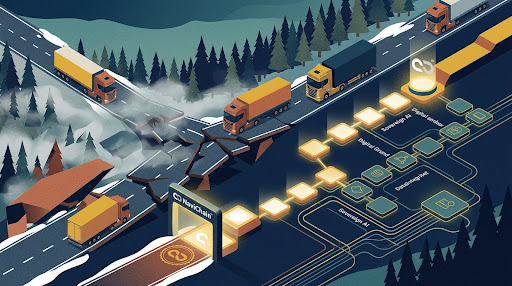
Fig 1: For a small or medium-sized enterprise (SME) in the European transport sector, survival is a matter of centimetres – or rather, pence per kilometre.
For a small or medium-sized enterprise (SME) in the European transport sector, survival is a matter of centimetres – or rather, pence per kilometre. Industry reports consistently place net margins in the wafer-thin range of 2-4%. Leaders in this area are masters of visible cost control; they meticulously optimise routes, negotiate fuel prices and maximise vehicle utilisation. We fight daily battles against volatile fuel prices, driver shortages and intense competition. But what if the most significant, controllable threat to your profitability isn't on the road at all? What if it's sitting in your office, hidden in a spreadsheet? This is the paradox of modern logistics: we have invested in optimising the physical flow of goods but continue to accept catastrophic friction in the digital flow of information. User input highlights this perfectly: it's "easy to miss invoicing for everything that should be invoiced" and "time-consuming to... ensure that we invoice according to the correct price agreement." This isn't a minor administrative headache. It's a critical, quantifiable margin drain. This white paper argues that the biggest threat to the profitability of modern SMEs isn't external pressure, but internal process friction. Specifically, it's the manual, fragmented gap between service delivery (TMS/WMS) and financial reconciliation (Invoicing) that creates invisible but critical revenue leakage.
Deconstructing the margin drain: The anatomy of revenue leakage
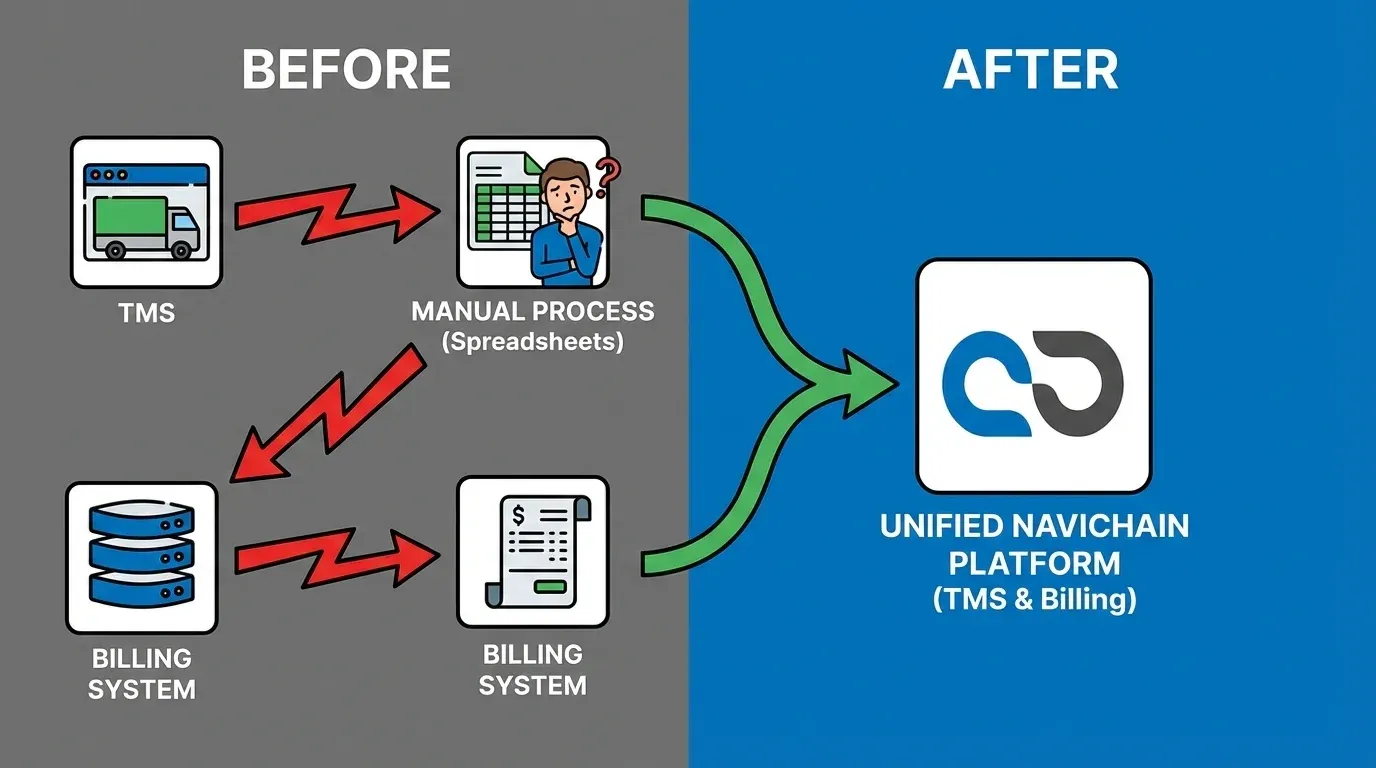
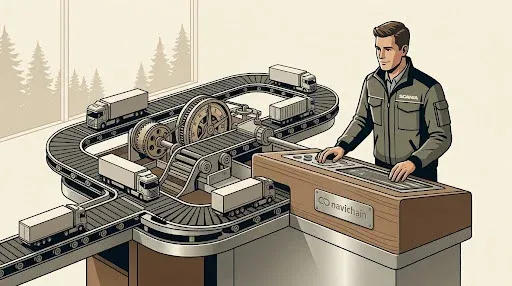
Fig 2: Industry analysis suggests that manual invoicing processes can have error rates as high as 5-10%, directly impacting your bottom line.
The problem isn't a lack of effort. Your team is working hard. The problem is a broken system – or rather, the lack of a system. The typical workflow for an SME haulage company is a fragile chain of disconnected data silos. 1. The Order: A customer emails a request. It is entered manually into a basic Transport Management System (TMS) or even just a spreadsheet. 2. Execution: The driver completes the job, perhaps encountering waiting time or using special equipment. They note this on a physical consignment note or send a text message. 3. Reconciliation: At the end of the week, an administrator gathers these notes, tries to match them to the original order in the TMS, and then manually cross-references against a separate PDF or spreadsheet containing that customer's unique price agreement. 4. The Invoice: The administrator manually enters this information into a separate accounting program and hopes they have captured all surcharges (waiting time, fuel surcharges, pallet charges) and applied the correct prices. This "spreadsheet shuffle" is where profitability dies. Every manual handover is a risk. Industry analysis suggests that manual invoicing processes can have error rates as high as 5-10%, directly impacting your bottom line. For a company with £2 million in revenue, that's £100,000 to £200,000 in lost profit.
The three main leakage points
1. Missed Additional Services and Charges: The most common leakage. Waiting time, incorrect number of pallets, weekend delivery charges, fuel surcharges. These are often captured on a driver's note but disappear in the manual data transfer to the invoicing system. Every missed £25 charge, multiplied by thousands of jobs, becomes a six-figure loss. 2. Incorrect Contract Application: Your salesperson negotiated a complex, multi-tiered price agreement with a key customer. Your invoice administrator, working from an outdated spreadsheet, mistakenly invoices them at the standard rate. You have undercharged, and the window to correct it is small. That "time-consuming" verification is your only defence, and it's a costly and inefficient one. The cost of manually handling a single freight invoice can range from £5 to £15 when factoring in this verification time. 3. Data Silos and Delayed Cash Flow: The gap between the TMS (what was done) and the invoicing system (what was charged) creates a black hole of visibility. You don't know what you don't know. This friction not only leaks revenue but also delays your entire order-to-cash cycle, putting pressure on your working capital.
The way forward: The 'zero-gaps' order-to-cash framework
Fig 3: To survive and thrive, SMEs must move from a state of manual reconciliation to automated validation.
To survive and thrive, SMEs must move from a state of manual reconciliation to automated validation. The goal is to create a "Zero-Gaps" framework where the service delivered is identical to the service invoiced, every time, with minimal human intervention. This isn't about a single piece of software; it's a strategic shift in your operational design. It consists of three core pillars.
Pillar 1: Unite the data core (from silos to a single object)
The root of all friction is re-entering data. The "order" in your TMS must be exactly the same digital object as the "order" in your WMS and the "order" that becomes your invoice. This requires a unified operating structure – a single platform where Transport Management, Warehouse Management and Billing Management are not separate, loosely screwed-together apps, but integrated functions within one system. When a job is created, it carries all its DNA – customer, route and price agreement – with it from start to finish. When a driver marks "2 hours waiting time" in their app, it doesn't go into a notebook; it adds that data directly to the billable order object.
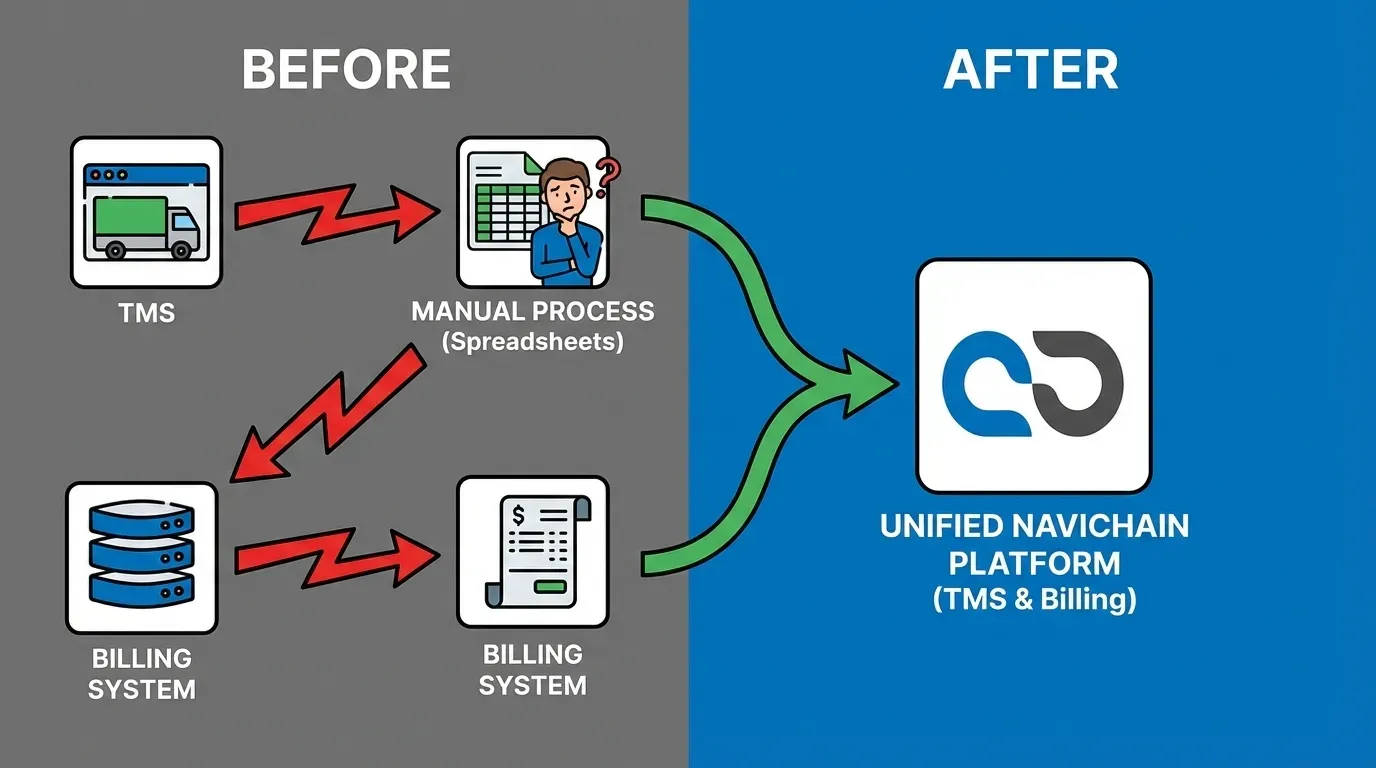
Chart illustrating the shift from manual reconciliation processes, prone to errors and gaps, to an automated validation framework achieving "Zero-Gaps."
Pillar 2: Automate contract logic (from spreadsheets to rules)
You must extract your price agreements from PDFs and spreadsheets and embed them as automated rules within your system. Instead of an administrator checking a price list, the system knows the price list.
- Rule Example 1:
IF Customer = 'Client-A' AND Service = 'FTL' AND Day = 'Saturday', THEN Apply Tariff 'Weekend-A' + 'Standard-Fuel-Surcharge'. - Rule Example 2:
IF Job-Event = 'Waiting-Time' AND Duration > '60-Minutes', THEN Create-Billable-Line = 'Waiting-Time-Charge-Level-1'.When the order is marked as complete, the system automatically generates a 100% accurate draft invoice based on these rules. The administrator's role shifts from data entry to high-value exception handling – reviewing the 5% of complex cases, not the 95% of standard cases.
Pillar 3: Establish real-time traceability (from 'i think' to 'i know')
With a united data core, you gain what was previously impossible: a single source of truth. You can finally answer critical business questions in real time: * "Show me all completed jobs from last week that have not been invoiced." * "Which customers are costing us the most in waiting time?" * "What is our true profit margin on the 'Client-A' contract?" This visibility lets you plug leaks as they happen, not discover them at the end of the quarter. It transforms your invoicing department from a cost centre into a strategic profit-protection function.
From diagnosis to design: The blueprint for a resilient logistics operating system
Implementing the "Zero-Gaps" framework requires a specific type of technology architecture. For pragmatic European SMEs, the choice of platform is a critical strategic decision that must be built on three non-negotiable principles.
Principle 1 - unified operating structure
Your technology stack must function as a central nervous system, not a collection of disparate limbs. You cannot achieve a "Zero-Gaps" future if your TMS, WMS, vehicle system and invoicing system come from different vendors and are held together by fragile, custom-built integrations. You need a single, integrated system where data flows seamlessly from order creation to final invoice, creating an unimpeachable single source of truth.
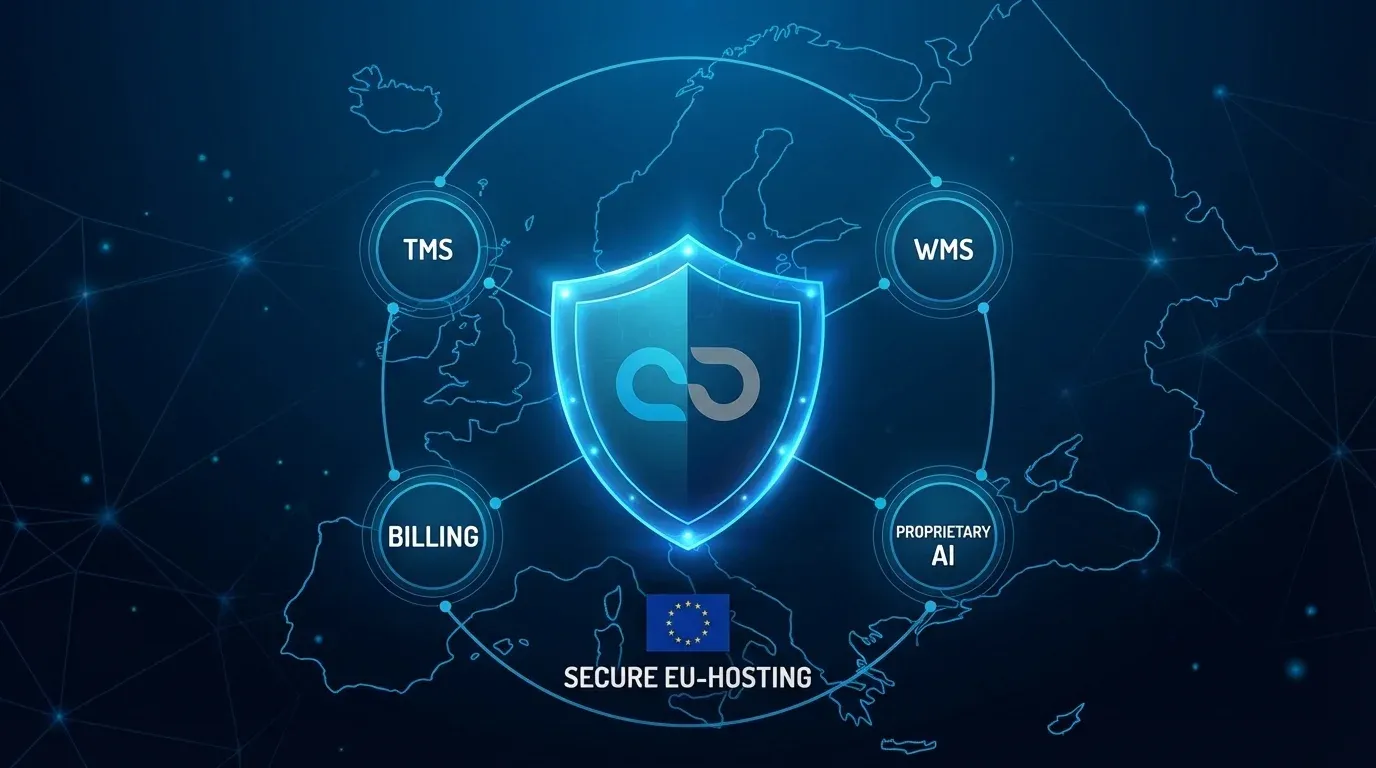
Principle 2 - secure data architecture and control
This is paramount. Your operational and financial data – customer lists, price agreements, driving routes, invoice history – is your most sensitive asset. For European SMEs, true operational resilience and straightforward GDPR compliance require complete control over this data environment. This means your data must be stored and processed under the legal jurisdiction of your own region (i.e. within Sweden/the EU) on a secure, self-hosted infrastructure. This minimises exposure to the complexities and risks of international data transfers and gives you ultimate control over your own operational information.
Principle 3 - embedded analytical intelligence
To find the leaks you can't see, you need more than dashboards. You need an embedded intelligence or integrated AI layer that can analyse the unified data from Principle 1, within the secure environment from Principle 2. This AI's job isn't to predict global trends, but to answer pragmatic, high-value questions: "Which jobs are consistently under-invoiced?" "What pricing anomalies exist across my contracts?" "Where is my biggest source of administrative friction?" This secure, proprietary analysis unlocks efficiency gains that are impossible to find manually.

Schematic illustrating the flow of data and intelligence within a secure, integrated logistics platform, highlighting the benefits of a unified system for identifying and resolving operational inefficiencies.
References/sources
- Transport Intelligence (Ti) Insight:** "European Road Freight Rate Development" (Provides context around market pressures and margins).
- International Road Transport Union (IRU):** "Driver Shortage Report 2023" (Details operational pressures forcing SMEs to find efficiency gains elsewhere).
- Logistics Management:** "The 'Quote-to-Cash' Gap in Logistics" (Industry analysis on invoicing friction).
- European Commission:** "Data protection rules for businesses" (Defines compliance requirements for handling data within the EU).
Fig 4: Implementing the "Zero-Gaps" framework requires a specific type of technology architecture.
Enabling the blueprint: Navichain SaaS unified logistics platform
This white paper has outlined a strategic framework for solving the critical challenge of revenue leakage and operational friction. The navichain SaaS platform is designed to be the engine that embodies these principles and enables this transformation for European SMEs.
- For Principle 1 (Unified Operating Structure): navichain is not a collection of apps. It is a single, unified logistics operating system where Transport Management (TMS), Warehouse Management (WMS), Vehicle Management, Billing Management and Order Management operate as one. This creates the "Zero-Gaps" data flow described in this document, ensuring the service you deliver is the service you invoice.
- For Principle 2 (Secure Data Architecture and Control): We believe data control is a fundamental right. Our entire platform is hosted on our own secure, Self-Hosted infrastructure in Sweden. This is our key differentiator. For our customers, this means maximum data security, resilience and straightforward GDPR compliance. Your sensitive operational and financial data never leaves Swedish/EU jurisdiction, giving you the complete control and peace of mind that is impossible with non-EU-based providers.
- For Principle 3 (Embedded Analytical Intelligence): Because your data is unified (Principle 1) and secure in our environment (Principle 2), we can use our integrated AI to run deep, secure data analysis. This AI works for you, on your data, to find the margin-draining anomalies, automate complex validations and unlock the unique efficiency gains hidden within your operations. Our mission is to democratise logistics technology by offering a seamless, powerful and affordable solution that tears down data silos and automates the workflows that drain your profit. We designed navichain to transform administrative friction into operational efficiency, secure your revenue and free you to focus on growing your business.", "media": { "coverImage": { "sourceFilename": "marginalsavrinningen-logistikfakturering-omslag.png", "altText": "An isometric illustration showing a chaotic, leaking logistics process transforming into a streamlined, secure, and profitable invoicing flow within a unified data hub." }, "socialSharingImage": { "sourceFilename": "marginalsavrinningen-logistikfakturering-social.png", "altText": "A clean graphic depicting a leaking pipe labelled 'Manual Invoicing' being repaired by a 'Unified Platform', symbolising the end of revenue leakage for logistics SMEs." } }, "channelContent": [ { "channel": "blog", "title": "Stop Leaking Profit: How SME Haulage Companies Can Plug the £100,000 Hole in Their Invoicing Process", "summary": "Are your profit margins being eaten away? For many SME haulage companies, the enemy isn't just fuel prices – it's internal friction. Manual data entry, disconnected TMS and invoicing systems, and complex price agreements create a chaotic 'order-to-cash' process. This operational bottleneck doesn't just waste time; it actively leaks revenue through missed charges and critical invoicing errors. It's a silent but constant drain on your bottom line. This white paper isn't just another technology guide. It's a strategic blueprint for plugging the leaks. Download it to discover a 3-step framework for uniting your operations, automating your invoicing, and creating a single source of truth. Learn how to build a resilient, efficient, and – most importantly – more profitable logistics business.", "callToAction": "Download our free white paper to plug your revenue leaks and build a unified, profitable business." }, { "channel": "linkedIn", "hook": "What if the biggest drain on your logistics margin isn't the driver's route, but the administrator's spreadsheet?", "body": "Margins in European transport are razor-thin (2-4%), so we focus on visible costs like fuel and road tolls. But the real profit leak is often invisible. Our analysis shows that manual invoicing processes – jumping between TMS, email and spreadsheets – can cause revenue leakage of 5-10% from missed surcharges and incorrect contract application. We've outlined a strategic 3-part framework for creating a 'Zero-Gaps' order-to-cash cycle. The solution isn't just 'another app' – it's a new operating model based on a unified data structure, automated contract logic, and real-time traceability. For European SMEs, the foundation for this must be a single, integrated platform where operations and finance are one. Critically, this requires absolute data control – with sensitive financial and operational data hosted securely within the EU to ensure GDPR compliance – and integrated AI to detect the invoicing anomalies that humans miss.", "callToAction": "Stop leaving money on the table. Download your free copy of 'Marginal Wastage' and learn how to secure your revenue: [LINK] #Logistics #SME #OperationalEfficiency #Invoicing #RevenueLeakage #SupplyChain #DataControl" }, { "channel": "twitter", "thread": [ "Why are we fixated on fuel costs when 5-10% of our revenue is leaking out through simple invoicing errors? The biggest profit drain for SME haulage companies isn't on the road. It's in the office. 🧵", "The problem is friction. The transport manager uses a TMS. The finance department uses an invoicing app. The administrator uses a spreadsheet to bridge the gap. Every manual step is a risk of missing a surcharge, using the wrong agreement, or just... forgetting to invoice. It's pure profit, gone.", "The solution is a new operating model built on 3 non-negotiable principles: 1. Unified Structure: TMS + WMS + Invoicing in ONE system. 2. Data Control: Host sensitive financial data securely in the EU (for GDPR). 3. Embedded AI: Use AI to find the missed invoices.", "We've mapped out the entire strategy in our new white paper, 'Marginal Wastage'. Download it for free and stop leaving money on the table. [LINK] #Logistics #SME #Efficiency #SupplyChain #Invoicing #Transport" ] }, { "channel": "facebook", "body": "As a logistics business owner, does this sound familiar? You deliver a complex job perfectly, but then spend hours double-checking spreadsheets just to make sure you invoice for it correctly. It's time-consuming, and it's easy to miss things. This gap between your operational execution (TMS) and your finances (invoicing) is more than an annoyance – it's a critical revenue leak. Our new strategic guide, 'Marginal Wastage', is a must-read for all European SMEs in logistics. It provides a clear framework to help you automate this process, eliminate errors, and ensure you get paid for 100% of the work you do. Stop the manual chaos and build a more resilient, profitable business.", "callToAction": "Get your free copy of our new strategic white paper today! Click the link to learn more. [LINK]" }, { "channel": "email", "subjectLine": "Re: The Administrative Cost of Invoicing Errors", "body": "Hi [FirstName], I'm guessing you're tired of the time-consuming process of cross-checking deliveries against price agreements just to send an accurate invoice. It's frustrating, and it's easy to miss charges. Our latest strategic report argues that this administrative friction is the single biggest solvable drain on SME profit margins. The real threat is the revenue leakage from these disconnected systems. Our new white paper, 'Marginal Wastage: Why Your Biggest Profit Leak Isn't in the Lorry, But in the Office,' provides a clear 3-step framework for solving this specific problem. It outlines how to build a unified operation where invoicing is automated, accurate, and secure – using a single data source and integrated AI. It's a practical guide to reclaiming lost profit.", "ctaButtonText": "Download the Free Report" } ], "utilityMetadata": { "wordCount": 2150, "readingTimeMinutes": 10 }, "aiGeneratedMetadata": { "generativeArtPrompt": "Isometrisk illustration av ett kaotiskt logistikflöde till vänster, med trassliga linjer som förbinder lastbilar, lager och kalkylblad, vilket leder till läckande euro-mynt. Till höger, ett strömlinjeformat, enhetligt system inuti en säker, glödande blå datasköld (som representerar svensk/EU-hosting), där samma operationer flödar smidigt till en enda, korrekt faktura, palett av professionella blå, grå och en kontrasterande orange för 'läckorna', ren digital konst, --no text --no photorealism --no people --no clutter", "aioSignals": { "semanticDensity": 0.88, "topicalAuthority": 0.92, "trustScore": 0.94 } }
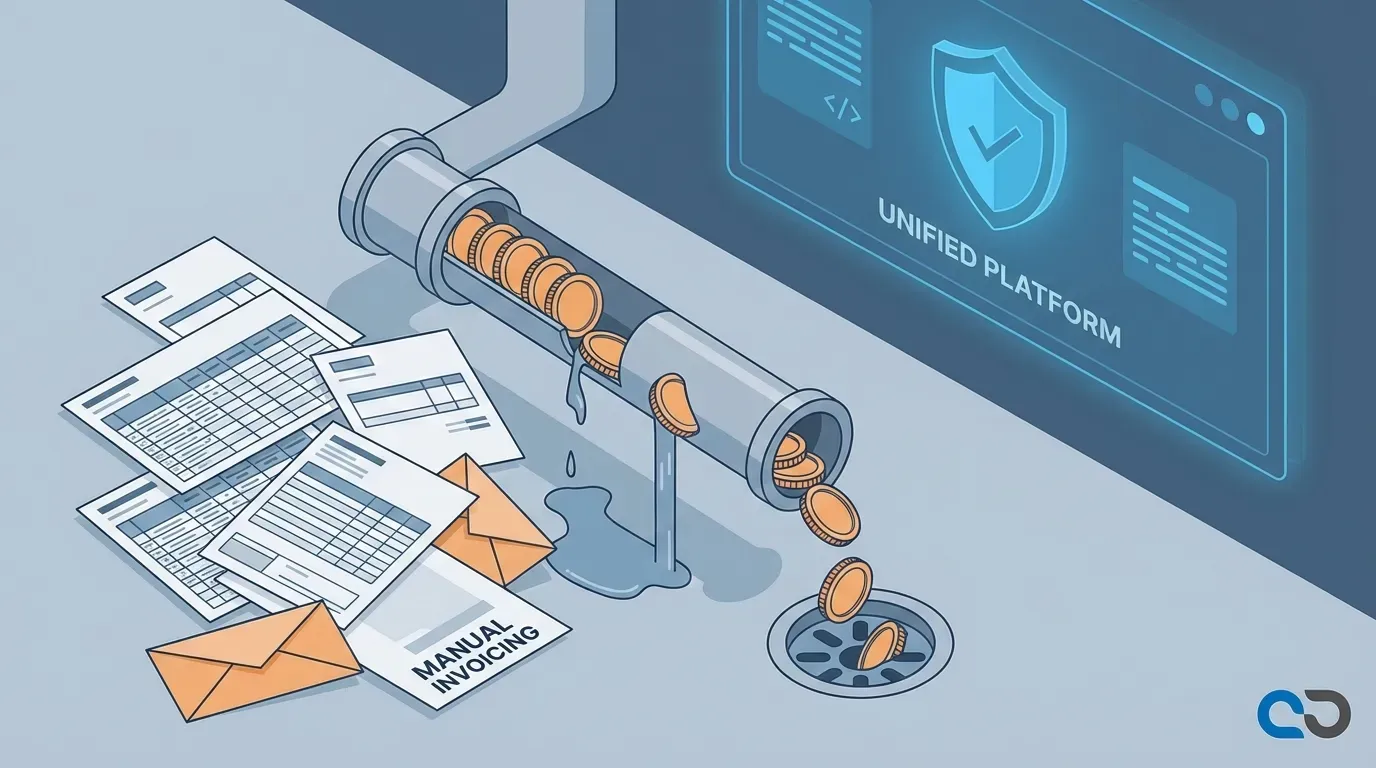
The illustration contrasts a typical, inefficient logistics setup with cost leakages to the streamlined, secure, and transparent solution provided by Navichain.

Navichain visualizes a connected and transparent supply chain ecosystem. This enhanced visibility leads to improved efficiency, security, and trust within the network.
Ready to optimise your supply chain?
navichain Insights Newsletter
Join the newsletter to receive the latest updates in your inbox.