From Administrative Burden to Strategic Asset: Redefining Data Collection
Table of Contents

From Administrative Burden to Strategic Asset: Redefining Data Collection
Introduction: The data paradox for SME hauliers
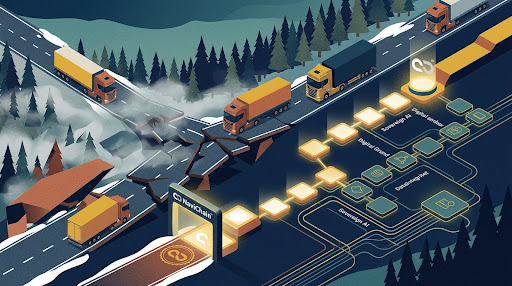
Fig 1: For owners and managers of medium-sized haulage companies in Europe, the operational landscape has never been more challenging.

The perception of data collection as a complex and tedious burden prevents many hauliers from embracing digitization, despite its potential benefits.
For owners and managers of medium-sized haulage companies in Europe, the operational landscape has never been more challenging. According to recent analyses from Transport Intelligence (Ti) and national bodies such as Trafikanalys in Sweden, cost pressures from fuel, road tolls and driver wages continue to increase in 2024 and 2025. At the same time, large-scale logistics giants, with their advanced digital platforms, are driving down freight prices. In this climate, data is no longer a luxury; it's a survival mechanism. The ability to analyse fuel consumption, downtime, route optimisation and load fill rates in real time is crucial to protect already slender margins. Yet a fundamental barrier remains. When leaders hear 'data collection', they envisage a nightmare of manual registration. They see drivers who must key in times, traffic managers who have to double-register in different systems, and an administrative staff drowning in paperwork. This fear is so strong that many choose to abstain from digitisation altogether, relying instead on gut feeling and Excel spreadsheets. This is the central paradox: the need for data is acute, but the fear of data collection is paralysing. This white paper argues that this fear, although understandable, is based on an outdated assumption. The problem isn't the data itself, but the flawed system architecture that equates 'collection' with 'manual data entry'.
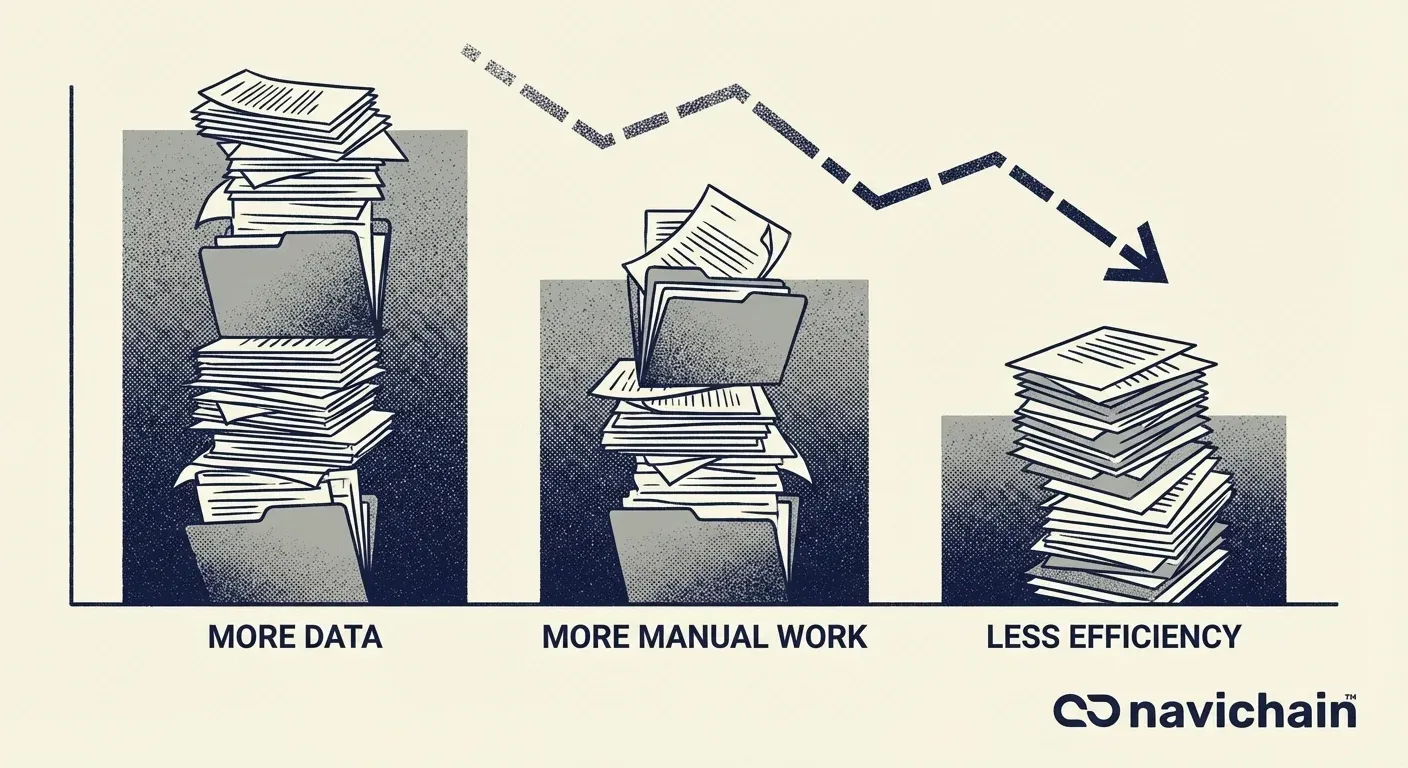
The architectural flaw: Why 'more data' became 'more work'
Fig 2: System 1 (TMS): Required a traffic manager to manually enter order details.
Why has this fear of manual data entry taken such a strong hold? The answer lies in how logistics systems have traditionally been built. Most TMS (Transportation Management Systems) and WMS (Warehouse Management Systems) platforms that dominate the market were designed in a different era. Their architecture was built on a central database that relied on people acting as 'sensors'.
- System 1 (TMS): Required a traffic manager to manually enter order details.
- System 2 (WMS): Required a warehouse worker to scan or key in pick lists.
- System 3 (Invoicing): Required an administrator to manually transfer data from consignment notes to the accounting system. When the need for more data arose (e.g. precise waiting times, proof of delivery, driving behaviour), the logical conclusion was that it required more manual data entry. This created a vicious circle: the more data you needed to become efficient, the more inefficient you became at collecting it. This is an architectural design flaw. Systems were built that were passive recipients of human input, instead of active collectors of operational data. For SME hauliers, who cannot afford large IT departments or expensive integration projects, this barrier became insurmountable.
An 'automation-first' architecture: A new design
Fig 3: A modern logistics platform must invert the old logic.
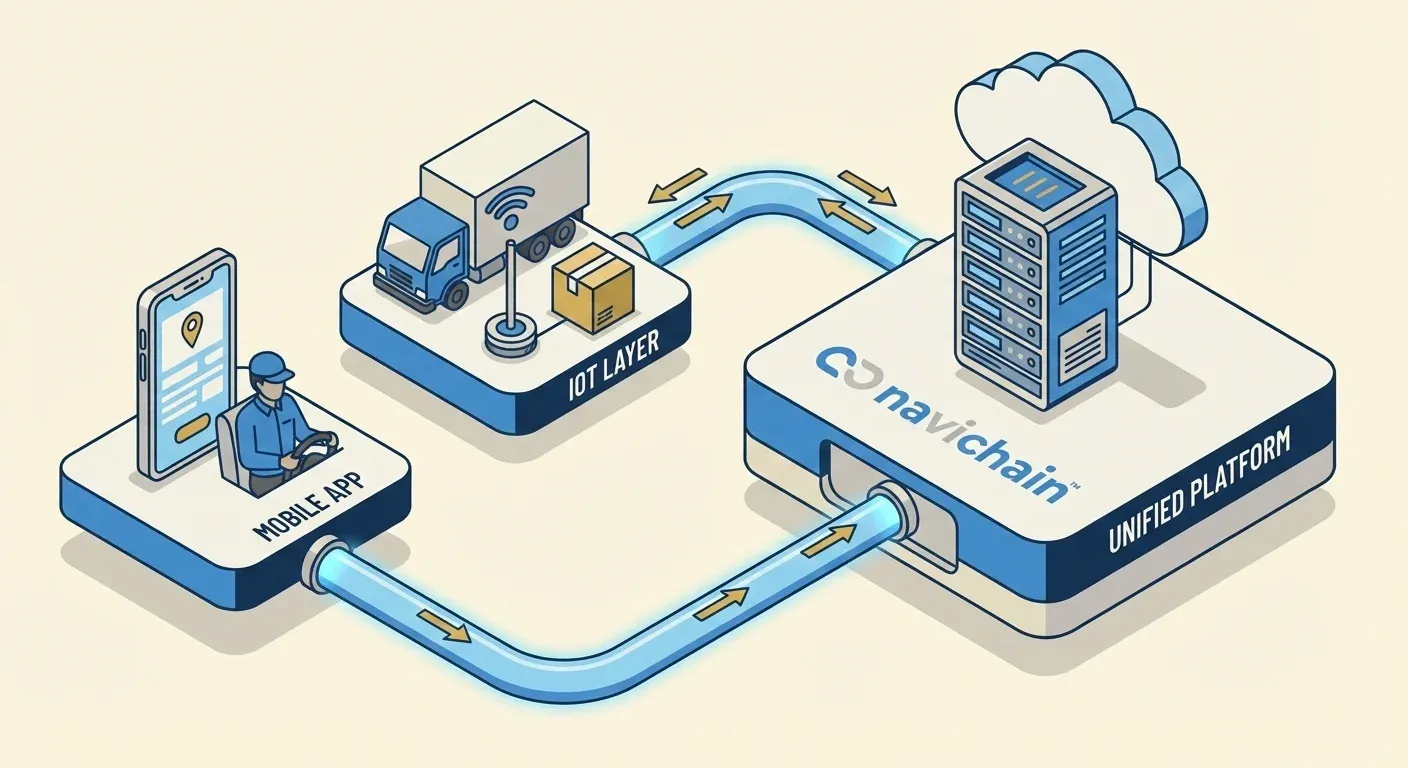
This is called an 'automation-first' or 'passive' data architecture. It's built on three primary layers of data collection that minimise or completely eliminate manual registration.
The mobile layer: The app as data collector
The driver is the most important sensor in the entire operation. Instead of being a data entry clerk, the driver's mobile app becomes a passive collector. When a driver performs their usual tasks – starts a route, arrives at a customer, scans a package, takes a photo, or obtains a digital signature (POD) – the app automatically captures dozens of data points: * Precise timestamps: When did the stop occur? How long was the waiting time at Customer A vs. Customer B?
- Precise geoposition (GPS): Where did the drop-off occur? Does it match the address?
- Digital proof: Signatures, photos of goods, scanner logs. Manual data entry is reduced from filling in complex forms to essentially just pressing 'Start' and 'Finish'.
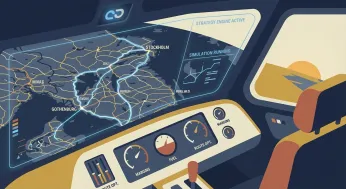
The mobile app transforms drivers from data entry clerks into passive data collectors, streamlining data capture at each stage of the delivery process.
The IoT layer: Vehicle and goods telematics
The next layer is the data that neither the driver nor the traffic manager can see. By connecting the system directly to the vehicle's telematics (tracking equipment) and to sensors on goods (parcel tracking), a continuous, automatic data flow is created.
- Vehicle data: Real-time fuel consumption, driving behaviour (hard braking, idling), exact routes and engine data for preventative maintenance.
- Goods data: Each package can be tracked automatically from pick-up, through transhipment terminals, to final delivery. The system 'knows' where each package is without a person needing to register it at each stop.
The unified data core (single source of truth)
This is the most important thing. All data from the mobile layer and IoT layer must flow into one and the same platform. The biggest source of manual labour is when data from one system (e.g. vehicle tracking) has to be transcribed and entered into another (e.g. the invoicing system). In an 'automation-first' architecture, the POD signature from the driver's app flows immediately to the invoicing module. Fuel consumption from the vehicle flows directly into the order profitability calculation. Everything happens automatically, in real time, creating a single source of truth.
The strategic upside: From burden to asset
When data collection transitions from a manual burden to an automated asset, the entire operation changes. Administrative work decreases drastically, but the real gain is strategic.
Enable fact-based decisions in real time
Instead of waiting until the end of the month for a report based on guesswork, management can act immediately.
- Profitability analysis: Which customers cause the most waiting time and erode our margin? Which routes are consistently unprofitable?
- Efficiency: Why does Vehicle A have 15% higher fuel consumption than Vehicle B on the same route?
- Quality: Which transhipment points have the most deviations or damage? These are no longer opinions; they are facts, presented automatically and immediately.
Drive ai-powered insights
The biggest gain with clean, automated data is that it becomes fuel for Artificial Intelligence (AI). AI solutions are worthless if they are fed with 'dirty' data (i.e. inaccurate, incomplete, manually entered data). But with a stream of clean data from apps and IoT, an AI engine can start to work.
- Predictive Analysis: "Based on current traffic, weather and historical waiting times, this delivery will be 30 minutes late."
- Optimisation: "By adjusting routes 3 and 5, we can consolidate two runs into one and save X litres of fuel."
- Anomaly detection: "This driving behaviour is unusual and indicates a high risk of an unplanned maintenance stop within 48 hours." Data has thus completed the journey: from a dreaded administrative burden to an autonomous, strategic asset that actively improves operations.
The non-negotiable foundation: Data sovereignty
However, there is a critical, final component to this architecture, especially for European companies: data sovereignty. All this automatically collected data – driver positions, customer lists, freight prices, routes – is extremely sensitive. It is the company's absolute core business.
The risk with foreign clouds: Us CLOUD Act
Many modern SaaS (Software-as-a-Service) platforms are built on the large US cloud providers (such as Amazon Web Services, Google Cloud or Microsoft Azure). This poses a fundamental legal risk. Through legislation such as the US CLOUD Act, US authorities can, under certain circumstances, request data from these providers – regardless of where in the world the servers are physically located. For a European haulage company, this poses a risk that their most sensitive operational data could end up in the hands of a foreign power, outside their control.
The mandate for GDPR compliance
At the same time, Europe has the world's strictest data protection laws. GDPR (General Data Protection Regulation) places extreme demands on how personal data (such as driver data and customer data) is handled, stored and processed. Ensuring compliance when data flows through global cloud services is a legal and technical nightmare.
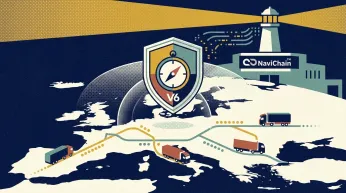
Schematic illustrating the risk of data access by foreign powers via US-based cloud providers, highlighting the need for data sovereignty in Europe.
Sovereignty as an architectural cornerstone
Therefore, an 'automation-first' architecture for European SMEs must also be a 'sovereign-first' architecture. This means that all data, from collection to processing and AI analysis, must remain within the same legal jurisdiction as the company itself. For a Swedish haulage company, this means that the data must be stored and processed on servers in Sweden, under Swedish law. This is not just a matter of regulatory compliance. It's a matter of trust. It is the only guarantee that the company's most valuable asset – its operational data – remains its own. It is also the only secure environment in which one can confidently apply powerful AI tools to one's own sensitive data.
From diagnosis to design: The blueprint for a resilient logistics operating system
The central thesis of this white paper is that SME hauliers are stuck in a paradox: they need data to reduce costs, but fear the manual administration that traditional systems require. The way out of this paradox is not to avoid data, but to adopt a new system architecture designed to solve this problem from the ground up. To transform data from a burden to an asset, a modern logistics platform for SMEs must exhibit three fundamental characteristics. Consider this as a strategic requirements list for your next system investment.
1. a unified operational fabric
The system must tear down the internal silos that create manual duplication. Loose 'integrations' are not enough. The platform must function as a single operating system for the entire operation, where Transport Management (TMS), Warehouse (WMS), Invoicing, Order Management and Asset Management are parts of the same logical core. Data created in one place (e.g. a delivery signature in the mobile app) must be immediately and automatically available everywhere else (e.g. as invoice documentation). This is the 'central nervous system' of logistics.
2. a sovereign data architecture
This is a non-negotiable foundation. For European and Scandinavian SMEs, trust and regulatory compliance are crucial. True ownership of operational data can only be guaranteed if the platform's infrastructure is sovereign. This means that all data – without exception – must be stored and processed within its own legal region (e.g. Sweden/EU). This is the only watertight guarantee of full GDPR compliance and protection against foreign legislation such as the US CLOUD Act. Security and regulatory compliance should be built-in, not an add-on.
3. embedded analytical intelligence
Data that is collected but not used is just a cost. The platform must have a built-in intelligence engine (AI) that can analyse the unified data flow (from Principle 1) within the secure environment (from Principle 2). This intelligence should not require an external data expert, but should be embedded in the daily workflows to automatically identify anomalies, suggest optimisations and provide traffic managers with the fact-based information required to make profitable decisions in real time.
References/sources
- Transport Intelligence (Ti) Insight: "European Road Freight Market 2024 Report". Provides data on market trends, cost pressures and digitisation.
- Source
- Trafikanalys (Sweden): "Åkerinäringens utveckling". State authority that publishes official statistics on the Swedish haulage industry's costs, revenues and challenges.
- Source
- International Road Transport Union (IRU): "European Road Freight Rates". Quarterly reports showing the development of spot and contract prices in Europe.
- Source
- Integritetsskyddsmyndigheten (IMY): Guidance on GDPR and third-country transfers, including consequences of Schrems II and CLOUD Act.
- Source
Fig 4: The central thesis of this white paper is that SME hauliers are stuck in a paradox: they need data to reduce costs, but fear the manual administrati...
Enabling the blueprint: Navichain SaaS unified logistics platform
The strategic blueprint described in this white paper – a unified, sovereign and intelligent platform – is the exact model that navichain SaaS is built upon. We designed our platform from the ground up to solve the specific challenges faced by medium-sized haulage companies. 1. For 'A Unified Operational Fabric': navichain SaaS is not a collection of modules, but a single, unified logistics operating system. Our platform seamlessly integrates Transport Management (TMS), Warehouse Management (WMS), Asset Management, Invoicing and Order Management. The data captured in our mobile app by the driver is immediately available to the traffic manager and the invoicing clerk. No duplication, no data silos.

Navichain SaaS provides a unified platform, sovereign data architecture, and embedded analytical intelligence to empower medium-sized haulage companies with data-driven insights and operational efficiency.
- For 'A Sovereign Data Architecture': This is our core differentiator. The entire navichain SaaS platform is hosted on our own proprietary infrastructure in Sweden. Your data stays in Sweden, under Swedish jurisdiction. This guarantees full GDPR compliance and makes you immune to foreign legislation such as the US CLOUD Act. Your operational data remains 100% your own.
- For 'Embedded Analytical Intelligence': Our platform is augmented with a integrated AI that runs on the same secure, Swedish infrastructure. Because your data is already unified and stored sovereignly, our AI can conduct deep, secure analyses on your operational data to unlock unique efficiency gains and provide you with the fact-based decisions that this white paper describes. Our mission is to democratise logistics technology and give SME hauliers the tools they need to not only survive, but thrive. We have eliminated the administrative burden so that you can focus on what is important: building a profitable and resilient business.
Navichain SaaS provides a unified, sovereign, and intelligent logistics platform designed to empower SME hauliers with integrated tools for efficient operations and data-driven decision-making.

Navichain's platform architecture ensures data sovereignty and security, hosted entirely within Sweden to guarantee GDPR compliance and protect against foreign legislation. This secure foundation enables integrated AI analytics for deep operational insights.
Ready to optimise your supply chain?
navichain Insights Newsletter
Join the newsletter to receive the latest updates in your inbox.