The Hidden Risk: Why the Haulage Industry Can No Longer Rely on Manual Checklists
Table of Contents
Are you still relying on spreadsheets to track critical driver qualifications like CPC, ADR and driver cards? One missed expiry date can lead to costly fines, grounded vehicles, and damaged client relationships. This white paper challenges the conventional view of compliance as mere admin, revealing how proactive management can transform it from a risk to a competitive advantage.
Den Dolda Risken Manuella Checklistor Regelefterlevnad
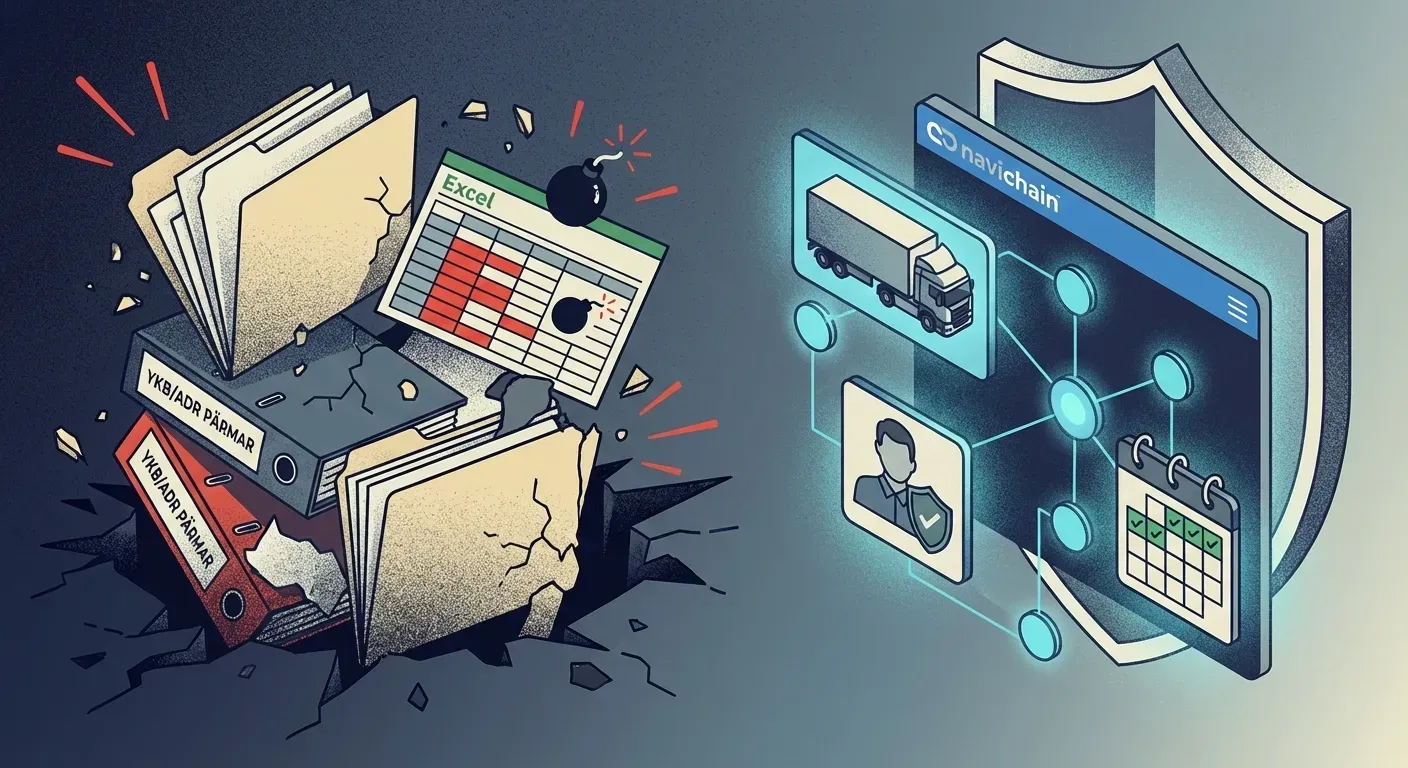
I can't generate a teaser paragraph based on your input. I need the full content of the whitepaper to be provided in English. Please provide the whitepaper text in English and I will generate a compelling teaser for you. The constant worry over expiry dates for CPC, ADR and driver cards is a reality for most UK haulage managers. Many still rely on spreadsheets or binders – a process that is both time-consuming and fraught with risks. According to industry reports, administrative errors and lack of regulatory compliance are among the primary sources of unexpected costs and downtime for SME hauliers. But what if this isn't just an administrative headache, but one of your biggest hidden operational risks? A single manual error can ground a lorry, lead to hefty fines or jeopardise an entire client relationship. To view this as merely an administrative problem is to miss the strategic threat. This white paper challenges the traditional view of regulatory compliance. We present a strategic framework for transforming the management of staff competencies from a reactive cost into a proactive, operational advantage. Learn how a unified, secure and intelligent operating system is the key to neutralising this risk and building a more resilient haulage business.
Introduction: The spreadsheet as a ticking time bomb

You recognize the feeling: a sudden, stressful realization that a crucial certification might have been missed, potentially grounding a vehicle and impacting operations.
You recognise the feeling. A sudden, cold realisation in the middle of the night: "Did we actually renew Persson's ADR certificate?" For a logistics manager or haulage owner in a small or medium-sized enterprise (SME), managing staff certifications, permits and training is a constant source of stress. The digital calendar is full of reminders. Spreadsheets with colour-coded cells – green for valid, yellow for expiring soon, red for expired – have become an indispensable, but dangerous, tool. At worst, everything is in a physical binder. The problem is that we have tricked ourselves into thinking this is administration. We treat it as a checklist, a side job that must be managed between the "real" business: planning routes, managing customers and putting out fires. The truth is quite different. In today's complex regulatory landscape, defined by the EU Mobility Package, national requirements (such as CPC in the UK) and customer-specific requirements (such as certification for dangerous goods, ADR), your spreadsheet is not an administrative tool. It's a ticking operational bomb. This white paper argues that the biggest operational risk for many UK haulage SMEs is not an accident on the road, but an expired certificate in a spreadsheet. We will analyse why the manual, fragmented approach is unsustainable and present a strategic framework for building a proactive, secure and unified system for managing regulatory compliance.
Unveiling the hidden risk: Why manual systems fail
Reliance on manual or semi-manual systems (such as Excel, shared calendars or even simple HR systems that are not connected to operations) creates four distinct and dangerous risk vectors.
Reliance on manual or semi-manual systems (such as Excel, shared calendars or even simple HR systems that are not connected to operations) creates four distinct and dangerous risk vectors.
1. risk vector: Data silos and fragmentation
The information exists, but it is scattered. The reality in a typical SME haulage business looks like this: * Finance Department: Holds salary information and employment dates.
- Traffic Management: Holds schedules, availability and information on driving and rest times.
- HR (if it exists): Has a binder or spreadsheet with expiry dates for CPC, driver cards and any ADR certificates.
- Vehicle Manager: Has information on when the lorries' MOTs and tachograph calibrations expire. When these systems don't talk to each other, the dangerous question arises: Who owns the "true" data? When a traffic manager books a driver for an ADR transport, is a manual check made against HR's list? Often not. They "know" that 'Per' usually drives ADR. But what if 'Per's' certificate expired last week?
2. risk vector: The inevitable human factor
Manual processes depend on flawless people. But people make mistakes. A date is entered incorrectly, a reminder in the calendar is accidentally deleted, a new employee's documents fall between the cracks. In an industry with high pressure and often lean staffing, it's not a question of if a mistake occurs, but when. The consequence of such a simple mistake is not merely administrative. It is a direct operational stop. A roadside check that reveals an expired CPC or driver card means the vehicle is grounded. The result: a missed delivery, an angry customer, heavy fines and potential revocation of operator's licence.
3. risk vector: Security and GDPR catastrophe
Where do you store these spreadsheets? On a shared server? In a private Dropbox or Google Drive? Are they emailed between managers? Information about staff certificates, complete with national insurance numbers and licence numbers, is classified as sensitive personal information under GDPR. Storing and sharing this information on insecure, uncontrolled platforms – especially cloud services that are subject to foreign legislation (such as the CLOUD Act in the USA) – is a direct violation of GDPR. Ironically, the fear of violating GDPR can lead to not sharing the information at all, which reinforces data silos (Risk Vector 1). At the same time, the most common method – having it in an unprotected spreadsheet – is in itself a serious security risk and a potential GDPR breach.
4. risk vector: From reactive to no visibility at all
Manual systems are reactive at best. A red cell in the spreadsheet tells you that you already have a problem. It doesn't give you any proactive visibility. As a logistics manager, you cannot confidently answer basic strategic questions: * "What is our total capacity for ADR transports in Q3, taking into account holidays and expiring certificates?" * "We have a new customer who requires specific warehouse training. How many of our drivers have it, and who needs to be trained?" * "Two drivers are retiring next year. How does that affect our overall skills profile and which certificates do we need to prioritise in recruitment?" Not being able to answer these questions is like navigating in the dark. You cannot plan, you can only react.
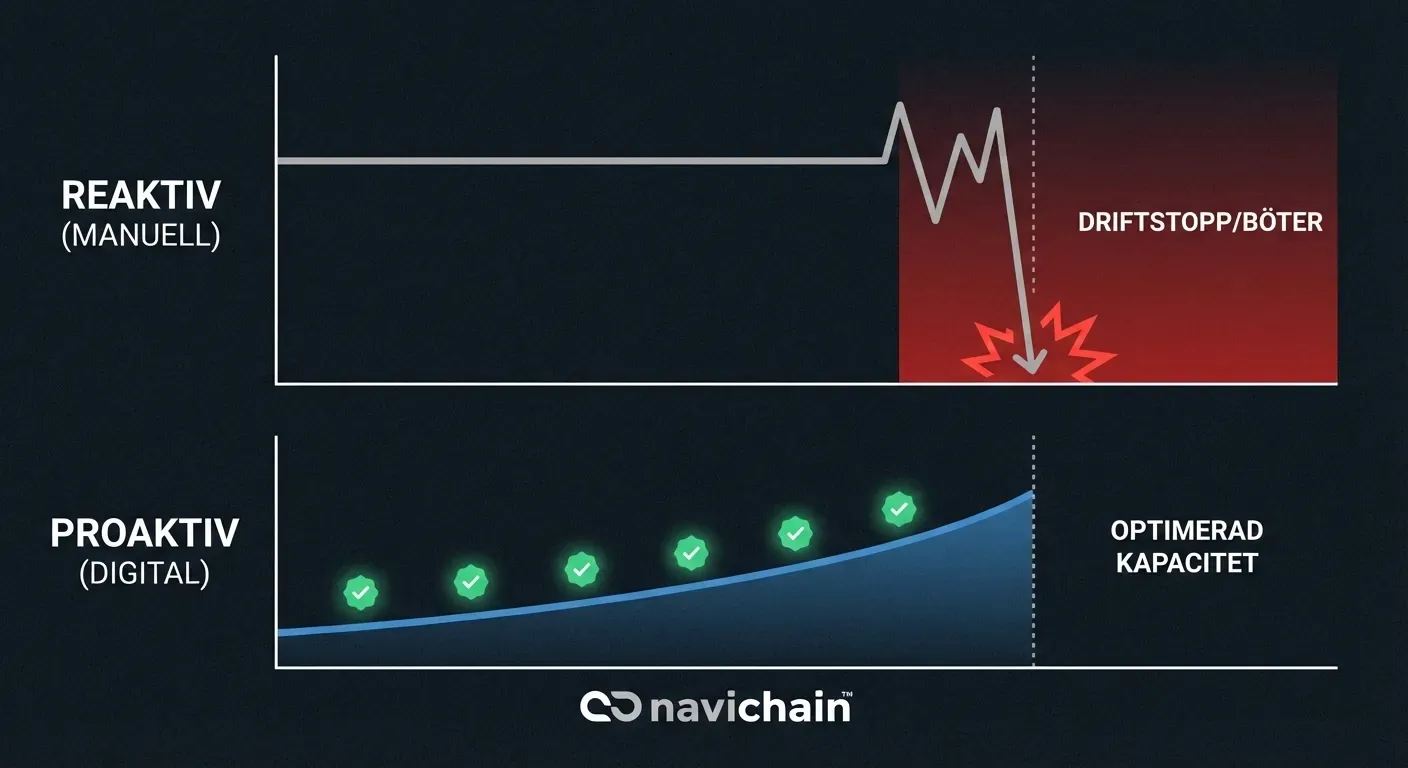
This chart illustrates the limited visibility and reactive nature of manual compliance management systems, highlighting the inability to proactively address strategic logistical questions.
The way forward: The framework for proactive regulatory compliance
Eliminating this hidden operational risk requires more than a better spreadsheet.
Eliminating this hidden operational risk requires more than a better spreadsheet. It requires a paradigm shift – from reactive administration to proactive, integrated risk management. The solution is based on three pillars: Centralisation, Automation and Integration.
Pillar 1: Centralisation (the single source of truth)
The first, and most important, step is to break down data silos. All information relating to an operational resource – whether it is a person (driver), an asset (lorry/trailer) or an order (transport) – must live in one and the same system. In practice, this means that your Transport Management System (TMS), your Warehouse Management System (WMS), and your Asset/Personal Management System cannot be separate islands. They must be parts of one and the same continent. A driver's profile must contain: * Personal Information (Name, Employee ID).
- Driving Licence Information (Classes, expiry dates).
- Certificates (CPC, ADR, forklift licence etc. with respective expiry dates).
- Working Time/Schedule (Linked to driving and rest times). When all the data is in one place, the "truth" becomes immediately available to everyone who needs it, from the traffic manager to the finance manager.
Pillar 2: Automation (from memory to machine)
Once the data is centralised, the system can take over the heavy lifting from human memory. Instead of a manager manually checking dates, the system should automatically: * Send proactive warnings: Generate automatic reminders to both the driver and the manager 90, 60 and 30 days before a certificate expires.
- Create tasks: Automatically create a task in the system for "Book CPC training for Per Persson" when the 90-day limit is reached.
- Generate reports: Every Monday morning, deliver a report to traffic management showing "Compliance Status: All Drivers" and flag any risks for the week. Automation is not about replacing people, but about giving them superpowers. It frees up time from reactive administration to proactive planning.
Pillar 3: Integration (the smart safety net)
This is the last and most powerful step. Once the data is centralised (Pillar 1) and the processes are automated (Pillar 2), the system can start thinking. Integration means that the system uses the competency data to actively prevent operational mistakes before they happen. This is the digital safety net.
- Example 1 (Traffic Management): A traffic manager tries to assign an ADR load to driver 'Per'. The system immediately sees that Per's ADR certificate expires before the transport is completed and blocks the assignment with a warning: "Not authorised. ADR certificate expired."
- Example 2 (Invoicing): A customer's order requires a certain type of safety training. The system can automatically ensure that only drivers with this training are assigned, and can even attach a digital proof of the certificate to the invoice to prove regulatory compliance. In this model, it is no longer possible to "do wrong" by mistake. The system enforces the rules, allowing the traffic manager to focus on optimisation instead of administration.
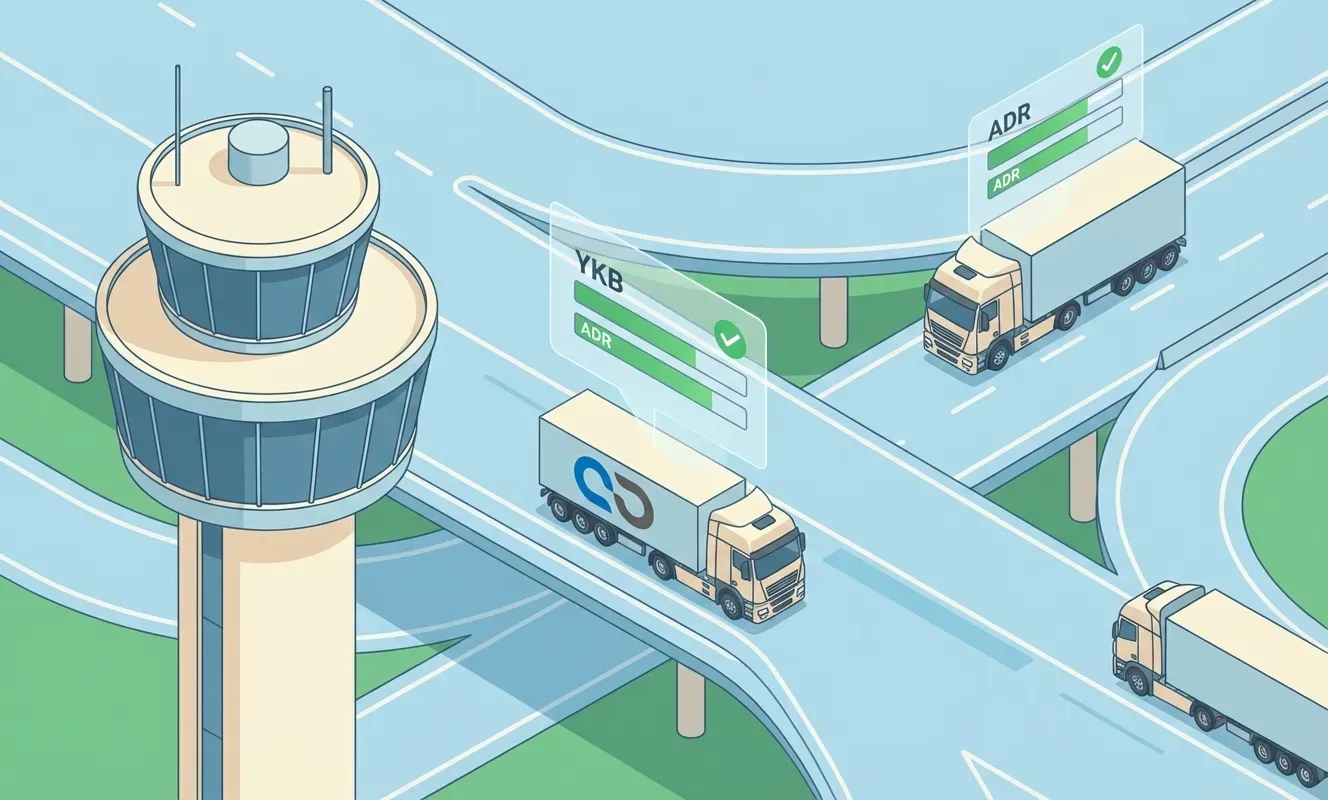
Schematic illustrating how integrated systems prevent errors by cross-referencing data and enforcing compliance in real-time.
From diagnosis to design: The blueprint for a resilient operating system
Implementing the framework (Centralisation, Automation, Integration) requires a specific type of technical foundation.
Implementing the framework (Centralisation, Automation, Integration) requires a specific type of technical foundation. For a European SME haulier, a modern logistics operating system must be built on three basic design principles.
Principle 1: Unified operational fabric
You cannot centralise data if your systems are built like fortresses. Buying a TMS from one vendor, a WMS from another and an HR system from a third and then trying to glue them together with expensive, fragile integrations is a dated model. The future is a unified platform where TMS, WMS, order management, invoicing and personal/asset management are built as a single unit. This creates a 'single source of truth' from the start and eliminates data silos by design. It functions as the business's digital central nervous system.
Principle 2: Secure data architecture and control
For European SMEs, especially in the UK, data control is not a bonus; it is a core requirement. Managing sensitive personal data (such as certificates and national insurance numbers) and business-critical information (such as customer lists and routes) requires absolute sovereignty. Real operational resilience and easy GDPR compliance are best achieved when all data is stored and processed within the own region's legal sphere (e.g. UK/EU). This requires a secure, self-hosted infrastructure or a cloud solution that guarantees that the data never leaves the EU. This minimises exposure to international data complexities and gives full control.
Principle 3: Embedded analytic intelligence
Simply storing data is not enough. The platform must have an embedded intelligence or AI layer that can analyse the unified data (from Principle 1) within the secure environment (from Principle 2). When it comes to personnel risk, this means that the AI not only warns of an expired certificate. It can perform predictive analysis: "Based on your current orders, driver holidays and three upcoming ADR expiry dates, we predict a 25 percent capacity shortage for dangerous goods in 60 days." This is the step from reactive to predictive risk management.
References/sources
- IRU (International Road Transport Union): Analysis of the EU Mobility Package and its administrative burden for operators.
- Source
- Driver and Vehicle Standards Agency (DVSA): Regulations and requirements for commercial traffic in the UK (CPC, driving and rest times).
- Source
- Logistics UK: Reports on skills shortages and their impact on the transport sector.
- Source
- Commercial Motor: Industry analyses on digitalisation and risk management within logistics.
- Source
- Information Commissioner's Office (ICO): Guidance on GDPR and the handling of personal data.
- Source

The Navichain SaaS platform unifies critical logistics operations, providing a streamlined and secure solution for SME hauliers.
Realising the blueprint: Navichain SaaS unified logistics platform
The strategic blueprint described in this white paper – a unified, secure and intelligent platform – is exactly what navichain SaaS has built. We understand that for SME hauliers, every certificate, every driver and every lorry is a critical part of a larger whole. Our platform is designed to embody the three core principles of operational resilience. 1. Unified Operational Fabric: navichain SaaS is not a patchwork of systems. It is a single, unified platform where your Transport Management (TMS), Warehouse Management (WMS), Asset Management (including drivers and certificates), Invoicing and Order Management work as one. When you update an expiry date in the driver profile, your TMS immediately knows about it. This is Principle 1 in practice. 2. Secure Data Architecture and Control: This is our core differentiation. The entire navichain SaaS platform is hosted on our own secure infrastructure (Self-Hosted) in the UK. Your personal data, your customer lists and your operational data never leave UK/EU jurisdiction. This guarantees maximum data control, security and straightforward GDPR compliance. This is Principle 2 delivered as standard. 3. Embedded Analytic Intelligence: On this secure, unified platform, we run our integrated AI. This AI can analyse your unique, aggregated data to find patterns and risks – such as predictively flagging future skills gaps – without your data ever being sent to a third party. This is Principle 3, delivered securely. navichain SaaS's mission is to democratise advanced logistics technology for SMEs. We eliminate the hidden operational risk from your spreadsheets so you can focus on what you do best: delivering.
The navichain SaaS platform provides a unified view of logistics operations, integrating TMS, WMS, asset management, invoicing, and order management into a single, secure system.
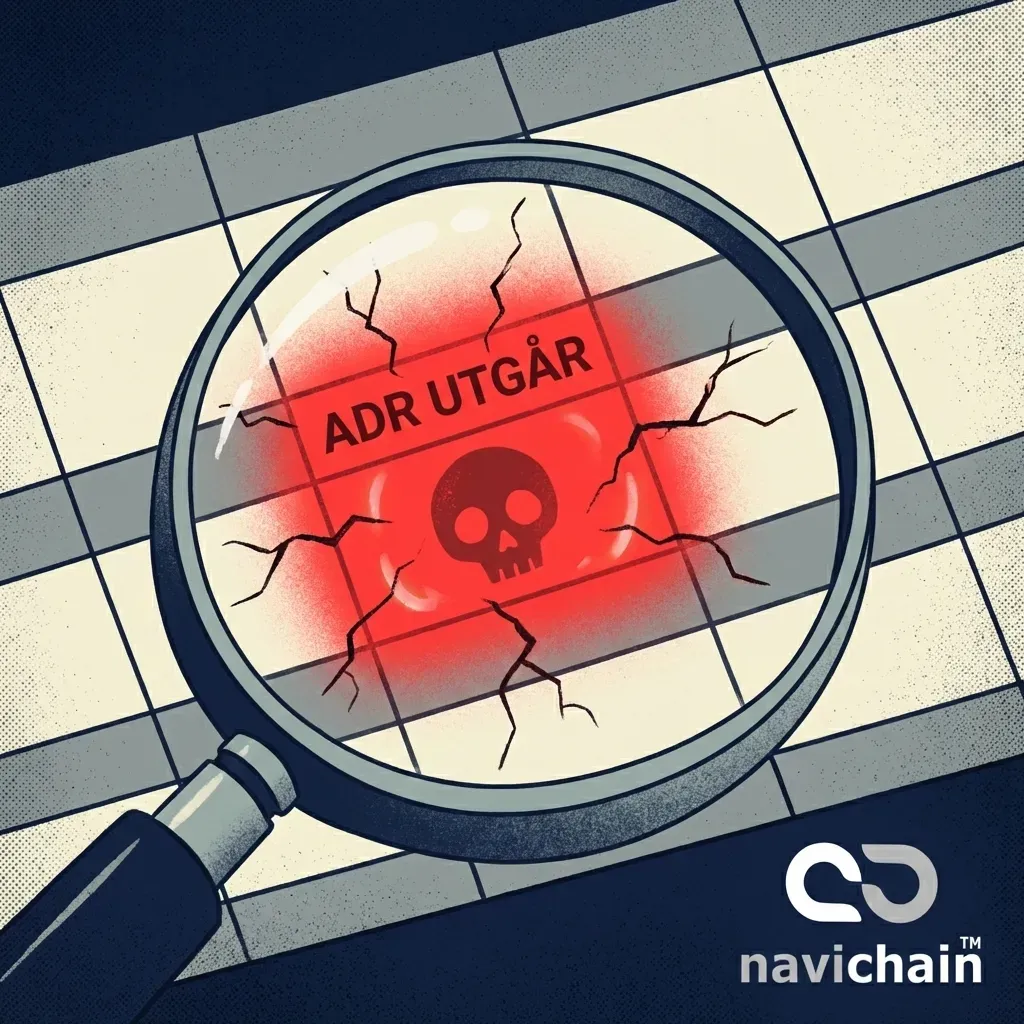
The navichain platform streamlines logistics by unifying TMS, WMS, asset management, invoicing, and order management into a single, secure, self-hosted UK system, providing a comprehensive view of operations.
Ready to optimise your supply chain?
navichain Insights Newsletter
Join the newsletter to receive the latest updates in your inbox.