The Competition Trap: Why SME Hauliers Must Collaborate
Table of Contents
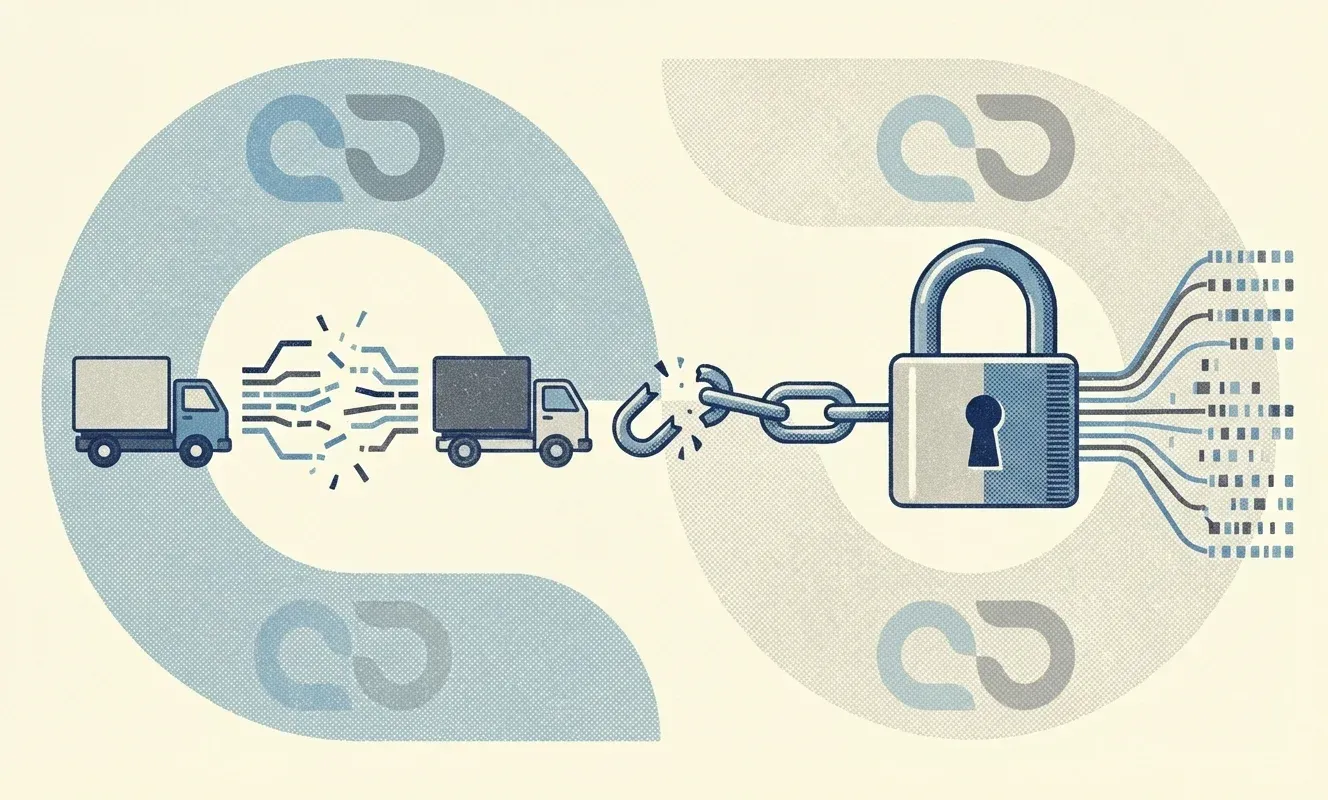
Small and medium-sized haulage firms (SMEs) in Scandinavia are facing a "scale crisis". You make up over 90% of the market but are struggling against the network density and technology budgets of the giants. Margins are squeezed by fuel prices and mandatory digitalisation requirements from customers. The instinct is to compete harder, to "be independent". But this strategy is a trap. Acting alone guarantees that you will be overtaken. So, why do most attempts at collaboration fail, even though the logic is obvious? The answer lies in trust and technology. This white paper presents a framework for "horizontal collaboration" – a new model where independent hauliers create a collective strength. We analyse how a unified and, crucially, sovereign technology platform is the only way to build the digital trust required to succeed.
The great margin squeeze
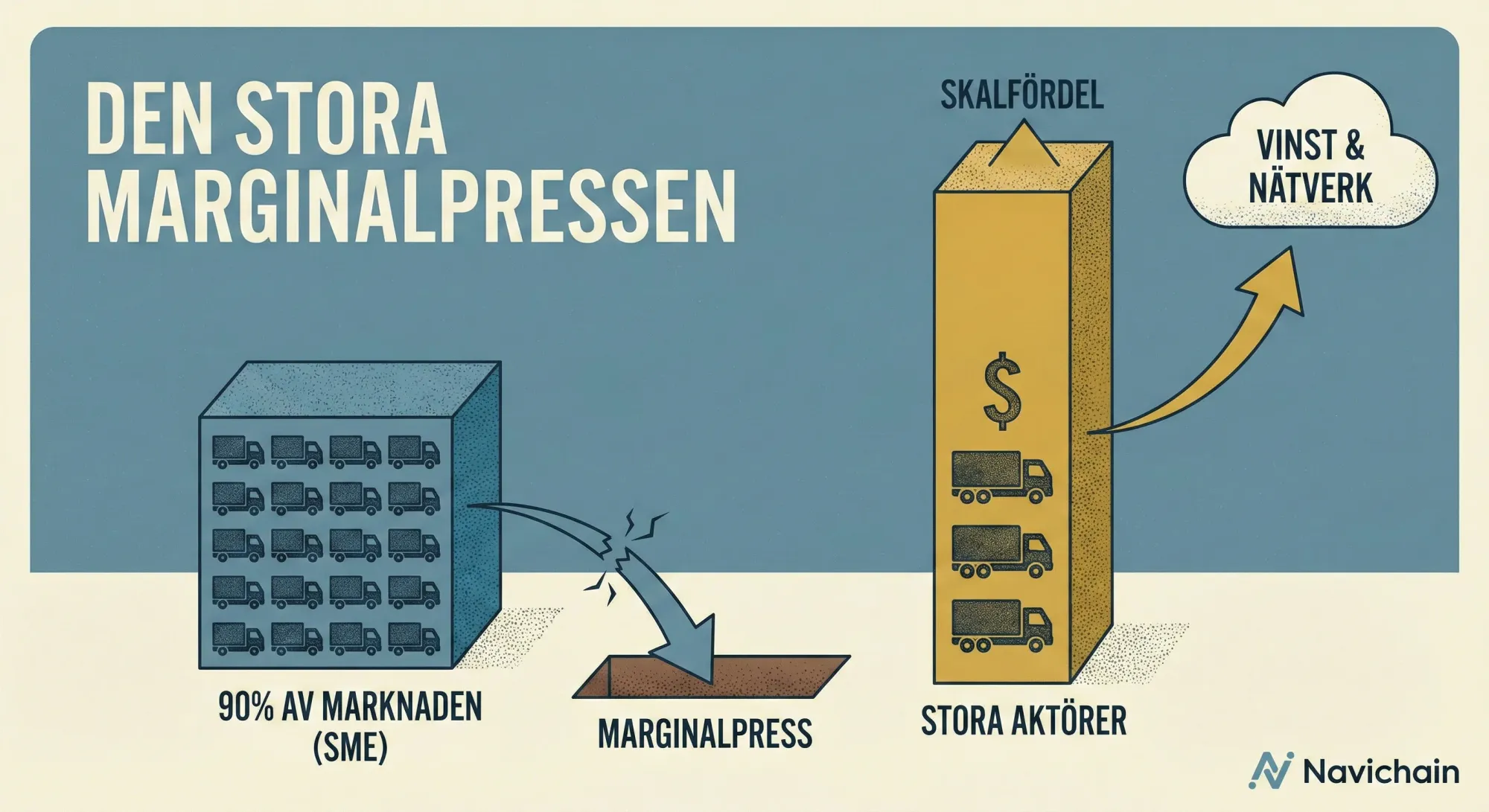
The European haulage industry is defined by a fundamental imbalance. On the one hand, it is dominated by small and medium-sized enterprises (SMEs). Data from Eurostat and industry organisations such as the Swedish Haulage Association consistently show that companies with fewer than 50 employees form the backbone of the industry, often over 90% of all companies. On the other hand, the market is being consolidated by a few global giants. These "dragons" are investing billions in technology, automated warehouses and global networks, creating an enormous scale advantage.
For a medium-sized haulage firm in Scandinavia, this gap is palpable every day: 1. Rising costs: Fuel prices, wage inflation and the costs of meeting new ESG requirements (environmental, social and governance) are squeezing margins that are already thin. 2. Customer demands for digitalisation: Large freight forwarders and customers now require complete digital integration, from API-based ordering to real-time tracking. Meeting this with a fragmented IT environment is costly and complex. 3. Network inefficiency: Empty running is a chronic plague. While large players can optimise flows across entire continents, an SME haulage firm struggles to fill return journeys outside its core routes.
The traditional response – investing in a new truck, hiring a new salesperson or squeezing prices – no longer works. It's playing a game you can't win. The giants win on scale, and scale cannot be achieved through individual efforts.
The collaboration paradox: Why we must, but cannot
The logic is simple: if individual SME haulage firms cannot match the scale of the giants, they must create scale together. This is called horizontal collaboration – an alliance between competitors at the same level in the value chain to achieve mutual benefits.
The benefits are well documented. Studies show that effective collaboration can: * Reduce empty running by 15-20% by pooling capacity and filling each other's return flows. * Increase bargaining power when purchasing fuel, tyres and insurance.
- Offer a broader network to customers, making the alliance a more attractive partner than a single small haulage firm.
- Share the cost of necessary technology and digitalisation.
Despite these obvious benefits, 9 out of 10 collaborative initiatives fail. This is the collaboration paradox. We must collaborate to survive, but in practice we cannot. Why? The answer lies in two fundamental obstacles: technology and trust.
Obstacle 1: Technical fragmentation (digital silos)
Imagine two haulage firms that want to collaborate. Haulage firm A uses TMS system X, WMS system Y and invoicing program Z. Haulage firm B uses completely different systems. There is no common language. Sharing an order, tracking a delivery or consolidating an invoice becomes a manual hell of emails, phone calls and Excel files. The inefficiency in managing the collaboration quickly eats up the profit from the collaboration. Without a unified, shared platform – a common operating system – collaboration remains an expensive and inefficient dream.
Obstacle 2: Lack of trust (the data dilemma)
This obstacle is even higher. To effectively share capacity, you need to share data. Sensitive data. Who are your customers? What are your prices? What are your routes? The fundamental fear is: "If I share my data with my 'partner', what's to stop them from stealing my customer next week?" This lack of trust is the single biggest reason why haulage firm owners, rightly, are reluctant to collaborate.
The hidden threat: When your data isn't your own
Let's assume a group of haulage firms decides to solve these problems. They choose a modern, cloud-based collaboration platform. Problem solved? Probably not. They have probably only traded one problem for a much bigger and more insidious one: the lack of data sovereignty.
Most large, global cloud platforms (SaaS) for logistics are owned and operated by American companies. Even if their servers are located in Europe (e.g. in Ireland or Germany), the parent companies are still subject to American law.
The risk: US CLOUD Act
The most potent of these laws is the US CLOUD Act. It gives American authorities the right to demand data from American technology companies, regardless of where in the world that data is stored. This means that your collected commercial data – your customer lists, your price agreements, your transport routes, your volumes – can be disclosed to a foreign state without your knowledge or consent.
GDPR protects your personal data, but the CLOUD Act targets your commercial data. For an alliance of British haulage firms, this is an unacceptable strategic risk. Building a collaboration on a non-sovereign platform is like building a house on a foundation that someone else can pull out from under you at any time.
True digital trust is therefore impossible without true data sovereignty. Collaboration partners must have a legal guarantee that their shared data stays under British and European jurisdiction. Always.
A new model: The digital haulage alliance
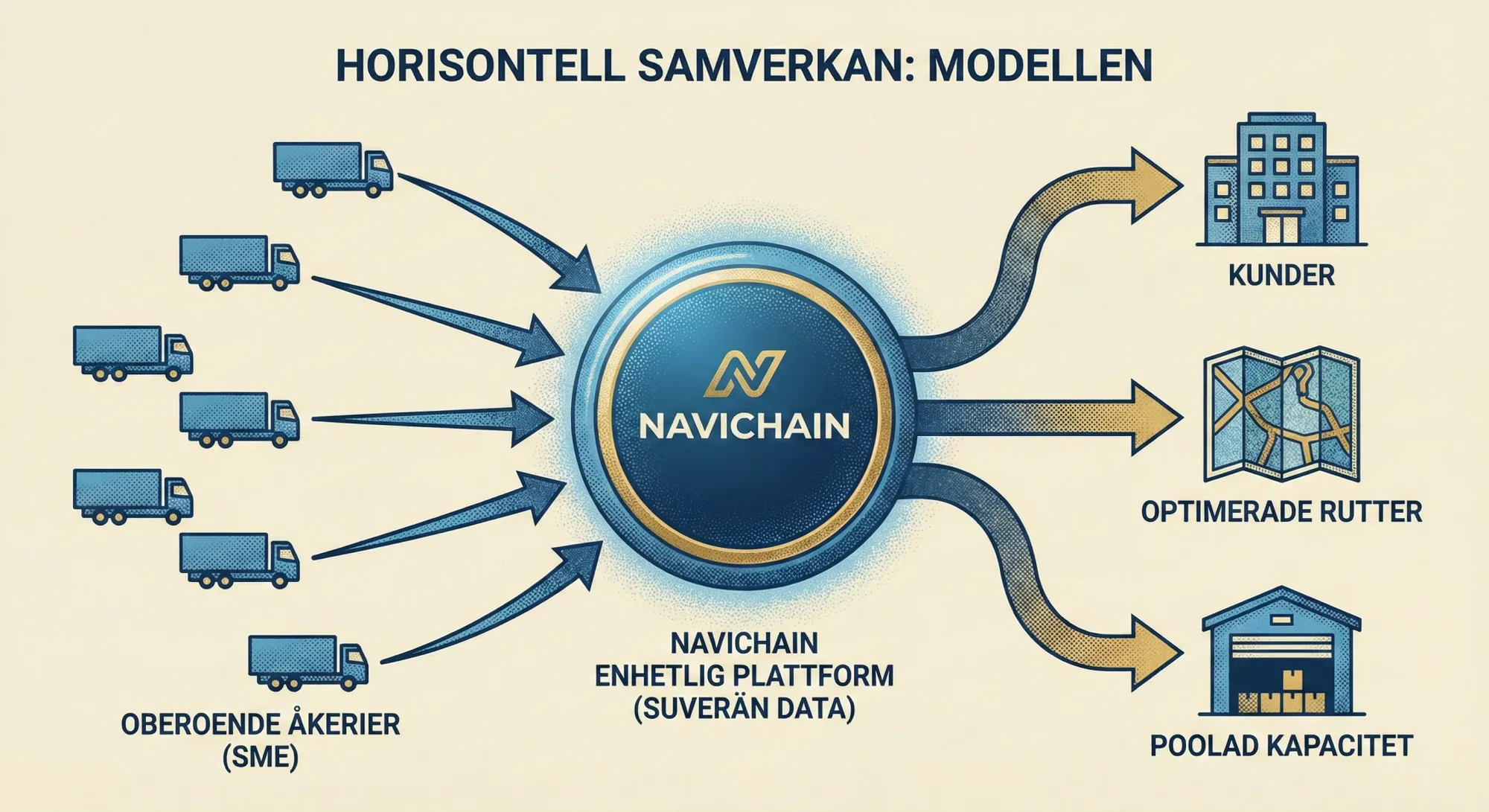
To break the competition trap, SME haulage firms need a new framework for "horizontal collaboration" or "co-opetition" (collaboration + competition). This is not a merger. It is an agile, technology-driven alliance where independent companies act as a unified, powerful player in the market.
In this model, members can: * Publish and buy capacity from each other in a closed, trusted network. * Automate order flows and invoicing between parties, eliminating manual work. * Offer customers consistent tracking and service, regardless of which partner in the alliance performs the transport. * Analyse aggregated (anonymised) data to find large-scale optimisations that no single member could see.
But for this model to work, a new type of technological backbone is required. A platform that is built on principles that go far beyond just features.
From diagnosis to design: The blueprint for a resilient operating system for logistics
The challenges described – scale competition, technical silos and data risks – are not insurmountable. But solving them requires us to stop thinking of software as a "tool" and start seeing it as a "strategic foundation". Based on our analysis, an effective, modern logistics platform for SME alliances must meet three core principles.
Principle 1: A unified operational web
Before you can collaborate effectively with others, you must first put your own house in order. Trying to connect fragmented systems to an alliance is doomed to failure. The platform must function as a central nervous system for each individual member. This means that Transport Management (TMS), Warehouse Management (WMS), Invoicing, Order Management and Asset Management are not separate modules, but parts of a single, unified operating system. Data is entered once and flows seamlessly across all functions, creating a single, indisputable source of truth.
Principle 2: Sovereign data architecture
This is the non-negotiable foundation for trust. For European SME companies to dare to share sensitive data, the platform must guarantee data sovereignty. This is not a marketing term; it is a legal and technical promise. It means that all data – every order, every route, every customer record – must be stored and processed on infrastructure that is physically located within the EU/United Kingdom and that is solely subject to British and European law. It must be demonstrably immune to extraterritorial laws such as the US CLOUD Act. Only then can the fear of data leakage be eliminated and real trust be built.
Principle 3: Embedded analytical intelligence
Once you have unified data (Principle 1) and a secure foundation (Principle 2), you can unlock the real power: intelligence. The platform must have an embedded AI or analytics engine that can analyse the aggregated, unified data. This engine should not only look at a single company's data, but be able to (with consent and anonymisation) identify patterns and optimisation opportunities between the alliance members. This is where the 15-20% reduction in empty running is realised – not through manual planning, but through predictive analysis that suggests the most profitable collaborations in real time.
Enabling the blueprint: Navichain SaaS unified logistics platform
The blueprint described above – a unified operational web, sovereign data architecture and embedded intelligence – is not just a theoretical model. It is the exact strategic foundation on which the navichain SaaS platform is built. We designed our platform from the ground up to solve the specific challenges for small and medium-sized haulage firms in Scandinavia.
- For Principle 1 (Unified Operational Web): navichain SaaS is not a collection of modules. It is a single, unified logistics operating system. Our platform seamlessly integrates Transport Management (TMS), Warehouse Management (WMS), Asset Management, Invoicing and Order Management. This breaks down your internal data silos and creates the single source of truth required for efficient operation and future collaboration.
- For Principle 2 (Sovereign Data Architecture): This is our core differentiator. The entire navichain SaaS platform is hosted on our own proprietary infrastructure in Sweden. Your data never leaves Sweden. It stays under Swedish jurisdiction. This guarantees full GDPR compliance and, most importantly, makes your business immune to foreign legislation such as the US CLOUD Act. With us, your data sovereignty is absolute.
- For Principle 3 (Embedded Analytical Intelligence): On top of this unified, sovereign foundation runs our integrated AI. Because it operates within our secure Swedish infrastructure, it can perform deep, secure data analysis on your aggregated operational data to unlock unique efficiency gains and predictive insights – without your data ever being put at risk.
By providing this foundation, our mission is to democratise logistics technology for the SME sector, giving you the tools you need to not only survive, but to collaborate, thrive and successfully compete with the giants of the industry.
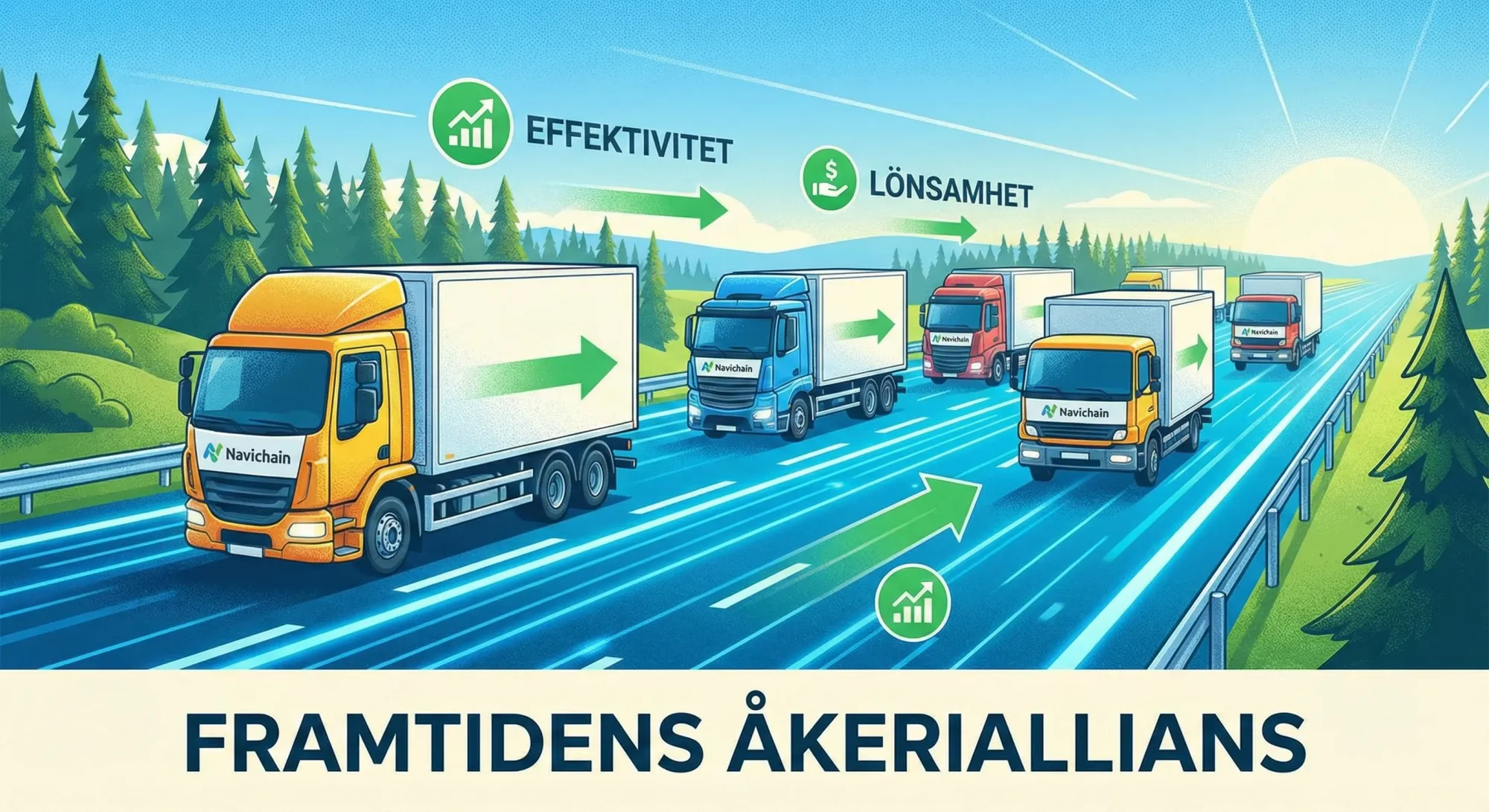
Stop competing alone. Join the sovereign alliance.
navichain Insights Newsletter
Join the newsletter to receive the latest updates in your inbox.