The Agility Trap: Why Fragmented Tech is a Competitive Liability
Table of Contents
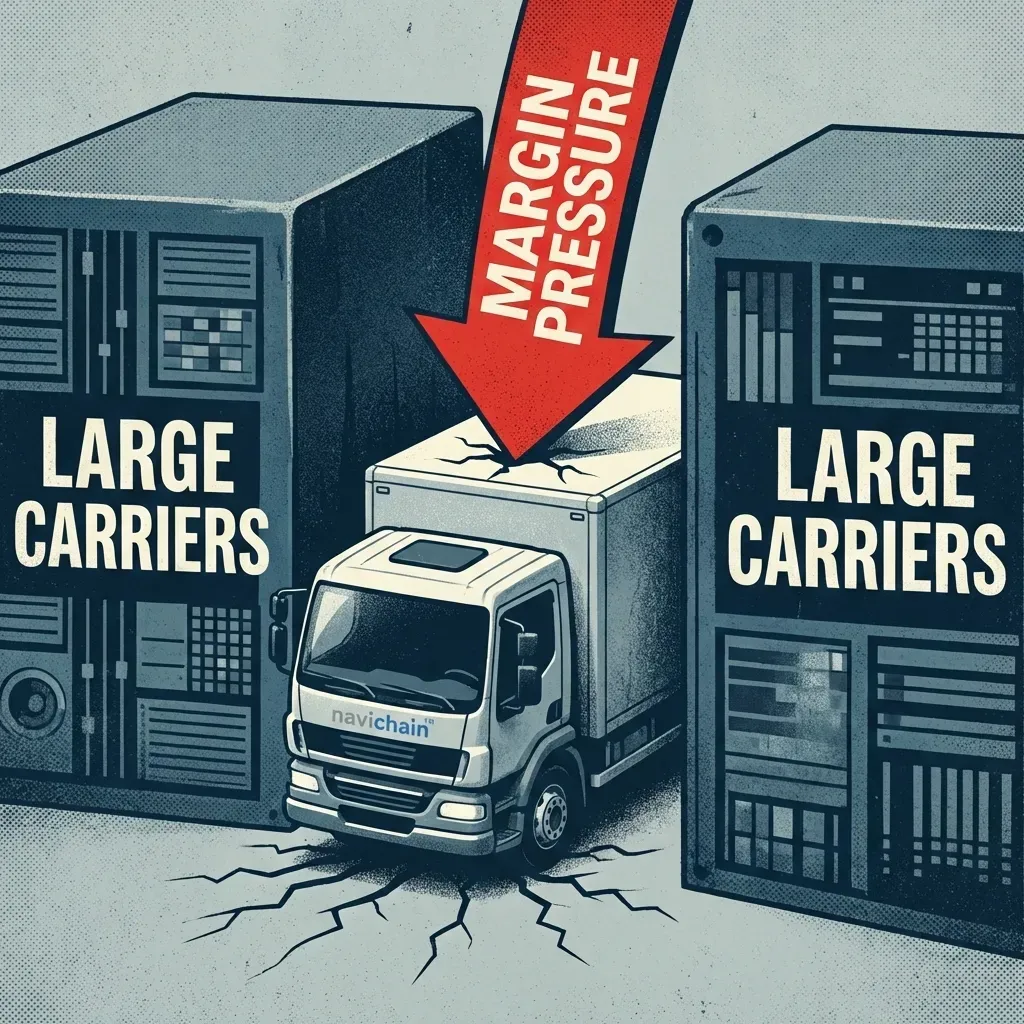
SME haulage firms are the backbone of the European economy, yet face unprecedented margin pressure, while large carriers often achieve 2-3 times higher profitability. The conventional response – adopting niche software solutions for individual tasks – is a trap. This 'cost-saving' measure creates data silos, high administrative overheads and operational friction, undermining the very agility SMEs need to compete. Why are your cost-saving measures secretly your biggest competitive disadvantage? This white paper presents a strategic framework for SME haulage firms to break free from this paradox. It outlines a path to transform fragmented data into a unified, intelligent operating system, enabling you to compete with agility and intelligence, not just size.
The 'david vs. goliath' myth in modern logistics
For decades, the competitive advantage for small and medium-sized enterprises (SMEs) in haulage was simple: agility. While large carriers were weighed down by bureaucracy, the local SME could offer flexible, personalised service and adapt to customer needs on the fly.
Today, that advantage has been inverted.
Large carriers are no longer just 'big'; they're 'smart'. They've leveraged their capital to build comprehensive, integrated technology platforms. Their Transport Management Systems (TMS) talk seamlessly to their Warehouse Management Systems (WMS), which are directly connected to automated invoicing and customer-facing visibility portals. They use integrated AI to optimise routes, maximise asset utilisation and predict maintenance. For them, data is a centralised, weaponised asset.
Meanwhile, the SME haulage firm, in an effort to remain 'lean', has fallen into the Agility Trap. You've adopted a patchwork of 'affordable' solutions: a cloud-based app for route planning, a separate accounting package for invoicing, spreadsheets for job orders, and perhaps a basic WMS that doesn't talk to anything else.
Each tool might be effective for its individual task, but the system as a whole is critically inefficient. The 'agility' you were promised is consumed by the friction between these systems.
Squeezed: Where smes are losing
The competitive landscape is no longer defined by the size of your fleet, but by the intelligence of your operations. Pressure is mounting from all sides:
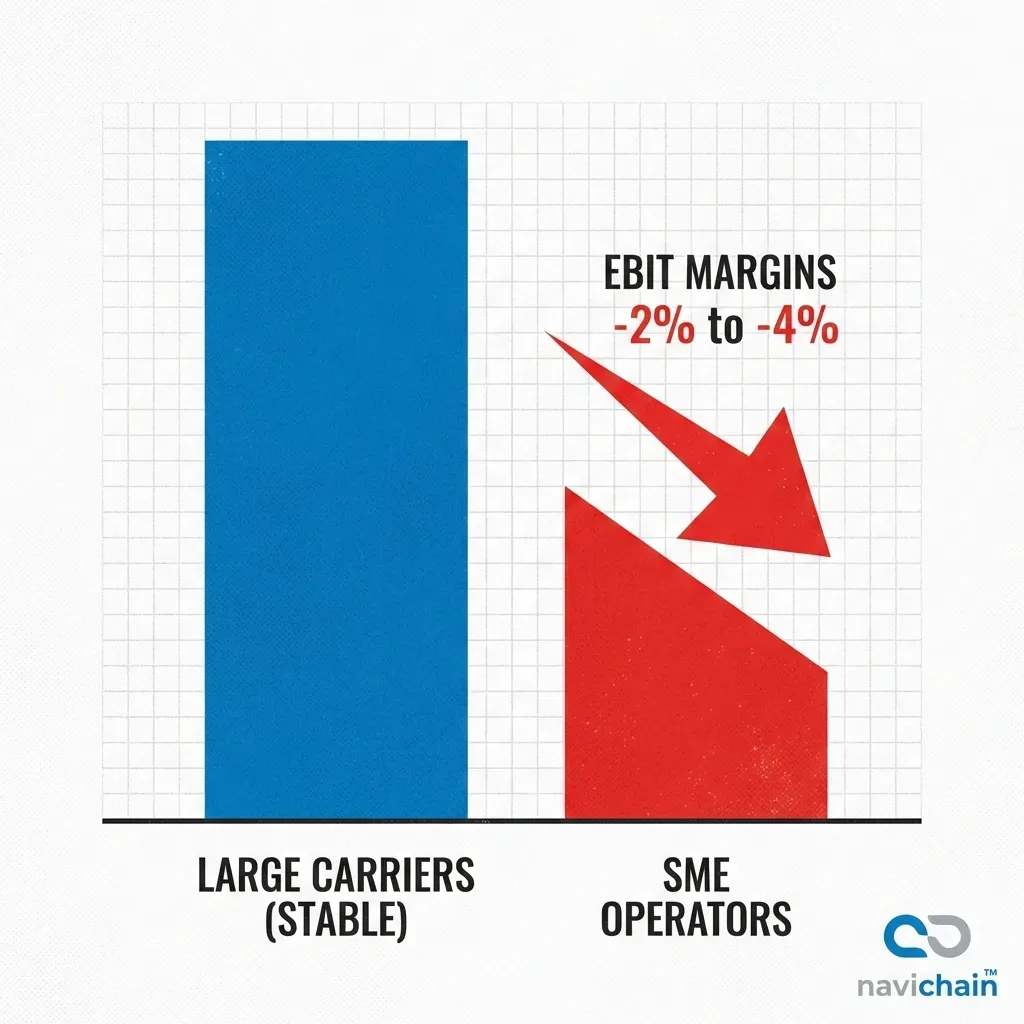
- Margin Pressure: Recent industry analysis from Transport Intelligence (Ti) shows that while large carriers have stabilised their EBIT margins post-pandemic, smaller operators have seen theirs shrink by an average of 2-4 percentage points. This is driven by the inability to absorb shocks from volatile fuel prices, driver shortages and the EU Mobility Package with the same efficiency as larger, data-optimised players.
- Customer Demands: The 'Amazon effect' is total. Transport buyers no longer ask for real-time visibility and EDI/API integration; they demand it. A 2024 survey of European transport buyers found that 'real-time data integration' is now a top-three selection criterion for 65% of contract tenders. Large carriers offer this as standard. For an SME running on fragmented systems, providing this data is a manual, costly and error-prone nightmare.
- Operational Blindness: How many of your routes are actually profitable? What is your true 'cost-to-serve' for your most demanding customer? For most SMEs, this data is impossible to find. It lives in three different systems and a spreadsheet. Large carriers, with their unified data, know this instantly. They can undercut you on simple routes and overcharge on complex ones, surgically capturing the most profitable segments of the market while you're left competing on price for the scraps.
We're at an inflection point. SME haulage firms cannot win by trying to be a smaller, cheaper version of a large carrier. You cannot compete on size. You must compete on real agility, and this is only possible by addressing the underlying data and process fragmentation.
Deconstructing the agility trap: The hidden costs of data silos
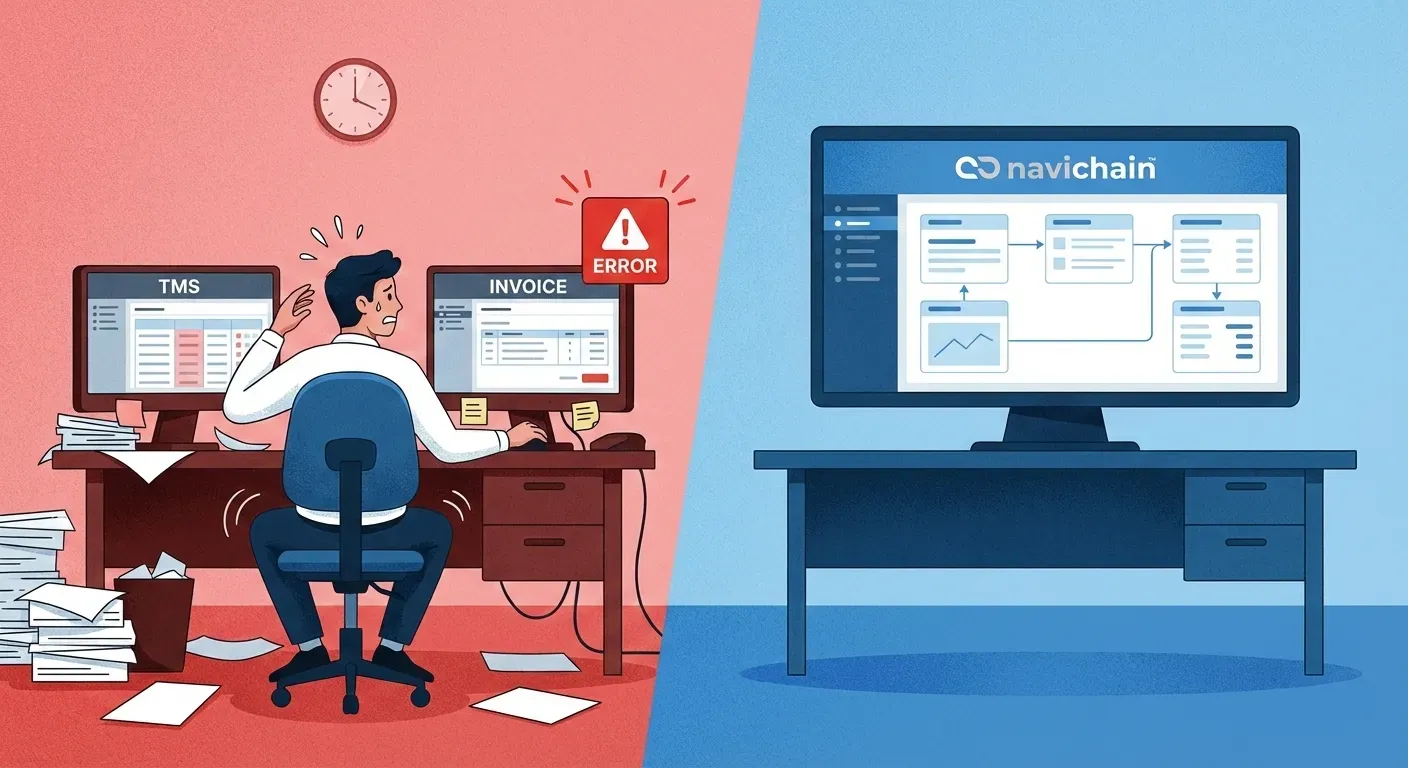
The Agility Trap is compelling because it feels fiscally responsible. Buying a TMS for £100/month and an accounting app for £50/month seems cheaper than investing in an integrated system.
This is a dangerous illusion. The real cost isn't in the software licences, but in the administrative overheads, lost opportunities and strategic risks that fragmentation creates.
1. the high cost of manual integration
Your organisation is likely paying a highly paid employee – or worse, yourself, the owner – to be a human API. This is the time spent manually keying data from one system to another.
- Order-to-Payment: An order comes in via email. Someone types it into the TMS. A driver completes the job. Someone types the completed data into the invoicing system. The invoice is generated and emailed. This 'swivel chair' process, repeated dozens or hundreds of times a day, isn't just slow; it's a critical source of errors. A 2023 study from the IRU cited administrative overheads (including invoicing errors and disputes) as one of the top five drags on profitability for SMEs.
- Transport Management-to-Driver: A route is planned in the TMS, but the job order is sent to the driver as a PDF or text message. Any changes – a new pickup, a traffic delay – require a phone call. The proof of delivery (POD) is a physical paper that must be returned to the office, scanned and manually attached to the invoice. Every step is a point of failure and a delay in your cash flow.
2. the inability to optimise
Optimisation requires data. Not just any data, but unified data. You can't optimise what you can't see.
- Empty Miles: Your TMS might show you have a truck returning empty from Manchester to London. But does it know that your WMS has a (non-urgent) order for a customer in Birmingham that could be picked up en route? Without that connection, that truck runs empty. For large carriers, this LTL (Less-Than-Truckload) optimisation is automated. For SMEs, it's a missed opportunity that directly impacts the bottom line. Reducing empty miles from 25% to 20% can be the difference between profit and loss for a year.
- Asset Utilisation: Is your most expensive truck being used on your least profitable routes? How much time are your drivers spending idle at warehouses (wait times) that you're failing to charge for? Without a unified view of asset management, driver hours and invoicing, it's impossible to know. You're running the business on 'gut feel' in a market dominated by algorithms.
3. the compliance and security precipice
Finally, fragmentation creates a serious and often underestimated risk profile.
- GDPR and Data Control: Where is your customer data? It's on a US-based cloud server for your TMS. It's on an Irish-based server for your accounting software. It's on your local server for your files. This data distribution across multiple jurisdictions is a GDPR compliance nightmare. A single data breach or regulatory audit becomes exponentially more complex. Furthermore, you're subject to the terms, price increases and data policies of multiple foreign vendors. You've lost control of your own operational data.
- Operational Fragility: What happens when one of your niche cloud apps has an outage? Or when they're acquired and sunset their product? Your entire operation grinds to a halt. A fragmented system is a fragile system.
To compete, SMEs must fundamentally change their thinking: from buying 'tools' to building a 'system'.
The path forward: From fragmented tools to a unified operating system
The solution isn't to spend millions trying to replicate the bespoke systems of a 'big beast'. The solution is to adopt a new strategic framework built on a unified operating model.
This model re-establishes your core advantage: agility. But it's an agility powered by data, not just intuition.
This framework consists of three strategic pillars.
Pillar 1: Achieve a single source of truth
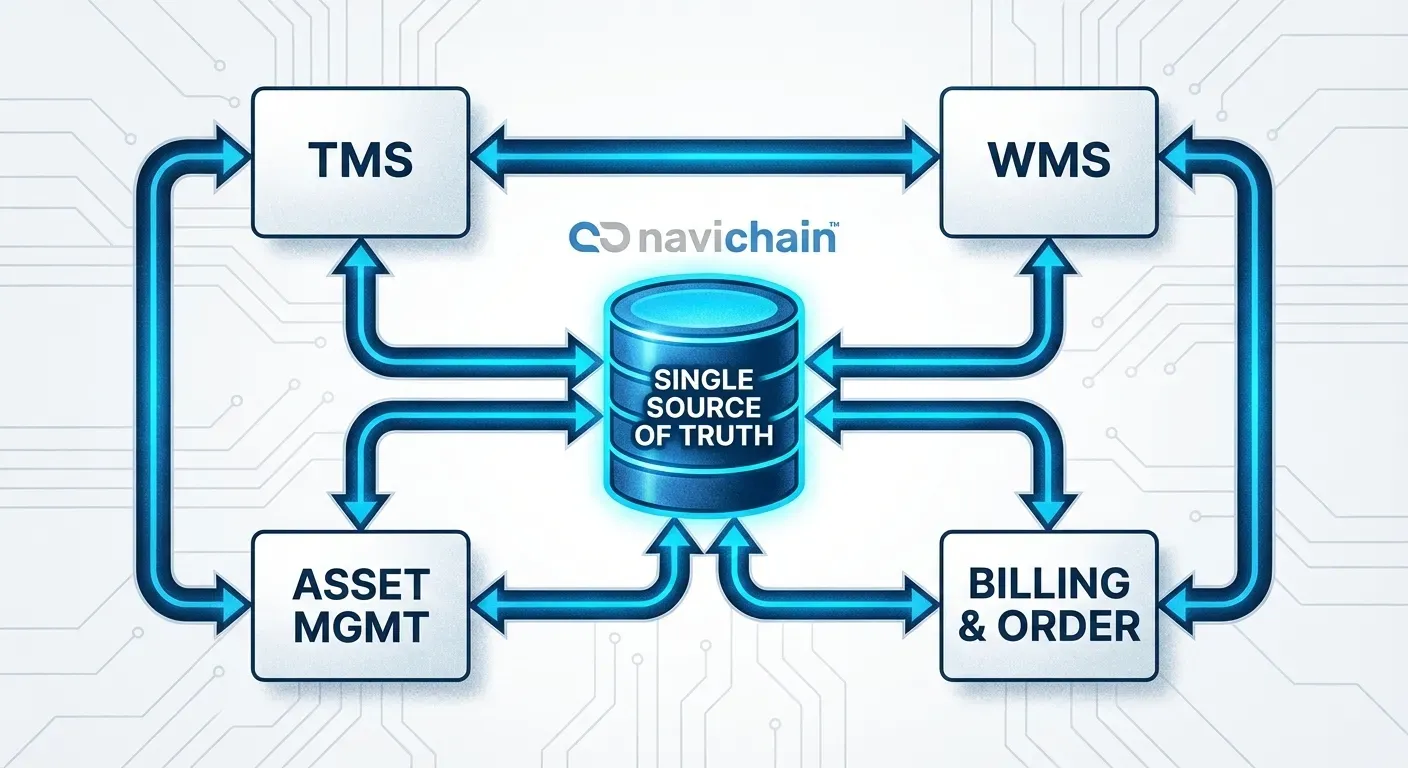
You must eliminate 'swivel chair' integration. Your core business functions – Transport Management (TMS), Warehouse Management (WMS), Invoicing and Order Management – must operate from a single database and a single platform.
- How it Works: When an order is created, it exists in one place. Transport management sees it, the warehouse sees it, and the invoicing module sees it simultaneously. When a driver marks a job as 'completed' in their mobile app, the WMS is updated, the customer is notified, and the invoice is automatically generated and queued for approval.
- The Competitive Advantage: This isn't just 'faster' – it's transformative. It reduces your administrative overhead by 30-50%. It shortens your order-to-payment cycle from weeks to days. It eliminates 90% of data entry errors. Your small team can now handle the workload of a team twice its size, instantly increasing your operational leverage.
Pillar 2: Compete on 'total visibility'
Transport buyers want to work with carriers who are easy to do business with. 'Easy' means 'transparent'. A unified system allows you to offer a level of visibility that competes with – and can even surpass – that of large carriers.
- How it Works: Because all your data is in one place, you can give your customers a secure portal where they can see exactly where their shipment is in real-time. They can place new orders, download past invoices and view PODs without ever having to call you.
- The Competitive Advantage: This becomes your unique selling point (USP). You're no longer just 'the local haulier'; you're 'the local haulier with best-in-class technology and visibility'. This builds incredible customer loyalty and 'stickiness', making it much harder for a large competitor to steal your customers on price alone. You compete on service, driven by technology.
Pillar 3: Weaponise your own data
This is the final and most powerful step. Once your data is unified (Pillar 1) and your processes are streamlined (Pillar 2), you can finally use that data to make strategic decisions.
- How it Works: You can now run a 'Profit and Loss per Customer' report with a single click. You can see which routes consistently generate the most empty miles. You can analyse driver performance, asset downtime and warehouse pick rates. You can use an embedded AI layer to analyse this unified data, suggest route consolidations or identify at-risk customers before they churn.
- The Competitive Advantage: You're no longer flying blind. You can now make the same data-driven optimisations as your largest competitors. You can confidently bid on complex jobs, knowing your true costs. You can strategically offload unprofitable customers and double down on profitable ones. You've transformed your own operational data from a fragmented burden into your single greatest competitive asset.
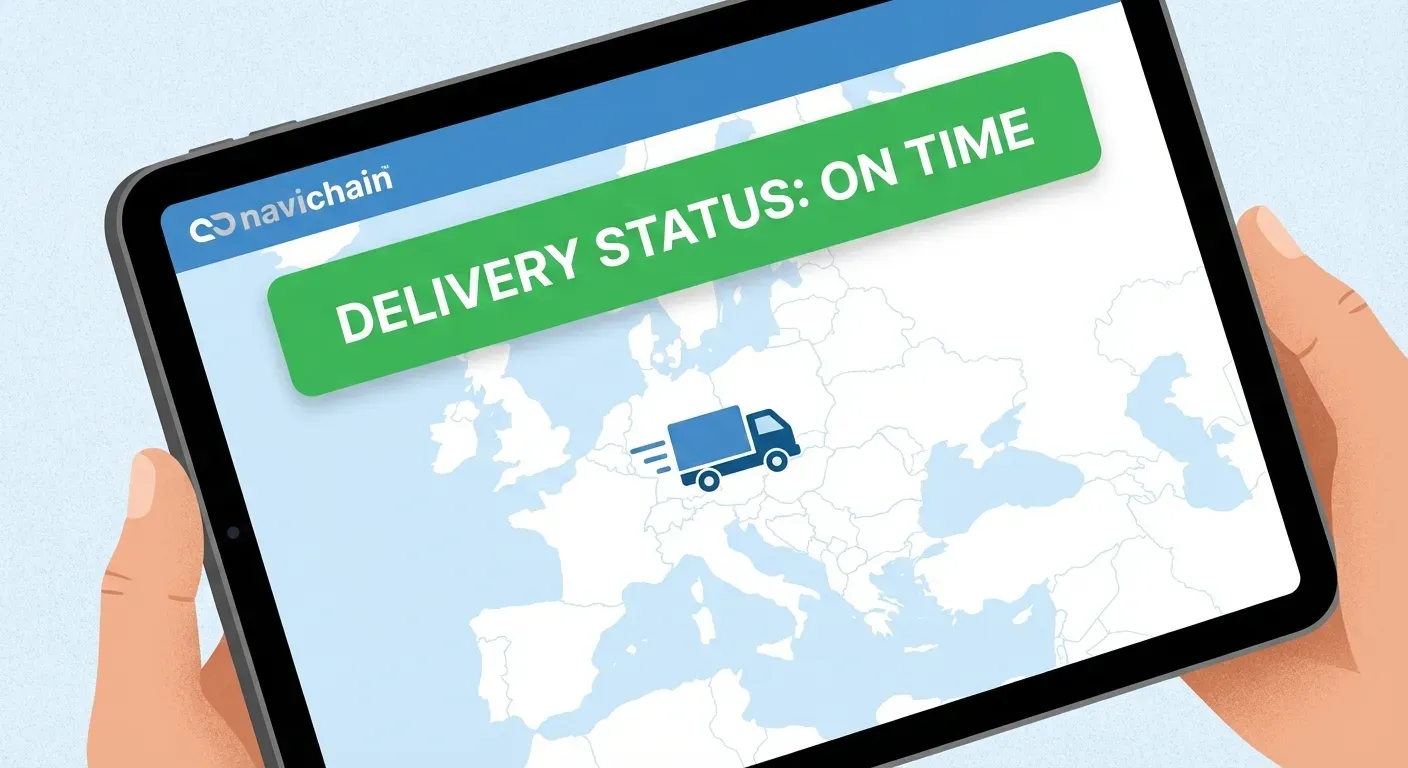
From diagnosis to design: The blueprint for a resilient logistics operating system
Adopting this framework requires a new way of thinking about technology. The 'best-of-breed' approach, stitching together multiple specialist apps, is the root of the problem. A modern, resilient SME logistics operation must be built on a platform that embodies three non-negotiable design principles.
Principle 1: Unified operational fabric
Your technology must function as a 'central nervous system' for your entire operation, not a collection of disparate body parts. This means that TMS, WMS, Asset Management, Invoicing and Order Management aren't just 'integrated' – they are one. Data must be entered once and flow immediately and automatically to every other part of the business that needs it. This single source of truth is the foundation of efficiency and the only way to eliminate the data silos that create administrative drag and operational blindness.
Principle 2: Secure data architecture and control
For European SMEs, and particularly those in Scandinavia, data is not just an asset; it's a regulated liability. True operational resilience requires complete control over your data environment. Your most sensitive operational and customer data must be stored and processed under the legal jurisdiction of your own region (e.g., within Sweden/the EU) on secure, self-hosted or fully controlled infrastructure. This ensures easy and demonstrable GDPR compliance, protects your intellectual property, and minimises exposure to the complexities, costs and risks of international data transfers and foreign data laws.
Principle 3: Embedded analytical intelligence
Data is worthless without the ability to analyse it. A modern logistics platform must have an embedded intelligence or integrated AI layer that works for you. This AI must be able to analyse the unified data from Principle 1, and run securely within the controlled environment of Principle 2. Its purpose is to move you from reactive to predictive, actively identifying optimisation opportunities, flagging unprofitable routes, and providing the actionable insights needed to compete on intelligence, not just brute force.
Enabling the blueprint: Navichain SaaS unified logistics platform
This white paper has laid out a strategic blueprint for SME haulage firms to compete and win. The challenge, until now, has been finding a platform designed to execute this strategy, built specifically for the needs of an SME.
navichain SaaS was designed to be the embodiment of these three core principles.
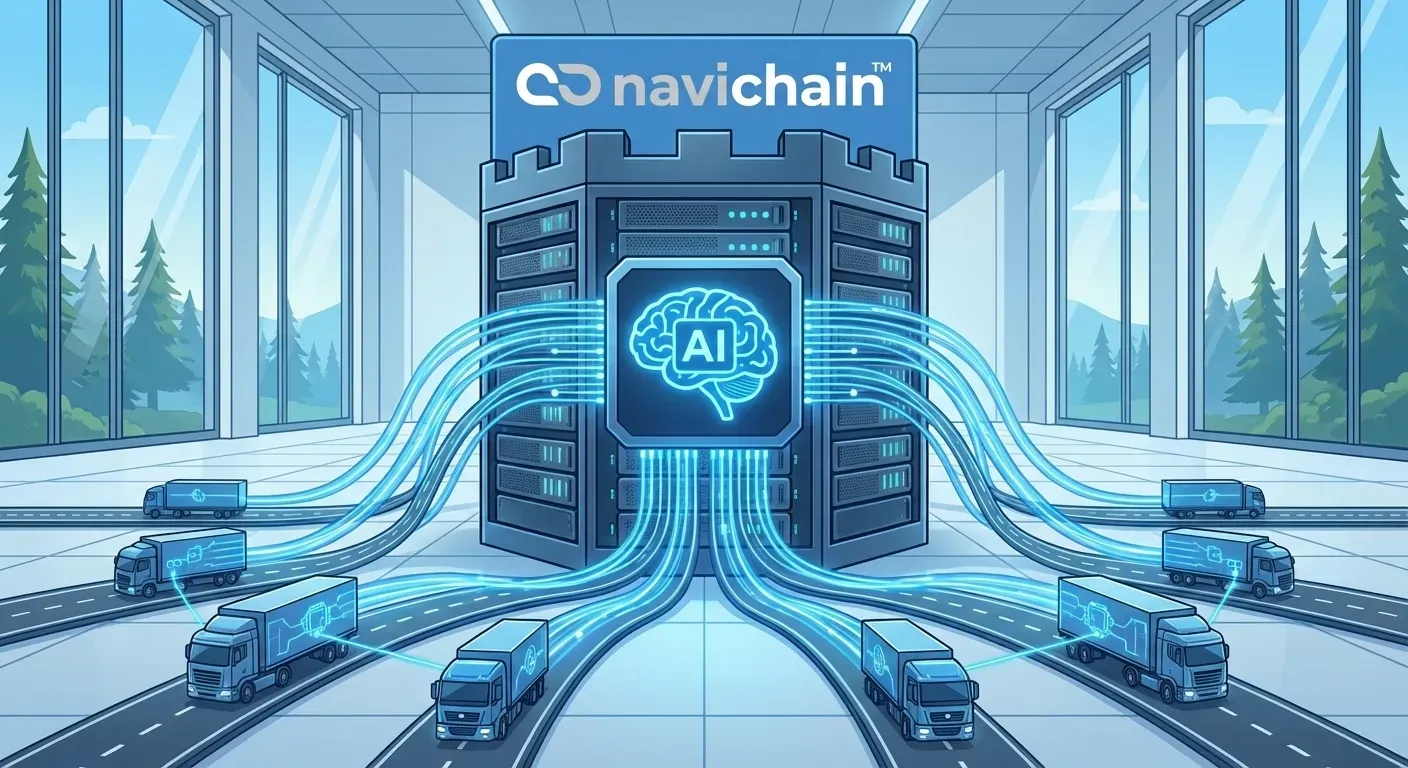
- A True Unified Operational Fabric (Principle 1): We are not a collection of 'integrated' apps. navichain SaaS is a single, unified logistics operating system. Our Transport Management (TMS), Warehouse Management (WMS), Asset Management, Invoicing Management and Order Management function as one, from one database. This breaks down the data silos that create friction and provides a single source of truth for your entire operation.
- Unparalleled Secure Data Architecture and Control (Principle 2): This is our primary differentiator. The entire navichain SaaS platform is hosted on our own secure, self-hosted infrastructure in Sweden. Your data never leaves Swedish/EU jurisdiction. This provides maximum data security, resilience, and makes GDPR compliance straightforward. You retain full control of your operational information, free from the complexities of international data transfers.
- Secure, Embedded Analytical Intelligence (Principle 3): Running on this secure Swedish infrastructure is our own integrated AI. Because your data is already unified on our platform, our AI can perform deep, secure analysis to unlock unique efficiencies. It helps you optimise routes, analyse profitability and manage your assets – all within the secure walls of your own data environment.
Our mission is to democratise logistics technology. We provide SMEs with the integrated, powerful and affordable platform they need to break free from the agility trap, automate their workflows and compete with any carrier, regardless of size.
navichain SaaS provides a unified logistics operating system, hosted on secure, self-hosted infrastructure in Sweden, with embedded AI for data analysis and optimisation.
Stop patching systems. Start building a foundation.
navichain Insights Newsletter
Join the newsletter to receive the latest updates in your inbox.